
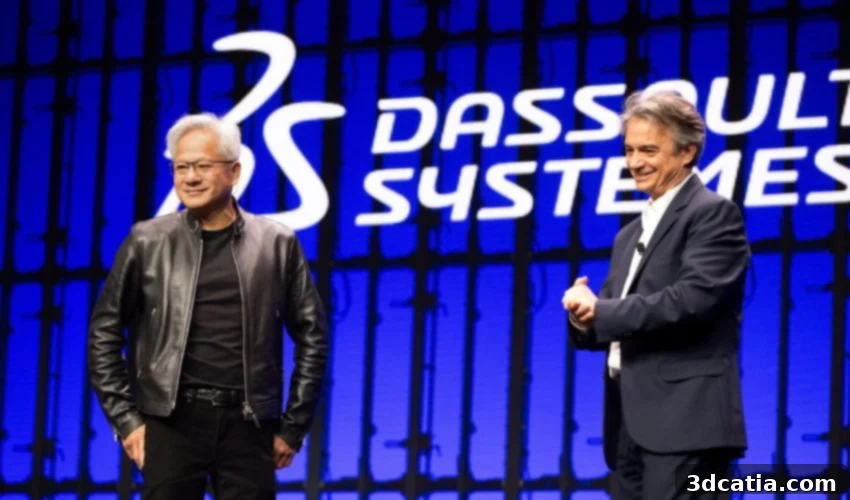
3DEXPERIENCE World: AI Revolutionizes SOLIDWORKS with NVIDIA Partnership
3DEXPERIENCE World, the premier event connecting SOLIDWORKS users for skill development and celebrating technological advancements, convened this year in Houston, Texas, from February 1-4. The event, brimming with insightful keynote speeches, hundreds of informative sessions, and a dynamic exhibition floor, aimed to inspire attendees with the expansive capabilities of the SOLIDWORKS ecosystem.
Artificial Intelligence (AI) unsurprisingly emerged as the focal point of the event. On Tuesday, February 3rd, Dassault Systèmes and NVIDIA unveiled a strategic partnership to construct industrial AI platforms that will power virtual twins. Throughout 3DEXPERIENCE World, SOLIDWORKS CEO Manish Kumar and Dassault Systèmes CEO Pascal Daloz emphasized that AI is not merely an “add-on” to Dassault Systèmes’ capabilities but rather a fundamental component at the core of their engineering technology. NVIDIA CEO and Founder, Jensen Huang, delivered a captivating keynote speech and hosted a press conference on the event’s second day, further elaborating on the significance of this collaboration.
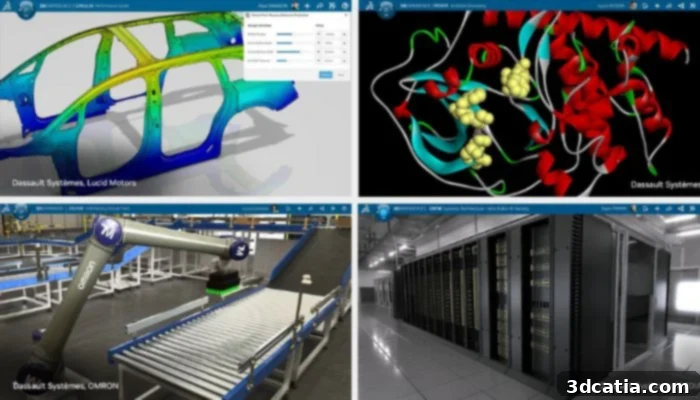
Digital twins powered by Dassault Systèmes and NVIDIA
AI Agents Powered by NVIDIA: Transforming Design and Engineering
Dassault Systèmes envisions its new AI capabilities as based on “science-validated world models,” positioning industrial AI as a “mission-critical system of record, not a point solution.” This platform, accelerated by NVIDIA, is “grounded in science by Dassault Systèmes, expanding long-term value creation across biology, materials science, engineering, and manufacturing, through a new way of working: skilled virtual companions.”
During the opening keynote, Manish Kumar and Pascal Daloz introduced these virtual companions, the AI agents. These agents, named Aura, Leo, and Marie, are designed to augment the capabilities of engineers and designers across various disciplines. Aura, standing for Assisting You to Realize your Ambitions, Leo, named after Leonardo DaVinci, and Marie, honoring Marie Curie, represent a significant leap forward in AI-powered engineering solutions.
- Aura: The Project Management Powerhouse. Designed to assist users in initiating and managing projects effectively, Aura considers logistics and business practices. This AI agent facilitates a deeper understanding of the potential impact of changes before they escalate into problems, thereby enabling faster and more informed decisions, minimizing unexpected challenges. Aura’s project management prowess helps streamline workflows and enhances overall project success.
- Leo: The Engineering Expertise Agent. Leo is specifically programmed to address engineering-related questions. It provides extensive mechanical and structural knowledge crucial for ensuring design viability and performance. Leo can analyze designs, suggest improvements, and provide insights that help engineers optimize their creations, making it an invaluable resource for tackling complex engineering challenges.
- Marie: The Scientific Mission Specialist. Marie focuses on scientific disciplines, such as chemistry, understanding formulas and principles that significantly influence a project’s desired outcomes. Marie offers profound scientific insights, enabling users to make well-informed decisions based on complex scientific data, leading to more efficient and effective solutions.
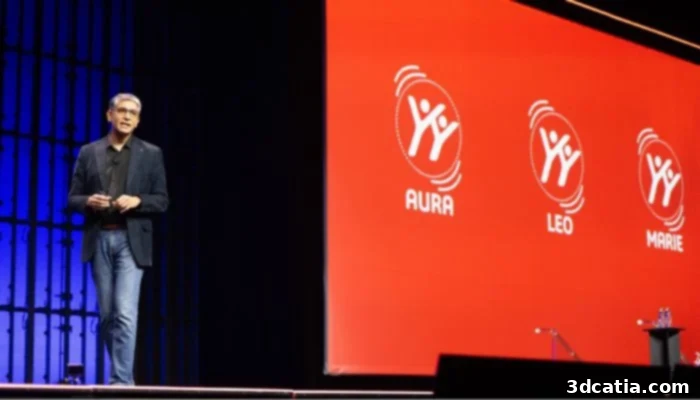
Manish Kumar introduces the AI agents: Aura, Leo, and Marie.
One of the most remarkable capabilities of this artificial intelligence is its capacity to generate 3D mesh models from 2D images. This feature enables users to easily share drawings and transform them into detailed 3D sketches. The AI can generate the geometry, conduct thorough performance analyses, and facilitate rapid iterations, empowering engineers to explore a wide range of design possibilities and accelerate the design process significantly. This feature can be a game changer for designers needing to quickly convert conceptual sketches into usable models.
The rollout of these AI agents is planned in phases, with Aura already available, Leo expected in the middle of the year, and Marie following later. Dassault Systèmes has emphasized its commitment to data privacy, intellectual property protection, and sovereignty for its customers using these AI integrations. The AI agents will also leverage the knowledge and expertise of the companies and individuals who utilize them, ensuring that the AI becomes more intelligent and tailored to specific needs over time.
The Virtual Twin: Democratizing Simulation and Driving Innovation
These AI assistants will significantly contribute to the development and enhancement of virtual twins. “The virtual twin is not a static model,” explained Pascal Daloz. “It’s a living representation of how something behaves across the entire lifecycle. The virtual world is no longer just representing the real world; it is generating it.” Dassault Systèmes envisions virtual twins being created for entire manufacturing ecosystems, enabling comprehensive modeling of the factory floor through generative design, which allows for optimized and efficient manufacturing processes.
Users will be able to interact with the AI agents in natural language to conduct simulations on these virtual twins, making advanced simulation capabilities more accessible. Previously, performing simulations required considerable expertise, but these AI companions will lower the barrier to entry. For instance, a user could ask the AI what types of simulations should be run on an object, and the AI can suggest and execute the simulations. These simulations include drop tests, squeeze tests, and simulations covering structure, fluid, electromagnetic, motion, and vibro-acoustic dynamics, allowing users to evaluate and optimize their designs comprehensively.
Addressing Concerns and Anxieties Around AI in Engineering
The advent of AI capabilities raises questions and anxieties among professionals regarding the technology’s potential impact on their jobs and skills. There are concerns about AI potentially replacing human engineers. However, during the 3DEXPERIENCE World opening speech, SOLIDWORKS CEO Manish Kumar offered reassurance, stating, “Some tasks will shrink. Some roles will change. Having said that, I believe the relevance of you, the engineers, the value you bring, must not be understated. AI is just a multiplier. You are the value. The coming wave of AI-enabled innovation will make your judgment, your craft, and your ability to work in the physical world even more important. AI is just an engine; you are the driver.”
Following Kumar’s speech, tech futurist Pablos Holman delivered a keynote presentation, echoing the positive potential of the new technology and urging attendees to “boycott dystopia,” emphasizing the need to focus on AI’s beneficial applications.
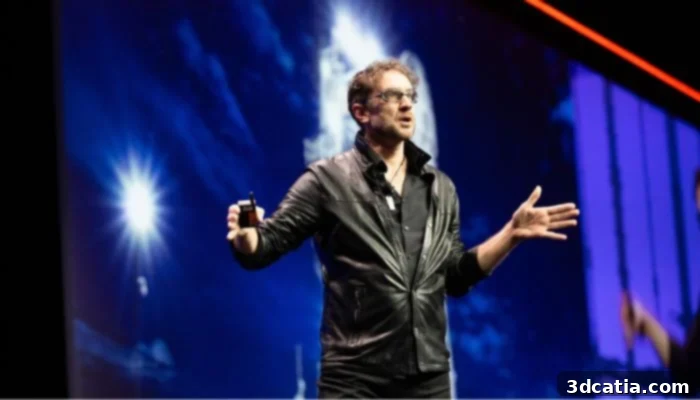
Pablos Holman spoke about the transformative power of artificial intelligence.
“I think we got off on the wrong foot, for the first round of AI in the last few years,” Holman said. “We’re freaking ourselves out with all these crazy stories. We’re using AI for the dumbest things we can think of. Now is the time to course correct. Now, we’re building AI for science, for engineering.”
Jensen Huang also addressed concerns about engineers losing jobs to AI, stating in a press conference, “Every designer, every software engineer will have [AI] companions that help them. The more AI companions you have, the more virtual seats you will have. The number of [AI] agents is going to grow exponentially…but they don’t have to have seats. Engineers have seats, and our seats are going to be fine.”
AI as a Foundational Infrastructure for Future Innovation
3DEXPERIENCE World showcased a vision where AI’s presence in manufacturing and engineering is not only inevitable but also essential for future innovation. Huang explained that they are “reinventing the computing stack,” transitioning from structured representations of designs where users manually define geometry and materials to a generative computer model that handles these tasks automatically.
“Because AI is foundational to every single industry, it is going to become an infrastructure. Just as water is an infrastructure, electricity is an infrastructure, internet is an infrastructure. Every single industry needs to build it. Every single country will be powered by it. Every society will have it. This is the beginning of a new industrialization.”
Building this AI infrastructure will demand substantial energy resources. When questioned about this during the press conference, Huang responded: “We now have a very large market force to enhance the power generation of the world. Remember, sustainable energy had a very difficult time taking off because the market-driven forces were weak. There were social forces, not market-driven forces. And it’s great to have social reasons and climate change reasons to do it, but nothing is more powerful than having the market-driven forces to do it…So now, for the very first time, we have a substantial, gigantic market force that is going to enhance the sustainable energy capabilities around the world.”
The AI agents aim to make design more accessible.
You can learn more about the partnership between Dassault Systèmes and NVIDIA here. What are your thoughts on these new AI capabilities? Share your opinions in the comments below or on our LinkedIn or Facebook pages! Don’t forget to subscribe to our free weekly Newsletter to receive the latest 3D printing news directly in your inbox. You can also find all our videos on our YouTube channel.
*All Photo Credits: Dassault Systèmes