
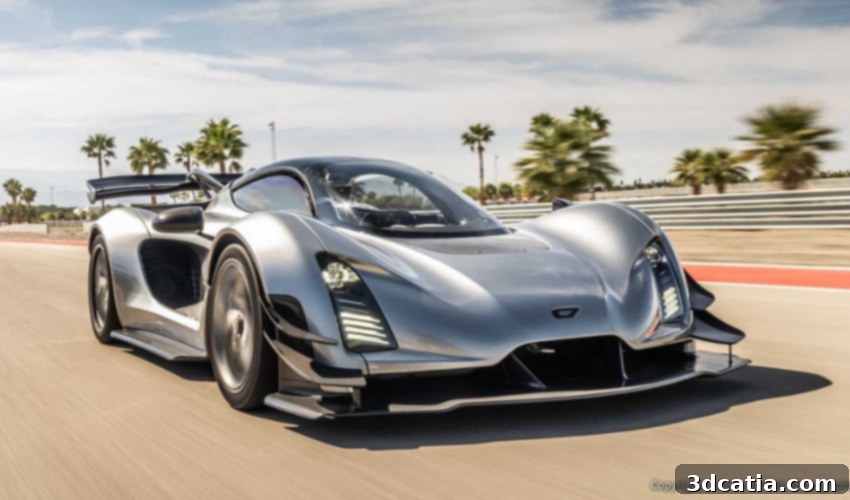
Czinger 21C: Pioneering the Hypercar Era Through AI and Additive Manufacturing
In the exhilarating world of high-performance automobiles, innovation is a constant pursuit, and very few vehicles truly manage to redefine what’s possible. The Czinger 21C Max supercar, a groundbreaking creation from the US-based manufacturer Czinger, stands as a testament to this relentless drive. Described as faster, more efficient, and incredibly innovative, the 21C isn’t merely another entry into the exclusive hypercar segment; it’s a profound statement on the future of automotive engineering. While its aggressive lines and aerodynamic profile might lead one to believe it’s a purpose-built racing machine, the Czinger 21C is, in fact, a fully road-ready passenger vehicle, meticulously conforming to US regulations. What truly sets this marvel apart, however, isn’t just its breathtaking appearance or its astonishing capabilities, but the revolutionary methodology behind its creation. Leveraging the potent combination of additive manufacturing and advanced artificial intelligence, Czinger has sculpted a powerful, lightweight, and arguably unparalleled vehicle, complete with signature large butterfly doors that hint at the extraordinary technology contained within.
The profound impact of this innovative manufacturing process, which fuses additive manufacturing with cutting-edge artificial intelligence, becomes strikingly evident upon closer inspection. Particularly captivating is the design revealed when the tailgate is opened: traditional straight lines and conventional carbon fiber beams are conspicuously absent. Instead, the Czinger 21C’s engine compartment presents an almost organic, biomimetic arrangement of structures, a visual symphony of engineered perfection that showcases the intricate complexity and optimized material distribution achieved through AI-driven generative design. This sophisticated hypercar boasts an incredibly low curb weight, tipping the scales at less than 1,500 kilograms. Powering this lightweight marvel is a 2.9-liter twin-turbo V8 engine, a masterpiece of engineering developed entirely in-house by Czinger. This powertrain generates an astonishing output of 932kW (equivalent to 1250 horsepower) and is capable of revving beyond an exhilarating 11,000 rpm. The 21C’s acceleration figures are equally astounding, setting new benchmarks for hypercar performance. It can rocket from 0 to 250 mph and then decelerate back to 0 in approximately 27 seconds, a feat that decisively shatters the previous record of 31.49 seconds, firmly establishing the Czinger 21C as a true “hypercar of the 21st century” and a pioneer in extreme automotive performance.
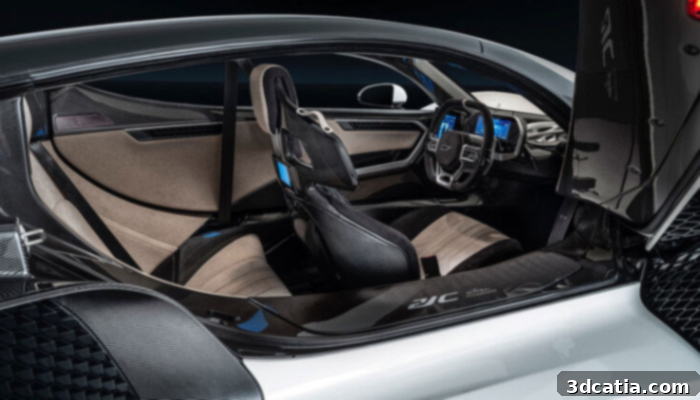
The Czinger 21C resembles a racing car, yet is engineered for road readiness and unparalleled performance (photo credits: Czinger)
The Manufacturing Revolution: How Additive Manufacturing and AI Define the Czinger 21C
What Role Did Additive Manufacturing Play in the Creation of the Czinger 21C Supercar?
To conceptualize and bring to life a vehicle with such groundbreaking features, extreme performance characteristics, and an entirely new manufacturing philosophy, an unparalleled level of specialized knowledge and innovation is indispensable. This deep expertise is precisely what defines Czinger, a company founded and led by the visionary father-and-son duo, Kevin and Lukas Czinger. Crucially, these two individuals also serve as the chairmen of their parent company, Divergent. Within the additive manufacturing sector, Divergent is an entity revered for its pioneering work, particularly its focus on the automation of design and development processes. It is this extensive and advanced knowledge, refined over years of research and application within Divergent, that forms the very bedrock of the Czinger 21C’s revolutionary approach to automotive construction. The synergy between Czinger and Divergent means that the hypercar benefits directly from a robust, data-driven framework for engineering and production, enabling the creation of components and structures previously deemed impossible with conventional manufacturing techniques.
Generative Design with Artificial Intelligence: Optimizing Every Component
The design and development of the Czinger 21C’s individual components represent a pinnacle of engineering, made possible through the extensive application of artificial intelligence. Far beyond traditional CAD software, AI was employed to generate and optimize the precise geometry of each part, which would later be manufactured using 3D printing. This sophisticated AI not only rigorously analyzed the myriad G-forces and stresses that could impact the vehicle during extreme performance scenarios but also, through countless simulations, autonomously determined the most appropriate shape, size, and weight for every single part. This generative design approach allowed Czinger engineers to push the boundaries of structural efficiency, removing superfluous material while reinforcing critical stress points. The result is a car that is not only incredibly powerful, delivering astonishing performance figures, but also exceptionally lightweight, directly contributing to its agility, fuel efficiency, and overall dynamic capabilities. This AI-driven optimization ensures that the 21C achieves an optimal strength-to-weight ratio, a crucial factor in hypercar design. Ultimately, the company states that nearly all structural components, with the notable exceptions of the body panels, wheels, interior elements, suspension system, and the core powertrain unit, are meticulously fabricated using additive manufacturing processes.
Precision Manufacturing: Laser Powder Bed Fusion for High-Performance Metals
For the production of its intricate and high-performance metal components, Czinger turned to an advanced additive manufacturing technique: laser powder bed fusion (LPBF). This method involves using powerful lasers to selectively melt and fuse metallic powders layer by layer, building up complex parts from the ground up. LPBF is particularly well-suited for creating components with extremely complex internal geometries, lattices, and thin-walled structures that would be impossible or prohibitively expensive to produce with traditional subtractive manufacturing methods. The precision and material integrity offered by LPBF are crucial for the demanding applications within a hypercar. Moreover, the integration of AI extends beyond the design phase into the manufacturing process itself. Thanks to the sophisticated algorithms developed by Divergent, the material deposition in LPBF is optimized for maximum efficiency, virtually eliminating metal waste. This smart approach not only reduces production costs but also contributes significantly to a more sustainable manufacturing footprint, aligning with modern demands for eco-conscious industrial practices. The ability to produce bespoke, topologically optimized parts on demand also reduces the need for extensive tooling, further streamlining the production cycle.
Revolutionary Assembly: In-House Adhesives Overcome Design Constraints
While additive manufacturing offers unprecedented freedom in design, the practical realities of 3D printing, such as limited build space within industrial machines, often present challenges for creating very large, monolithic components. Czinger, however, tackled this limitation with ingenious solutions for the 21C. Instead of scaling down the revolutionary designs, they developed a novel approach to modular assembly. The company’s dedicated researchers engineered a proprietary, ultra-strong adhesive that cures within a mere few seconds. This breakthrough adhesive technology is central to the 21C’s construction philosophy. It allows for the additive manufacture of smaller, highly optimized sub-components that can then be seamlessly and robustly bonded together to form larger, complex structures. This eliminates the need to design special attachment points or interlocking mechanisms into individual parts, as the incredibly strong adhesive provides a uniform and superior bond. The rapid curing time also dramatically speeds up the assembly process, contributing to a more efficient and agile manufacturing pipeline. This in-house adhesive is a pivotal innovation, enabling Czinger to fully leverage the benefits of additive manufacturing for complex geometries without being constrained by the physical dimensions of 3D printers, thus showcasing a holistic and forward-thinking approach to vehicle construction.
Czinger’s Vision: Redefining the Future of Automotive Performance and Production
Reflecting on the monumental achievement, Lukas Czinger eloquently articulated the company’s vision: “We have created the world’s most technologically advanced hypercar. From the AI-driven design software used to engineer it to the patented alloys its structures are printed in, the 21C embodies more than seven years of development and hundreds of millions of capital investment. We are excited to introduce new segment defining models to our line-up in the years to come and establish Czinger as one of the great American automotive brands of our time.” This statement underscores not just the technical prowess embedded in the 21C but also the ambitious long-term strategy of Czinger. The 21C is more than a car; it’s a proof of concept, demonstrating how advanced technologies like AI and additive manufacturing can fundamentally transform the automotive industry, particularly in the realm of high-performance vehicles. The substantial investment in research, development, and proprietary technologies highlights Czinger’s commitment to pushing boundaries and pioneering a new era of automotive engineering. As the company looks to expand its model lineup, it aims to cement its legacy as an iconic American brand known for its relentless pursuit of innovation and performance. The prospect of seeing such a technologically advanced supercar on public roads in the near future is indeed an exciting one, promising to inspire both enthusiasts and engineers alike.
The Czinger 21C serves as a powerful symbol of what’s achievable when traditional manufacturing constraints are challenged by cutting-edge digital and physical production methods. It represents a paradigm shift where vehicles are not just assembled but grown, optimized, and perfected through intelligent design and advanced fabrication. This hypercar is not only a marvel of speed and power but also a blueprint for sustainable, efficient, and highly personalized automotive production. Its existence challenges the status quo and offers a glimpse into a future where vehicles are lighter, stronger, and more dynamically capable, thanks to the harmonious integration of artificial intelligence and additive manufacturing. To delve deeper into the innovative world of the Czinger 21C and explore its full specifications, you can click HERE to visit their official website.
What are your thoughts on the revolutionary Czinger 21C and its pioneering use of AI and additive manufacturing? We invite you to share your insights in a comment below or connect with us on our LinkedIn, Facebook, and Twitter pages! Don’t miss out on the latest advancements in 3D printing news – be sure to sign up for our free weekly Newsletter here, delivered straight to your inbox! For more visual content, you can also explore all our videos on our dedicated YouTube channel.
*Cover Photo Credits: Czinger