
CultArm3D: Revolutionizing Cultural Heritage Digitization with Advanced 3D Scanning Technology
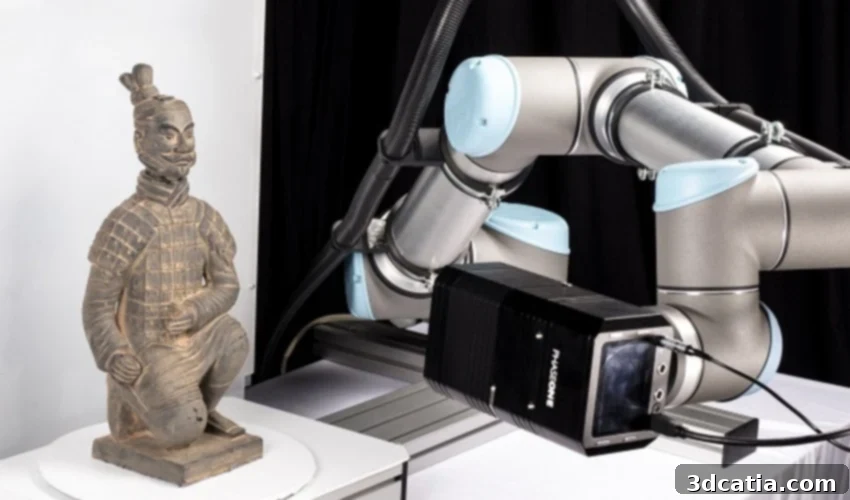
The Fraunhofer Institute for Computer Graphics Research (Fraunhofer IGD), a globally recognized leader in application-oriented research, has developed a groundbreaking mobile 3D scanner known as CultArm3D. This innovative device is engineered to produce highly precise 3D models of cultural exhibits, regardless of their size, with just the touch of a button. As its name suggests, CultArm3D is primarily designed for use in museums and cultural institutions, playing a crucial role in the extensive digitization of cultural assets. This ambitious project was brought to fruition through a successful collaboration with the renowned Danish camera manufacturer, Phase One. The digitization of cultural assets is rapidly gaining momentum worldwide, offering an invaluable means for people to engage with these historically significant artifacts without needing to be physically present. This capability has become even more critical in recent times, particularly as events like the COVID-19 pandemic have restricted travel and public gatherings. Thanks to advancements in 3D scanning technology, this innovation empowers museums to confidently step forward into the digital era, ensuring wider accessibility and long-term preservation of our shared heritage.
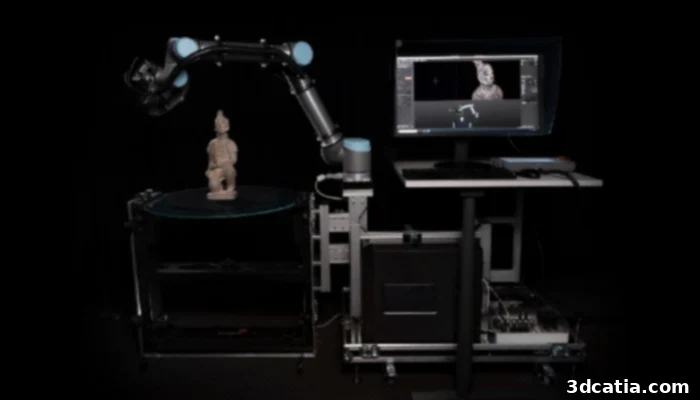
Image Credit: Fraunhofer
Pedro Santos, the distinguished head of department at Fraunhofer IGD, along with his dedicated team, has invested many years in researching large-scale 3D scanning technologies and their application in cultural asset digitization. Mr. Santos himself eloquently articulates the profound importance of this research: “3D models are tremendously important for research and can help improve our understanding of objects and their origins as well as analyze their attributes. They also serve as the basis for visualization in virtual and augmented reality, and when using 3D printing to create true-color physical replicas.” The creation of high-fidelity digital replicas opens up unprecedented opportunities for academic study, allowing scientists and historians to examine and compare cultural artifacts in intricate detail, free from the constant fear of damaging fragile originals. Many original exhibits are centuries old, inherently delicate, and susceptible to deterioration, making direct physical handling a significant risk. For this critical reason, the development of CultArm3D placed an exceptionally high emphasis on robust safety precautions designed to meticulously protect the scan objects. For instance, a crucial safety feature ensures that the joints of the scan arm immediately lock into place in the event of any power failure, preventing accidental movement or contact. Beyond safety, the 3D scanner was also engineered to meet other stringent requirements: consistently delivering results of the highest possible quality and providing an intuitive, easy-to-use system that can be operated effectively by museum personnel with minimal training.
CultArm3D’s Advanced Features for Unparalleled Digitization
The CultArm3D is a marvel of engineering, equipped with a state-of-the-art Phase One iXG 100-megapixel camera, renowned for its exceptional resolution and image fidelity. This powerful camera is seamlessly integrated with Fraunhofer IGD’s sophisticated autonomous scanning algorithms, which intelligently guide the scanning process. Furthermore, the system is complemented by specially designed ring lights, calibrated to provide optimal, uniform illumination that captures true colors and intricate surface textures with remarkable accuracy. This synergistic combination enables the autonomous scanning of objects from all angles, facilitating high-quality, detailed 3D rendering in the shortest possible time. A significant challenge during the development phase was the inherent uniqueness of cultural artifacts; no two objects are ever precisely alike, and many present extremely demanding surface geometries. This includes highly shiny or reflective objects made of materials like gold and bronze, as well as those with complex undercuts and intricate carvings. Overcoming these obstacles was a major triumph for the CultArm3D team. The system’s advanced technology successfully eliminates the traditional need for matting spray, a substance often applied to reflective surfaces to reduce glare during scanning, which can sometimes alter or affect the artifact. Moreover, the intelligent design and automated capabilities of the CultArm3D significantly minimize, and in many cases entirely eliminate, the need for laborious manual post-processing of the generated 3D models, even for the most complex object geometries. This efficiency dramatically reduces labor costs and accelerates the entire digitization workflow for cultural institutions.
Operating the CultArm3D scan arm is designed to be exceptionally straightforward, empowering museum staff to perform scanning operations independently after a brief orientation. Upon initial setup, integrated software intuitively guides the user through a quick, one-time calibration process that ensures the system’s accuracy and readiness. Cultural objects destined for digitization are simply positioned in the center of a provided turntable, and with a single press of a button, the automated scanning process commences. The operator can then relax and observe as the machine meticulously performs its task. First, a rapid pre-scan is conducted to gain a preliminary understanding of the individual object’s overall size and shape, informing the subsequent detailed scan. Following this, an advanced dynamic view planning system takes over, orchestrating the precise movements of the scan arm and camera. This intelligent system continuously analyzes the object’s geometry and surface, ensuring that all visible details are captured with the absolute minimum number of images, optimizing for both sharpness and true color representation. Dynamic view planning diligently continues its work until all quality targets, predefined by the user in terms of minimum coverage and desired resolution, are fully achieved. Once complete, the highly detailed 3D model can be utilized and exhibited in a multitude of versatile forms: as a stunning high-resolution video in both 2D or immersive 3D, as an interactive 3D web model accessible to a global audience, for engaging presentations in virtual and augmented reality environments, or as a precise print file for producing physical replicas via a 3D printer. This flexibility ensures maximum utility and accessibility for the digitized cultural heritage.
The practical advantages of the CultArm3D extend beyond its technical prowess. Its remarkably lightweight design facilitates easy transport, a crucial factor for institutions that may need to digitize collections across multiple locations or share the device among different departments. Consequently, the scan arm is already actively in use at several prominent museums and archives, where it is making a significant impact on their digitization efforts. The invaluable evaluations and feedback gathered from these real-world field applications provide the Fraunhofer IGD developers with essential pointers for continuous improvement and refinement of the system. Looking ahead, a formal sales channel through the esteemed camera manufacturer Phase One is projected to be established from 2022, broadening the availability of this cutting-edge technology. Until then, museums and cultural institutions interested in collaborating or acquiring the CultArm3D are encouraged to directly contact Fraunhofer IGD to explore partnership opportunities. To delve deeper and find out more about this revolutionary scanning technology, you can click HERE.
What are your thoughts on the transformative potential of the CultArm3D for preserving and making accessible our global cultural heritage? We’d love to hear your insights! Let us know your comments below or engage with us on our Facebook, Twitter and LinkedIn pages! Don’t miss out on the latest advancements in 3D printing and digital manufacturing; sign up for our free weekly Newsletter here to get the freshest news delivered straight to your inbox!