
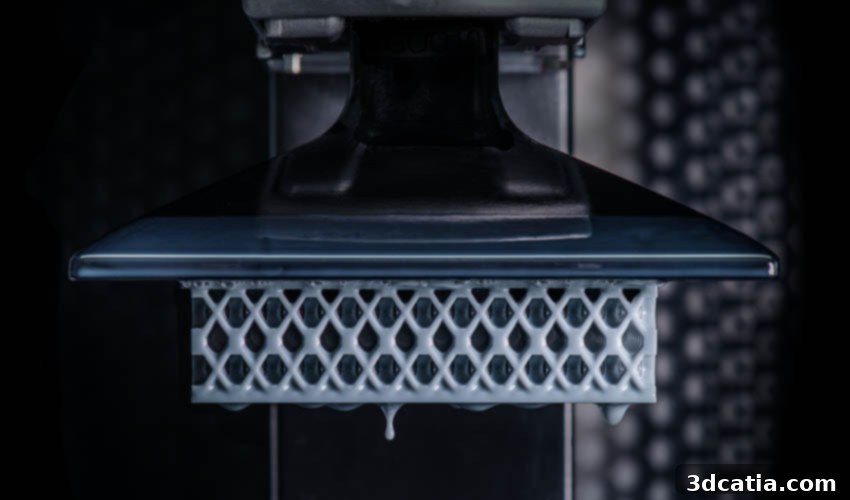
Global 3D Printer Market Outlook: Industrial and Design Segments Lead Significant Growth in 2019
The global additive manufacturing industry continued its dynamic expansion in 2019, driven by significant advancements and increasing industrial adoption. According to comprehensive research by CONTEXT, a renowned London-based research firm, the year was poised for substantial growth in the shipments of both metal and polymer 3D printers, with particular emphasis on the industrial and design categories. This optimistic forecast underscored a pivotal shift in the market, signaling a strong move towards higher-value, more sophisticated additive manufacturing solutions tailored for professional and production environments.
CONTEXT’s methodology for market segmentation provides clarity on the diverse applications and investment levels within the 3D printing sector. The firm defines industrial 3D printers as those priced over $100,000, machines typically utilized for high-volume manufacturing, complex component production, and advanced research in sectors like aerospace, automotive, and medical devices. The design segment encompasses 3D printers ranging from $20,000 to $100,000, which are crucial for professional prototyping, creating functional models, and enabling sophisticated product development across various industries. While these higher-value segments thrived, the report also highlighted a challenging period for the most affordable class of 3D printers, those under $2,500. This entry-level segment had already experienced a decline in 2018, a trend that CONTEXT anticipated would continue, reflecting a saturation in the consumer market and a stronger focus on enterprise-level solutions.
Despite the downturn at the entry-level, the broader market exhibited remarkable vitality in 2018, setting the stage for 2019. The industrial category, a dominant force accounting for a commanding 70% of the total global revenues from printer hardware, demonstrated an impressive year-on-year growth rate of 18%. This robust expansion was largely attributed to a significant increase in shipments of metal 3D printers, which saw a remarkable 26% year-on-year surge. Concurrently, industrial and design class polymer 3D printers, championed by innovators such as Carbon, HP, and 3D Systems, also contributed significantly to this growth. Furthermore, the professional segment, which covers 3D printers priced between $2,500 and $20,000, also experienced healthy growth in 2018, illustrating a broad-based expansion across professional and industrial tiers.

Top 5 industrial & design 3D printer vendor shipment share by machines shipped in 2018 | Credits: CONTEXT
Revolutionizing Metal Additive Manufacturing: Accessibility Meets Performance
A pivotal innovation trend observed in the additive manufacturing market involved the introduction of lower-priced multi-step metal printers. Trailblazing companies like Markforged and Desktop Metal have been at the forefront of this movement, effectively democratizing access to metal 3D printing. Unlike traditional high-cost, single-step laser-based powder bed fusion systems, these newer machines typically employ processes such as bound metal deposition or binder jetting. These methods involve printing parts with metal powder bound in a polymer matrix, followed by separate debinding and sintering steps in a furnace. This multi-step approach often results in a lower initial capital investment and simplified operational requirements, making metal additive manufacturing feasible for a broader range of businesses and applications.
Chris Connery, VP of Global Research at CONTEXT, elaborated on the strategic impact of these innovations. He commented, “New, lower priced metal 3D printers are targeted not just for factory use but also for office use and do not necessarily compete head-to-head with the more traditional robust metal 3D printers which use lasers to fuse powder in a single-step such as those from GE Additive, EOS, SLM Solutions, 3D Systems and others. Powder bed laser-based 3D printers are currently used for everything from jet engine parts to orthopaedic implants. New lower-priced metal printers look to augment this usage to now allow for more economical ways to create metal prototypes for these parts as well as allow for cheaper low-volume production of metal parts.”
Connery’s analysis underscores a critical market dynamic: the new generation of metal printers is not designed to displace the high-performance systems but rather to expand the overall utility and reach of metal additive manufacturing. Traditional powder bed laser-based 3D printers remain indispensable for demanding applications requiring extremely dense, high-strength, and precise metal components, such as those found in critical aerospace parts or customized orthopedic implants. These systems, offered by industry giants like GE Additive, EOS, SLM Solutions, and 3D Systems, utilize powerful lasers to fuse metallic powders layer by layer, resulting in parts with superior mechanical properties and consistent quality. However, their significant cost, complex operational demands, and specialized infrastructure often restrict their use to large corporations and specialized service providers.
The emergence of more affordable multi-step metal printers addresses a significant gap in the market. By providing a cost-effective pathway to produce metal prototypes, these systems accelerate the design iteration process, allowing engineers and designers to validate concepts more rapidly and with lower financial risk. Moreover, they open up new avenues for economical low-volume production of metal parts, enabling the creation of custom tools, jigs, fixtures, and even functional end-use components for industries where the ultra-high performance of laser-fused parts is not a prerequisite. This dual approach to metal 3D printing—catering to both high-end, mission-critical applications and more accessible prototyping/low-volume production—is profoundly transforming product development cycles and enabling unprecedented flexibility in manufacturing strategies.
Polymer 3D Printing: Enabling Mass Customization and Production Scale
While polymer 3D printing technologies have historically excelled in rapid prototyping and economical low-volume production, 2018 marked a transformative year that decisively propelled them towards widespread adoption in mass-customization and serial production. This evolution signifies a critical leap for polymer additive manufacturing, moving beyond its traditional role as a prototyping tool to becoming a viable solution for producing end-use parts at scale.
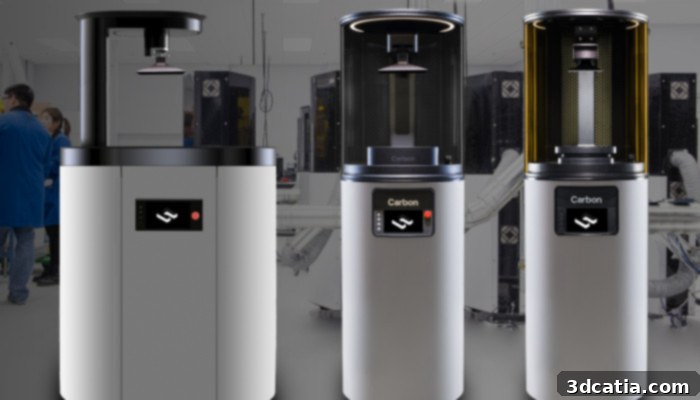
Carbon’s 3D Printers Leading Innovation in Mass Production
Key examples illustrating this shift include groundbreaking strategic partnerships. Carbon, a pioneer in Digital Light Synthesis (DLS) technology, cemented significant alliances with global consumer brands such as Adidas and Riddell. For Adidas, Carbon’s technology is instrumental in manufacturing the highly intricate lattice structures for their Futurecraft 4D midsoles, enabling unprecedented levels of customization, comfort, and performance for high-volume athletic footwear. Similarly, the collaboration with Riddell allows for the creation of customized football helmet liners, significantly enhancing player safety and ensuring a personalized fit. These partnerships are powerful demonstrations of how polymer 3D printing can be integrated into large-scale consumer product manufacturing, delivering unique value propositions through customization and design complexity that are unattainable with conventional methods.
Another compelling case study comes from HP, which has proactively integrated its Multi Jet Fusion (MJF) technology into its own internal supply chain. By leveraging its proprietary 3D printing solutions to produce functional components for its printers and other products, HP provides a compelling example of additive manufacturing’s capacity for substantial internal cost savings, accelerated design iterations, and a more streamlined production process. This strategic adoption not only validates the robustness and efficiency of MJF technology but also serves as a potent blueprint for other manufacturers seeking to integrate advanced 3D printing into their operational workflows. These collective developments vividly illustrate the increasing maturity and expanding industrial applicability of polymer 3D printing, empowering businesses to achieve unparalleled levels of design freedom, functional integration, and production efficiency.
2019 Forecast: Unprecedented Growth in Industrial and Design Segments
The combined momentum from technological breakthroughs, sustained market segment growth, and strategic industrial partnerships culminated in an exceptionally strong forecast for 2019. CONTEXT projected that the combined industrial and design segments would experience a substantial surge in machine shipments, anticipating an increase of 25% more machines compared to the total shipments in these same categories during 2018. This significant jump underscored a growing confidence among manufacturers and design firms in committing to and investing in advanced 3D printing solutions for their core operations.
A deeper dive into the forecast reveals even more compelling figures for specific technologies within additive manufacturing. Metal printer shipments were anticipated to achieve a phenomenal year-on-year unit-volume growth rate of over 49%. This explosive expansion in metal additive manufacturing directly reflects the broadening utility and increasing accessibility of these systems. It’s fueled by both the high-performance capabilities of established laser-based machines for critical applications and the wider adoption facilitated by newer, more cost-effective multi-step processes. The escalating demand for robust, lightweight, and custom metal components across critical sectors such as aerospace, automotive, medical devices, and tooling highlights metal 3D printing as a crucial technology for future innovation and competitive advantage.
Simultaneously, polymer machine shipments were also expected to demonstrate robust expansion, with projections indicating a growth of over 20%. This sustained growth in polymer 3D printing signifies its enduring importance in rapid prototyping, concept modeling, and, increasingly, in the direct production of functional end-use parts. Ongoing advancements in materials science, coupled with continuous improvements in machine capabilities—including enhanced speed, accuracy, and part quality—are enabling polymer 3D printers to address a much wider array of industrial applications, from intricate jigs and fixtures to highly customized consumer products and complex functional components. The diverse applications and growing material options ensure polymer 3D printing remains a dynamic and essential segment of the additive manufacturing market.
Broader Implications for Global Manufacturing Strategies
These detailed projections from CONTEXT are far more than just statistical figures; they represent fundamental shifts in global manufacturing paradigms. The robust growth observed in the industrial and design 3D printing segments signals a future where additive manufacturing transitions from a specialized niche technology to a mainstream, indispensable tool for fostering innovation, optimizing production processes, and enhancing supply chain resilience. The dual evolutionary path of metal 3D printing—with high-end systems continually pushing the boundaries of material performance and newer, more accessible systems democratizing its utility—will collectively unlock unprecedented levels of design freedom and manufacturing agility for businesses of all scales and industries.
For polymer 3D printing, the accelerating focus on mass customization and serial production heralds a new era of highly personalized products and significantly more efficient, flexible manufacturing lines. Companies are now empowered to respond with greater agility to fluctuating market demands, substantially reduce material waste, and develop products featuring complex geometries and integrated functionalities that were previously either impossible or prohibitively expensive to achieve using traditional manufacturing methods. This transformative shift promises to fundamentally redefine how products are conceptualized, designed, manufactured, and ultimately delivered to consumers worldwide, contributing to the establishment of more sustainable, responsive, and innovative production ecosystems.
The overarching trend towards higher-value 3D printers underscores a maturing market that is increasingly focused on delivering tangible economic benefits and addressing critical industrial applications. As more businesses progressively recognize and harness the immense potential of additive manufacturing for competitive advantage, we can confidently anticipate sustained investment in research and development, advanced material engineering, and sophisticated software integration. These ongoing advancements will undoubtedly further accelerate the capabilities and widespread adoption of this truly transformative technology well beyond 2019, cementing its role as a cornerstone of modern manufacturing.
What are your thoughts on these compelling predictions and the evolving, crucial role of industrial and design 3D printers in shaping the future of manufacturing? We invite you to share your valuable insights and perspectives in a comment on our Facebook and Twitter pages! For those keen to stay at the forefront of the additive manufacturing world, don’t miss out on the very latest news, groundbreaking innovations, and in-depth market analyses. Be sure to sign up for our free weekly Newsletter, delivering all the essential 3D printing updates and insights straight to your inbox!