
Unlocking Advanced Manufacturing: A Comprehensive Guide to Composite 3D Printing
Composite 3D printing has witnessed a significant surge in popularity and application in recent years, fundamentally transforming the landscape of additive manufacturing. At its core, a composite material is engineered by combining two or more distinct materials, each serving a specific purpose, to achieve enhanced properties that neither material could offer individually. Typically, one material acts as the matrix, providing the structural integrity and holding the composite together. The other material, known as the reinforcement, imbues the composite with additional, superior characteristics, addressing the inherent limitations of the matrix material. This synergy allows for the creation of materials with improved mechanical strength, enhanced flame retardancy, superior stability, increased resilience, and even specific thermal or electrical conductivities. Composites can be broadly categorized based on their material characteristics, such as metallic, mineral, ceramic, or organic, or distinguished by their geometrical configuration.
The world of composites encompasses several forms, including particle composites, fiber composites, layered composites, and impregnated composites. Within these classifications, fiber composites stand out as the most prevalent and impactful in the realm of 3D printing. Their immense popularity in materials engineering stems from their unique ability to reinforce materials precisely in specific directions, offering unparalleled control over mechanical properties. Among the vast array of reinforcing fibers available, carbon fiber holds the top spot as the most sought-after material, closely followed by glass fiber. Both are extensively utilized in additive manufacturing due to their exceptional performance attributes. Carbon fiber, in particular, is lauded for possessing one of the highest strength-to-weight ratios known, enabling the production of parts that are remarkably strong yet incredibly light. This characteristic makes it an ideal choice for demanding industries such as aerospace, automotive, and sports equipment, where performance and efficiency are paramount.
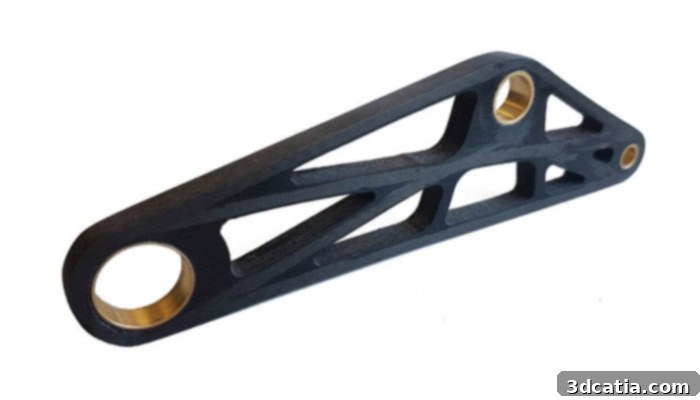
A 3D printed part using carbon fiber reinforcement, resulting in higher strength-to-weight ratio and less material consumption (photo credits: 9TLabs)
Properties of Composite Materials in 3D Printing
The integration of composite materials into 3D printing technologies has revolutionized the ability to create parts that are both lightweight and exceptionally strong. The reinforcing fibers play a crucial role by significantly augmenting a part’s strength without contributing substantial weight. In additive manufacturing, fiber reinforcements primarily come in two distinct forms: short fiber and continuous fiber. Each type offers unique advantages and is suited for different applications based on the desired performance characteristics.
In the case of short fiber composites, chopped fibers, which are typically less than a millimeter in length, are homogeneously blended into conventional thermoplastics. These thermoplastic matrices can include common materials such as nylon, ABS, PLA, PETG, or even high-performance polymers like PEEK. The addition of these chopped fibers primarily serves to increase the stiffness of components and, to a lesser extent, their overall strength. Different manufacturers will incorporate varying amounts and types of short fibers into their plastic polymer blends, resulting in filament spools with a diverse range of mechanical properties. It is important for users to be aware that the quantity of chopped fibers can also significantly impact print quality. Beyond a certain threshold, a higher fiber content can lead to a noticeable reduction in the surface finish of the 3D printed part, necessitating a balance between mechanical properties and aesthetic requirements.
For applications demanding the absolute highest performance, continuous fiber reinforcement is the preferred choice. The process of manufacturing parts with continuous fiber composites is considerably more complex than with short fiber composites. This is because the continuous fibers must be precisely integrated into the thermoplastic matrix as it is being extruded, often requiring specialized dual-nozzle systems or sophisticated deposition techniques. A key advantage of continuous fibers is the ability to strategically deposit them along specific load paths, following design techniques that optimize a part’s strength-to-weight ratio and minimize material consumption. This approach is central to DfAM (Design for Additive Manufacturing) principles, allowing engineers to create parts with tailored mechanical properties. Many manufacturers assert that parts reinforced with continuous fibers can achieve strengths comparable to, or even exceeding, those of traditional metal components, opening up possibilities for high-stress, critical applications.
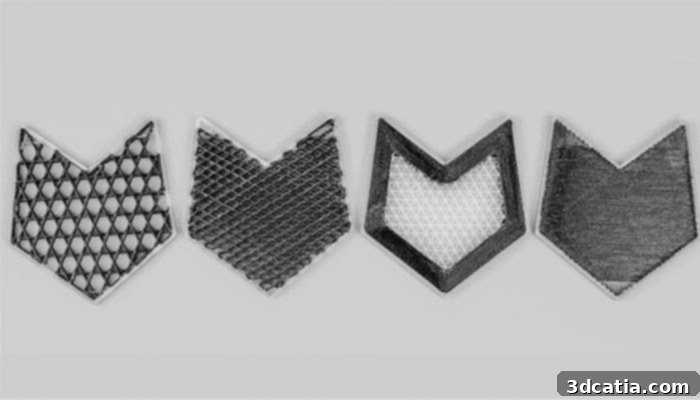
Anisoprint’s software can generate different types of continuous fiber reinforced infills (photo credits: Anisoprint)
Delving deeper into the types of fibers available on the market, carbon fiber remains undeniably the most popular and high-performance option. Its exceptional tensile strength, stiffness, and low density make it ideal for structural components where weight savings are critical. Another widely used material is fiberglass, which consists of glass fibers embedded in a plastic matrix. Fiberglass offers a cost-effective alternative to carbon fiber, providing good strength, excellent electrical insulation properties, and decent chemical resistance. Kevlar, a heat-resistant and remarkably strong synthetic aramid fiber, is also extensively employed in the industry, particularly for applications requiring high impact resistance and toughness, as it tends to bend rather than break under sudden loads. Beyond these high-performance options, there are also composites designed for more aesthetic or niche purposes. For instance, wood fibers, ceramic particles, or even vegetable fibers can be combined with polymers like PLA to create materials with unique visual textures, tactile properties, or specific thermal characteristics, catering to applications where appearance or specific functional attributes are prioritized over ultimate mechanical strength.
Composite 3D Printing Technologies
In the realm of additive manufacturing, composite materials are predominantly available in filament form, making them primarily suited for Fused Deposition Modeling (FDM) 3D printing, also known as Fused Filament Fabrication (FFF). This widespread adoption is due to the inherent compatibility of filament-based composites with the FDM process. However, the scope of composite additive manufacturing is continuously expanding, with significant advancements being made in other technologies. Approaches for producing metal matrix composites, for example, are gaining traction, particularly in laser-based processes such as Laser Powder Bed Fusion (LPBF). Fraunhofer, a leading research institution, has notably developed processes that utilize Laser Metal Deposition (LMD) with metal composites, underscoring the growing trend towards integrating composites across various additive manufacturing techniques. This continuous innovation highlights that composite additive manufacturing is rapidly gaining momentum in the market, with more technologies expected to enable advanced composite 3D printing in the near future.
The specific technologies for composite 3D printing fundamentally differ based on the type of composite material being utilized. Short fiber composites are relatively straightforward to process and can be extruded in the standard FDM process, as the fibers are already homogeneously mixed within the filament. These short fibers provide a uniform reinforcement throughout the entire part, enhancing its isotropic properties. However, as previously mentioned, the print quality and surface finish can be adversely affected by an excessive quantity of chopped fibers in the matrix; above a certain fiber content, the 3D printed part may experience a degradation in surface quality. In contrast, continuous fiber 3D printing is a significantly more intricate process. It often necessitates specialized printers equipped with two nozzles that operate simultaneously: one nozzle extrudes the thermoplastic matrix material, while the other precisely deposits the continuous reinforcing fiber. A prime example of such a printer is the Markforged Mark Two, which intelligently integrates long-fiber materials into parts created via the FDM process. This allows for strategic reinforcement only where it is functionally required and desired, optimizing material usage and maximizing part performance.
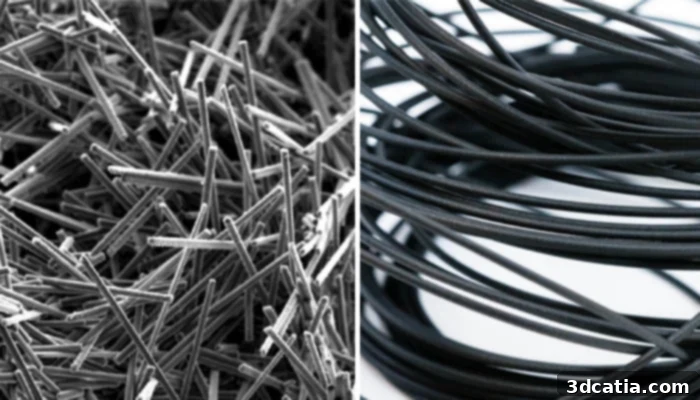
On the left you can see short fibers, which consist of segments less than a millimeter in length. On the right the filament has been reinforced by these short fibers. (photo credits: Markforged)
When working with FDM 3D printing using composite filaments, several important considerations must be taken into account to ensure successful prints and prevent damage to the equipment. One critical aspect is the nozzle diameter, as composite filaments often require a larger diameter than standard filaments due to the abrasive nature and irregular geometry of the embedded fibers. Manufacturers typically provide recommended settings for their specific composite filaments. As a general guideline, for fiberglass filaments, the nozzle should be set to a minimum diameter of 0.6 mm. For carbon fiber composites, a 0.4 mm nozzle can often suffice, but some users may opt for larger sizes depending on fiber content. For Kevlar, it’s advisable to start with a 0.6 mm nozzle and gradually decrease to 0.4 mm if the material flows smoothly. If the composite material contains wood particles, a nozzle diameter between 0.6 mm and 0.8 mm is typically necessary to prevent clogging and ensure consistent extrusion.
Beyond nozzle diameter, it is crucial to recognize that composite filaments can lead to accelerated wear on the hot end and extruder components of a 3D printer. The abrasive nature of reinforcing fibers, particularly carbon, fiberglass, and Kevlar, can quickly erode standard brass nozzles. To mitigate this, it is highly advisable to use hardened nozzles, such as those made from hardened steel, tool steel, or ruby-tipped variants, which offer significantly greater resistance to abrasion. Additionally, proper positioning of the filament spool during printing is essential to optimize the path to the extruder, ensuring it is as short and straight as possible to minimize friction and prevent filament grinding. Furthermore, the printing speed should generally be reduced when working with composite materials compared to their unreinforced counterparts. This is due to the typically higher viscosity of composite material filaments and the need for adequate time for the fibers to properly align and bond within the matrix, ensuring optimal layer adhesion and mechanical performance. While composite materials present these specific printing requirements and challenges, the advantages they offer in terms of enhanced material properties far outweigh these considerations, making them invaluable for advanced applications.
Applications With 3D Printed Composites
The ability to 3D print with reinforced composite materials has long been a strategic objective for numerous startups and established players in the additive manufacturing sector. Over recent years, the market has witnessed a proliferation of new machines, materials, and technologies specifically designed to enable an expanding array of applications, particularly within critical industrial sectors such as aerospace, automotive, and defense. Carbon fiber-filled materials are by far the most widespread composites in the 3D printing industry, revered for their exceptional performance in demanding applications. These include the creation of functional prototypes that closely mimic end-use parts, high-performance automotive components that benefit from lightweighting, and various lightweight structural elements where strength and rigidity are paramount. Beyond industrial uses, carbon fiber composites are rapidly gaining traction in the sports sector. Elite athletes are increasingly utilizing carbon fiber bikes for their superior lightness and speed, while Formula 1, other motor sports disciplines, and even activities like tennis and rowing are leveraging the advantages of these advanced materials for enhanced performance and competitive edge.
Indeed, the market for 3D printed composites is in a phase of robust growth, continuously driven by innovation in material science and engineering. This expansion is leading to novel material combinations that unlock entirely new application possibilities. For example, researchers are actively integrating composites into high-performance technical materials. Last year, researchers in China extensively studied the benefits of adding carbon fiber to high-performance thermoplastics such as PEEK. This combination creates materials capable of withstanding extreme temperatures, harsh chemicals, and high mechanical stresses, ideal for aerospace and medical implants. Another groundbreaking example comes from Sandvik, a global engineering group, which successfully created the first 3D printed diamond composite. Traditionally, diamond has been impossible to use in additive manufacturing due to its extreme hardness and processing difficulties. However, by developing a diamond composite, Sandvik has made it possible to harness diamond’s unparalleled hardness and wear resistance for a myriad of applications, including highly resistant tools for mining, drilling, or machining, as well as potentially long-lasting medical implants, showcasing the immense potential of composite materials to push the boundaries of what’s achievable with 3D printing.
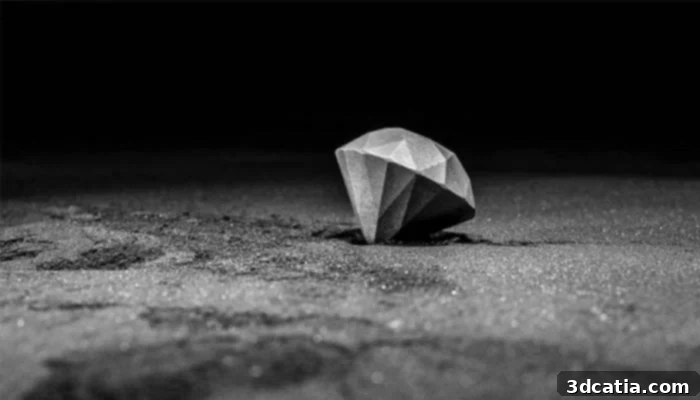
The diamond composite created by Sandvik (photo credits: Sandvik)
Manufacturers of 3D Printers and Filaments
It comes as no surprise that composite filaments and specialized 3D printers for composites are often more expensive than their conventional counterparts. The inherent costs associated with advanced materials, specialized manufacturing processes, and rigorous quality control contribute to this higher price point. Filament spools for composite materials typically range widely in price, from approximately $150 to $500, depending on the type of fiber, matrix material, and manufacturer. Moreover, these high-performance materials often necessitate a 3D printer with specific capabilities and robust components designed to handle their unique characteristics. Such specialized printers frequently come equipped with proprietary technologies, which manufacturers brand and market uniquely to differentiate their solutions in a competitive landscape.
In the rapidly evolving composite 3D printing sector, several prominent actors have emerged, whose names are now synonymous with innovation and performance. These include industry leaders such as CEAD, Markforged, Anisoprint, and Roboze, among others. For short fiber composites, a wide range of filament manufacturers offer compelling products, including Roboze, 3DXTech, ColorFabb, Proto-pasta, and Ultimaker. The market is also dynamic, with new innovators constantly emerging. For instance, the promising Swiss startup 9T Labs has developed an ingenious add-on system that enables ordinary FDM 3D printers to achieve continuous fiber 3D printing. Their process, known as Additive Fusion Technology (AFT), utilizes a carbon-filled material to create strong reinforcements, making high-performance composite printing more accessible.
Major manufacturers have developed proprietary processes to integrate continuous fibers into 3D printed parts, each with distinct methodologies and advantages. Markforged, a pioneer in this field, refers to its process as Continuous Filament Fabrication (CFF), renowned for producing exceptionally strong and functional parts. Anisoprint, another key player, employs a technique called Composite Fiber Coextrusion (CFC), which focuses on achieving “true composites” with optimized fiber volume fractions for superior mechanical properties. A particularly intriguing technology is AREVO’s proprietary process, which is based on Directed Energy Deposition (DED) technology. In this method, a laser simultaneously heats the thermoplastic filament and the carbon fiber, while a roller precisely compresses them together, resulting in high-strength, large-format composite structures like bicycle frames. Impossible Objects has also introduced systems for continuous fiber 3D printing into their machine portfolio, utilizing a unique approach. Their technology involves weaving sheets of carbon fiber into a print through a lamination process, allowing for high-speed, high-volume production of composite parts. Last but not least, Continuous Composites employs a hybrid technology where a strand of fiber is impregnated with a thermoset resin and then rapidly hardened using UV light, bearing similarities to SLA 3D printing. This method offers unparalleled geometric complexity and rapid curing, further diversifying the landscape of composite additive manufacturing.

AREVO’s bike frame has been created using continuous fiber 3D printing | Credits: AREVO
The future of composite 3D printing is bright and filled with potential. What new composite materials will emerge for 3D printing next? Will their adoption expand significantly into series production, moving beyond prototyping and specialized applications? Share your thoughts and predictions in the comments below or join the discussion on our Facebook and Twitter pages! Don’t forget to sign up for our free weekly Newsletter to stay updated with all the latest news and innovations in the world of 3D printing, delivered directly to your inbox!
*Credits Cover Image: SABIC