

Aeroswift Project: South Africa’s Visionary Leap into Large-Scale Metal 3D Printing for Aerospace
In recent years, the landscape of manufacturing has been dramatically reshaped by the rapid advancements in 3D printing, also known as additive manufacturing. This revolutionary technology, once confined to prototyping, is now at the forefront of industrial production, offering unprecedented design freedom, material efficiency, and accelerated development cycles. South Africa has emerged as a significant player in this global transformation, particularly in the realm of complex, large-scale projects. Demonstrating a clear vision for industrial innovation, the nation has invested heavily in research and development, positioning itself as a hub for cutting-edge additive manufacturing technologies, especially those tailored for demanding sectors like aerospace.
A cornerstone of South Africa’s ambition in this field is the Aeroswift project. Launched in 2011, this government-backed initiative represented a collaborative effort between Aerosud, a key player in additive manufacturing for the aerospace sector, and the esteemed Council for Scientific and Industrial Research (CSIR) in South Africa. The primary objective of Aeroswift was ambitious yet clear: to engineer and build one of the world’s largest and fastest metal 3D printers. This pioneering machine was specifically designed to utilize titanium powder for the creation of intricate and robust aircraft components, promising to redefine manufacturing capabilities within the aerospace industry.
The Genesis and Grand Vision of Aeroswift
The Aeroswift project was not merely about building a bigger printer; it was about addressing critical challenges and unlocking new opportunities within aerospace manufacturing. The aerospace market, characterized by stringent performance requirements and high costs, constantly seeks innovative solutions to enhance efficiency, reduce weight, and lower production expenses. Traditional manufacturing methods often involve extensive tooling, material waste, and lengthy lead times for complex parts. Additive manufacturing offers a compelling alternative, enabling the creation of intricate geometries directly from digital designs with minimal waste.
Recognizing this potential, Aerosud and CSIR pooled their expertise. Aerosud brought its deep understanding of aerospace design and manufacturing needs, while CSIR contributed its extensive scientific research capabilities and engineering prowess. This synergistic partnership, bolstered by government support, aimed to push the boundaries of what was previously considered possible in metal additive manufacturing. The overarching goal was to design a brand-new machine that could not only produce large-scale titanium parts but also achieve a new level of operational efficiency, thereby making additive manufacturing a viable and economically attractive option for flight-critical components.
Unprecedented Scale and Speed: A Technological Breakthrough
The Aeroswift metal 3D printer boasts impressive specifications that set it apart in the global additive manufacturing landscape. With a remarkable print volume of 2000 x 600 x 600 mm, it significantly surpasses the build envelopes of many established industrial metal printers. For context, prior to Aeroswift, leading machines like the Concept Laser Xline 200R, known for its substantial capabilities, offered a build volume of 800 x 400 x 500 mm. While utilizing different manufacturing technologies, the sheer scale of Aeroswift’s capacity allows for the production of much larger, single-piece aircraft components, reducing the need for assembly and potentially enhancing structural integrity.

The Aeroswift team showcasing their advancements.
Beyond its impressive size, the Aeroswift printer distinguishes itself through its groundbreaking speed. During testing, the South African team revealed that three titanium pieces printed by their machine demonstrated a processing speed ten times faster than other conventional metal additive manufacturing systems available at the time. This exponential increase in speed is a critical factor for industrial adoption, as it directly impacts production throughput and cost-effectiveness. Hardus Greyling from CSIR emphasized this unique advantage, stating, “Our machine is unique. We have developed new technologies and patents that allow us to improve the printing process to go faster and make larger parts.” This highlights the proprietary innovations embedded within the Aeroswift system, which likely include advancements in laser technology, material deposition strategies, and thermal management control, all optimized for high-speed, large-format metal printing.
The ability to print complex titanium parts at such an unprecedented scale and speed has profound implications for the aerospace industry. It opens the door to manufacturing structural components, brackets, and even entire sections of aircraft that were previously impossible or impractical to produce using additive methods. This not only streamlines the supply chain but also enables designers to create more optimized, lighter-weight parts with complex internal lattice structures, further contributing to fuel efficiency and performance.
Transforming Aerospace Manufacturing: Cost Reduction and Enhanced Performance
The commercialization efforts of Aerosud and CSIR are well underway, with active discussions taking place with major aerospace giants like Boeing and Airbus. The focus of these collaborations is the manufacturing of titanium parts aimed at significantly reducing aircraft weight and lowering production costs. This is a crucial area of development, as every kilogram saved on an aircraft translates into substantial fuel savings over its operational lifespan and contributes to reduced carbon emissions. The traditional method of manufacturing large aircraft components often involves extensive machining from large blocks of material, leading to significant material waste and complex assembly processes.
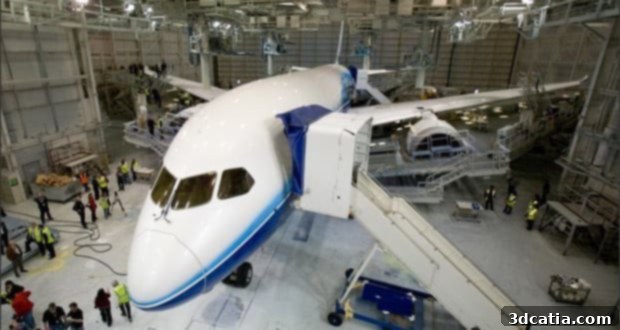
The Aeroswift printer promises significant cost savings in aircraft production.
This new aircraft manufacturing process, facilitated by Aeroswift’s capabilities, holds the potential to save millions of dollars in production costs for aircraft manufacturers. By replacing main aluminum parts with lighter, yet equally strong or stronger, titanium alloys produced through additive manufacturing, companies can achieve remarkable efficiencies. Titanium alloys offer superior strength-to-weight ratios and excellent corrosion resistance, making them ideal for demanding aerospace applications. Furthermore, the ability of 3D printing to create complex, optimized geometries that are impossible with conventional methods means parts can be designed to be intrinsically lighter and more structurally efficient, leading to better performance and longer service life for aircraft. This strategic shift represents a paradigm change, moving from subtractive manufacturing (removing material) to additive manufacturing (building up material layer by layer), which inherently reduces material waste and streamlines complex production cycles.
South Africa’s Strategic Advantage and Future Potential
South Africa is uniquely positioned to become a global leader in additive metal manufacturing, particularly for titanium components. This strategic advantage stems significantly from the country’s vast natural resources; South Africa boasts the fourth-largest titanium reserves globally, following China, Australia, and India. This abundant domestic supply of raw material provides a secure and cost-effective foundation for a thriving titanium additive manufacturing industry. It minimizes reliance on foreign imports for raw materials, enhances supply chain resilience, and reduces production costs, making South African-produced parts highly competitive on the international market.
The success of the Aeroswift project is not just a technological triumph but also an economic opportunity for South Africa. It paves the way for the creation of high-skilled jobs, fosters local expertise in advanced manufacturing techniques, and attracts further investment into the country’s industrial sector. By leveraging its natural resources and technological innovation, South Africa can establish itself as a critical hub for global aerospace manufacturing and a pioneer in advanced materials processing. The Aeroswift team had planned to begin testing flights with parts printed by their 3D printer, with a target for market penetration around 2019, indicating a strong drive towards practical application and commercial viability from the outset. This forward-thinking approach has allowed the project to mature into a critical asset for the nation’s industrial future.
Beyond the Horizon: Innovation and Commercialization
The Aeroswift metal 3D printer continues to show immense promise, not only in its current capabilities but also in its potential for future innovation. The foundation laid by this project is expected to deliver even more advanced solutions and applications in the coming years, extending beyond current aerospace uses. As the technology matures and processes become more refined, we can anticipate its application in other high-value industries where high-performance metal components are critical, such as automotive, medical, and defense sectors. The continuous research and development efforts by CSIR and Aerosud mean that the Aeroswift system will likely evolve, incorporating new materials, expanding its build envelope, and further improving its speed and precision.
The project’s success serves as a powerful testament to the transformative potential of strategic national investments in advanced manufacturing technologies. It highlights how collaboration between government, academia, and industry can lead to groundbreaking innovations that not only solve existing industrial challenges but also create entirely new economic opportunities. Aeroswift is more than just a 3D printer; it is a symbol of South Africa’s commitment to technological leadership and its capacity to contribute significantly to the global advanced manufacturing landscape.
What are your thoughts on the advantages of using additive manufacturing in aeronautics, particularly with the advancements seen in projects like Aeroswift? We invite you to share your insights in a comment below. Don’t forget to connect with us on Facebook and Twitter for more updates on 3D printing innovations!