
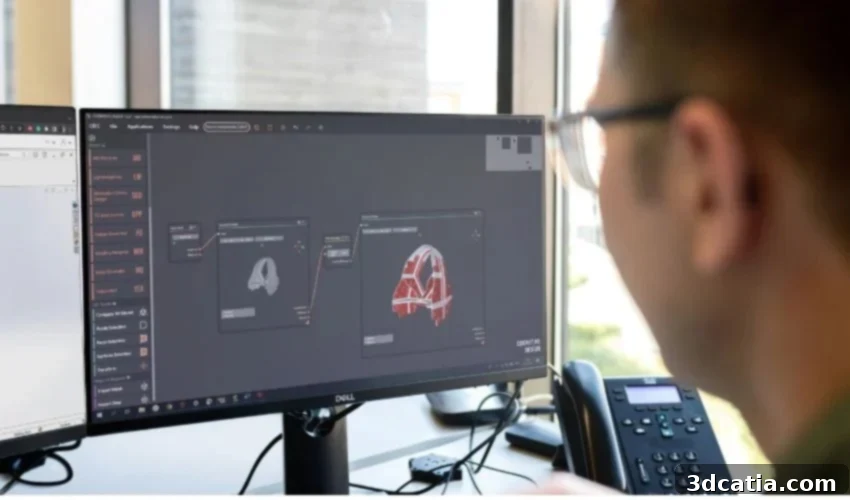
Revolutionizing Engineering Design: Cognitive Design Software for Optimized Additive Manufacturing
Engineers constantly strive for robust and reliable solutions that streamline their design processes and guarantee optimal manufacturability, irrespective of design complexity. However, the traditional engineering workflow often involves a fragmented approach, necessitating extensive back-and-forth between disparate design, simulation, manufacturing, and analysis teams. This disconnected process inevitably inflates lead times, escalates costs, and introduces a higher probability of errors, hindering innovation and efficiency.
Addressing these critical industry challenges head-on, Cognitive Design Systems has proudly unveiled its groundbreaking new software package: Cognitive Design. Specifically engineered to elevate the design process for high value-added parts, this innovative platform consolidates multiple functionalities into a single, intuitive tool. With Cognitive Design, CAD engineers gain the unparalleled ability to optimize designs that precisely fulfill all end-user requirements, achieve superior performance through intelligently optimized geometries, and, crucially, ensure the seamless manufacturability of their creations.
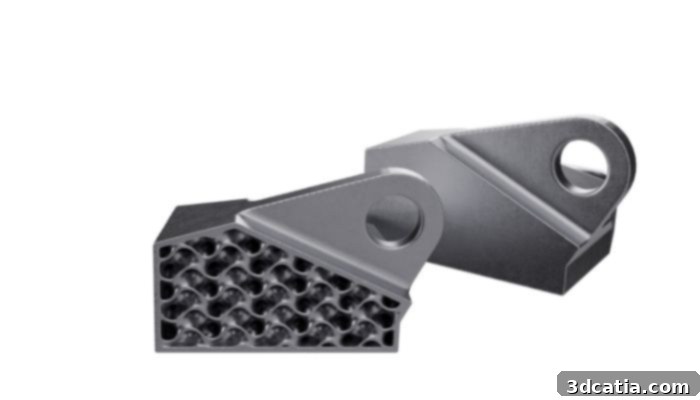
Optimized parts thanks to TPMS filling, illustrating the power of Cognitive Design
The Evolving Landscape and Challenges of Additive Manufacturing Design
Additive manufacturing, commonly known as 3D printing, has ushered in an era of unprecedented geometric freedom, unshackling designers from the restrictive constraints inherent in conventional manufacturing processes. This paradigm shift enables engineers to explore and implement design solutions previously deemed impossible. For instance, it’s now feasible to incorporate intricate architectural materials, such as complex lattice structures or cellular solids, directly into part designs. Furthermore, the technology facilitates the creation of organic, bio-inspired structures derived from advanced topological optimization or biomimetics, mirroring the efficiency and porosity found in natural forms like bone bodies. However, while additive manufacturing offers immense potential, traditional design tools often fall short in their capacity to fully support these new design freedoms, struggling to easily integrate vital data from simulation or feasibility analyses into the initial design phase.
A significant hurdle in the widespread adoption of additive manufacturing lies in the knowledge gap within the engineering community. Most design engineers possess extensive expertise in conventional manufacturing processes and their associated business rules and design limitations. As additive manufacturing represents a relatively new technology, it necessitates a fundamental shift in design philosophy. This implies not only a fresh perspective on how parts are conceived but also the imperative to integrate a new set of manufacturability rules specific to 3D printing. The ability to effectively educate and train engineers in these novel Design for Additive Manufacturing (DfAM) practices is increasingly recognized as a crucial factor in the successful integration of 3D printing, particularly within large-scale industrial corporations.
One of the touted advantages of additive manufacturing is its capacity for rapid prototyping and iterative design, allowing for the testing of various design iterations at a cost often lower than traditional methods like injection molding. However, this design optimization process is far from being obstacle-free. Each modification to a part’s design necessitates rigorous testing, extensive analysis, and often, physical prototyping. What’s more, there’s no inherent guarantee that a newly optimized design can be successfully 3D printed without encountering difficulties such as warpage, internal stresses, or support structure issues. This often translates into more iterations, longer lead times for product development, and the allocation of additional engineering resources. Furthermore, the crucial evaluations of design optimization and manufacturability are frequently conducted in separate software environments, creating digital silos that impede seamless data flow and introduce potential complications and inefficiencies throughout the development lifecycle.
Consequently, CAD engineers often find themselves managing multiple disparate data sets and performing numerous adjustments, typically through manual, labor-intensive processes. They are confronted with additional layers of complexity, forced to orchestrate a multifaceted project with limited integrated support. This challenge is particularly acute when dealing with intricate part geometries, which are precisely what additive manufacturing excels at creating. The entire design and manufacturing process becomes unduly lengthened, and the likelihood of costly errors increases considerably, undermining the very benefits that additive manufacturing promises.
The Main Benefits of Cognitive Design: A Unified Approach to Innovation
In light of these prevalent industry constraints and complexities, Cognitive Design Systems has meticulously developed a pioneering software solution designed to fundamentally simplify design optimization and unequivocally guarantee the manufacturability of any given part. At its core, this software leverages an innovative geometric engine, developed entirely in-house. This proprietary technology introduces a new dimension to optimization, offering both unparalleled computational capacity and remarkable ease of implementation, all while ensuring unrivalled robustness and reliability in its operations.
One of the software’s foremost key features is its unparalleled ability to help users achieve maximum performance quickly and efficiently. In practical terms, engineers can semi-automatically identify and implement a comprehensive range of possible geometric optimizations on their analyzed designs, entirely freed from the conventional limitations imposed by traditional CAD software. This translates into powerful options for reducing the weight of a part by intelligently manipulating internal filling strategies, integrating advanced lattice structures (like TPMS), or precisely placing reinforcing ribs. These critical geometric changes can be dynamically guided by input data derived from the user’s existing simulation software, forming the cornerstone of a highly effective Simulation-Driven Design workflow. By facilitating this seamless interoperability with the engineer’s existing digital chain, Cognitive Design ensures that the optimized geometry is perfectly aligned with the certified solutions and established protocols of their specific environment, thereby accelerating development without compromising on validated performance.
Beyond the topological optimization techniques commonly employed for performance enhancement and lightweighting, Cognitive Design offers advanced capabilities that significantly contribute to achieving optimal part geometry. Features such as variable thickness modification and adaptive filling allow for nuanced control over material distribution. Critically, these optimizations are based directly on simulation results, meaning Cognitive Design ensures increased part performance without the inherent risk of counter-productive modifications. This prevents issues like excessive material removal in critical areas, which could inadvertently alter vital mechanical properties or compromise structural integrity, thereby safeguarding the part’s intended function and longevity.

Optimization process using a simulation-driven design approach, enhanced by Cognitive Design
Furthermore, Cognitive Design serves a dual purpose by enabling users to effortlessly generate designs that are inherently 3D printable and to establish seamless liaison with production teams. The software achieves this by integrating sophisticated manufacturability analysis tools that are capable of identifying potential manufacturing defects right from the earliest stages of the design cycle. Leveraging a variety of intelligent strategies, Cognitive Design provides precise, actionable adjustments to critical design parameters such as part geometry, rib thickness, thermal concentration points, and optimized parameters for efficient removal of excess powder, for example. This proactive approach ensures designs are “right the first time,” minimizing costly rework and delays.
The true power of Cognitive Design lies not only in its ability to furnish users with this wealth of manufacturing insights, thereby dramatically streamlining the design process and reducing the number of costly iterations. More impressively, it is also capable of automatically executing the necessary geometric modifications required to significantly improve manufacturability and feasibility. This manufacturing-driven design methodology is absolutely essential for drastically shortening the overall development cycle and providing an ironclad guarantee of a part’s manufacturability, irrespective of its geometric complexity or the intricacies of the additive manufacturing process chosen.
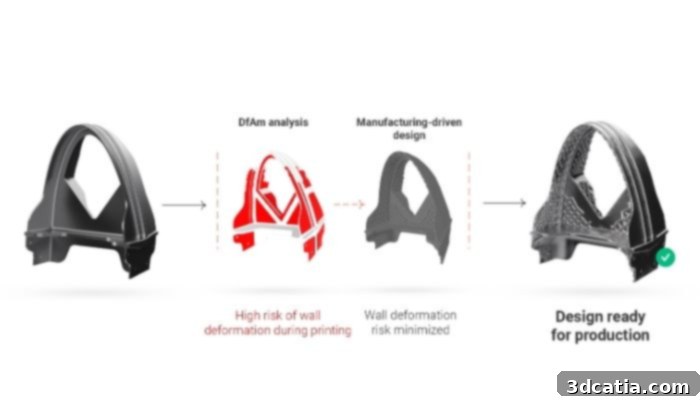
Geometric modification process based on feasibility analysis, empowered by Cognitive Design software
Finally, Cognitive Design significantly accelerates advanced engineering initiatives and the development of innovative products by enabling the creation of fully customized and highly efficient workflows. The solution comes equipped with a suite of pre-built optimization workflows, whose individual components can be entirely modified and tailored by the user to suit specific project requirements. The integration of robust parametric design capabilities makes it remarkably easier to multiply design iterations rapidly, allowing engineers to quickly generate and evaluate several versions of their design. This enables them to identify the absolute best iteration for performance and manufacturability with unprecedented speed. Furthermore, engineers can then effortlessly re-use their proven workflow on a new part, ensuring the efficient re-application of a successful design strategy with renewed ease and consistency.
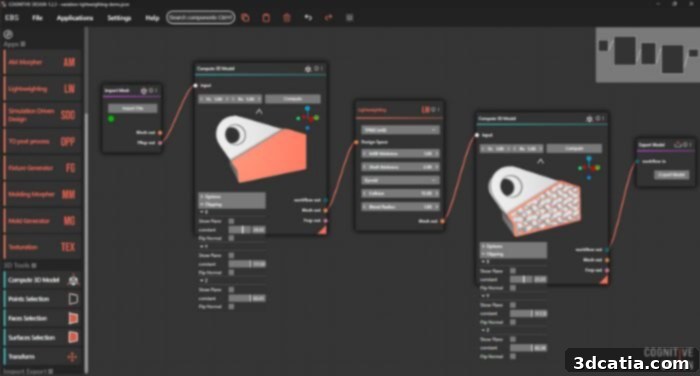
Cognitive Design interface overview, showcasing the intuitive lightweighting workflow
Cognitive Design stands as a truly complete software package, empowering engineers to produce exquisitely optimized designs, regardless of their geometric complexity or intended application. It offers a singular, integrated solution that not only enhances performance but also definitively guarantees the manufacturability of these advanced designs, eliminating the need for time-consuming manual steps or the reliance on multiple, disparate external tools. To celebrate the exciting launch of Cognitive Design, interested professionals can take advantage of an exclusive 60-day free trial of the software. To discover more about this transformative platform and begin your trial, simply click HERE.
What are your thoughts on Cognitive Design Systems’ innovative software solution? We encourage you to share your feedback in a comment below or connect with us on our LinkedIn, Facebook, and Twitter pages! Don’t forget to sign up for our free weekly newsletter here to receive the latest 3D printing news and insights straight to your inbox! You can also explore all our informative videos on our dedicated YouTube channel.
*All Photo Credits: Cognitive Design Systems