
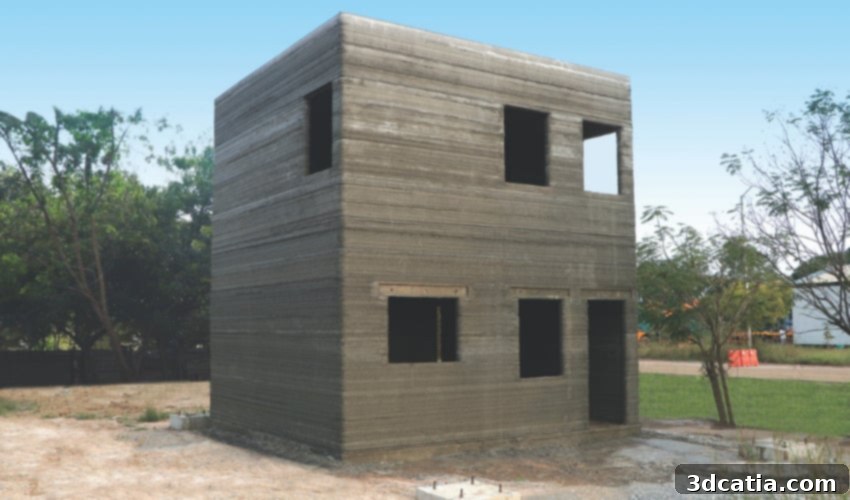
Revolutionizing Construction: L&T Builds India’s First 3D Printed Two-Story Building with COBOD Technology
The global construction industry is undergoing a significant transformation, with advanced technologies like 3D printing paving the way for unprecedented innovation. In a monumental achievement that sets a new benchmark for construction in India and beyond, L&T Construction, a preeminent name in engineering and building, has proudly announced the successful completion of India’s very first two-story building constructed entirely through 3D printing. This pioneering project was realized using a state-of-the-art COBOD printer, highlighting a crucial advancement in the application of additive manufacturing within the building sector. This landmark follows L&T’s earlier success in constructing India’s inaugural single-story 3D printed house, also leveraging COBOD’s cutting-edge technology, thereby cementing L&T’s reputation as a frontrunner in adopting future-forward building methods.
What truly distinguishes this two-story structure is its complete adherence to the rigorous Indian building codes, unequivocally demonstrating the practical viability, structural integrity, and regulatory compliance of 3D printed construction for widespread use. A key innovation in this project was the development of a specialized 3D printable concrete mix, meticulously formulated by L&T Construction’s dedicated in-house research and development team. This homegrown material solution underscores L&T’s strategic commitment to fostering self-reliance and pioneering sustainable, cost-efficient building alternatives. The accelerated adoption of additive manufacturing (AM) is increasingly reshaping the construction sector globally, with a growing number of companies recognizing the immense potential of 3D printing for achieving faster project completion, reducing overall costs, and minimizing environmental impact. L&T’s latest project stands as a powerful testament to this evolving paradigm, establishing a formidable precedent for future developments in automated construction.
COBOD’s Pioneering Role in Advancing Construction 3D Printing Globally
The past few years have been marked by astonishing breakthroughs in the application of 3D printing within the construction industry. These transformative innovations span a wide spectrum, including the construction of the first 3D printed house in a single piece, the ambitious creation of the world’s first 3D printed community designed to provide rapid housing solutions, and even speculative yet inspiring projects such as the development of a 3D printed habitat for potential life on Mars. Central to many of these groundbreaking endeavors is COBOD, a Danish manufacturer that has earned global acclaim for its unparalleled contributions to the advancement of 3D printing technology in the construction sector.
COBOD’s influence is evident across a multitude of international projects, firmly cementing its status as a global leader in additive construction. Their impressive portfolio encompasses the construction of Europe’s first 3D printed building, a innovative small-scale 3D printed office hotel located in Copenhagen, famously known as the BOD. More recently, within the last year alone, COBOD has played a pivotal role in the printing of Europe’s first two-story and even three-story 3D printed buildings, alongside pioneering the first 3D printed structures across various locations in Africa. These diverse achievements underscore COBOD’s adaptability and its capacity to deploy its technology in a variety of challenging environments and to meet complex building specifications. Such significant and consistent contributions have garnered widespread recognition, culminating in COBOD’s visionary founder, Henrik Lund-Nielsen, being honored as one of the most influential personalities in additive manufacturing in 2020. This accolade further solidifies COBOD’s position as a true pioneer and an indispensable force in shaping the future trajectory of construction worldwide.
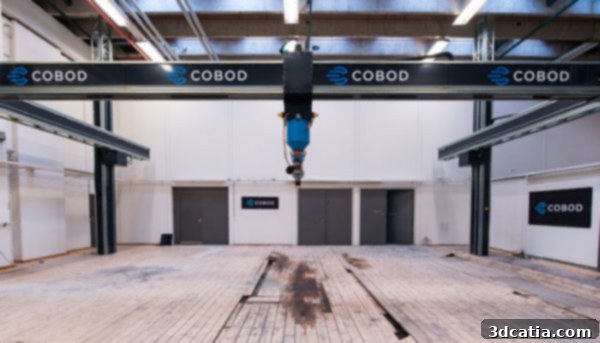
COBOD’s 3D printer, the BOD2, demonstrating its advanced capabilities in additive construction.
L&T Construction’s Groundbreaking Project: The Strategic Use of Conventional Concrete
The innovative project spearheaded by L&T Construction is particularly remarkable for its strategic and effective use of conventional concrete within the 3D printing process. As highlighted by COBOD in its official press release, a substantial majority of 3D printed buildings constructed to date have typically relied on ready-mix mortars. While these specialized mortars offer convenience, they are often significantly more expensive and generally possess lower structural strength compared to standard, conventional concrete. The aforementioned BOD building in Copenhagen represented an early, significant exception by also utilizing real concrete, but L&T’s project elevates this achievement by successfully implementing it for a multi-story structure.
The deliberate choice to employ conventional concrete in this pioneering Indian project marks a critical milestone for the entire additive manufacturing construction sector. This approach directly tackles two of the most significant impediments to the widespread adoption of 3D printing in construction: overall cost-effectiveness and inherent structural durability. By harnessing the economic advantages and superior strength properties of conventional concrete, L&T has effectively paved the way for the creation of more affordable, robust, and scalable 3D printed structures. Reflecting on this monumental achievement, Henrik Lund-Nielsen commented, “L&T Construction’s project marks a huge step forward for our industry, on a global scale. Not only is the project showing that more and more conventional construction companies are adapting 3D printing, but the 3D printing of a real concrete made by L&T themselves is significant, as this helps to drive down the cost even further.” This resounding endorsement from a key figure in the additive construction field underscores the profound and far-reaching impact of L&T’s innovative methodology.
L&T’s Strategic Vision and Global Leadership in Construction
V. Satish, Director and Senior Executive Vice President at L&T Construction, passionately articulated the transformative potential of concrete 3D printing within the broader construction landscape. He emphasized, “3D concrete printing is one of the disruptors with the potential to radically redefine construction methodologies and I am extremely happy that by demonstrating our growing expertise in 3D printing, we are well positioned to push the boundaries of automated robotic construction.” L&T Construction, already acclaimed as the largest construction company in India and consistently ranking among the world’s top 30 contractors, is exceptionally well-equipped to spearhead this technological revolution. Their extensive experience and significant market presence provide a robust platform for the widespread adoption and scaling of 3D printed construction.
The newly completed 65m² two-story building, strategically situated near Chennai, stands as a tangible and powerful demonstration of L&T’s advanced capabilities. Crucially, the concrete mixture used for its construction was meticulously developed by L&T’s dedicated in-house team, thoughtfully incorporating locally available raw materials. This localized approach not only ensures enhanced supply chain efficiency and cost-effectiveness but also actively promotes regional industries and significantly reduces the environmental footprint typically associated with the long-distance transportation of construction materials. Furthermore, the project showcased meticulous methods for seamlessly integrating reinforcement elements within the 3D printed concrete, guaranteeing the structural integrity, long-term durability, and safety required for contemporary multi-story buildings. This comprehensive approach, encompassing everything from material innovation to sophisticated structural reinforcement, exemplifies L&T’s unwavering leadership in sustainable, cutting-edge, and resilient construction practices.
The Broader Impact: Speed, Cost, and Sustainability in 3D Printed Construction
The transformative potential of 3D printing extends far beyond mere technological novelty; manufacturers and innovators globally are increasingly optimistic that this technology can deliver buildings that are not only constructed faster and more affordably but are also significantly more sustainable. Traditional construction methods are often characterized by substantial material waste, high labor demands, and protracted project timelines. Additive manufacturing directly addresses these systemic challenges by enabling highly precise material deposition, thereby minimizing waste, and automating a substantial portion of the building process. This paradigm shift offers a compelling solution to many inefficiencies inherent in conventional construction.
Unprecedented Speed and Operational Efficiency
One of the most compelling advantages offered by 3D concrete printing is the dramatic reduction in construction timelines. Conventional building projects, depending on their complexity and scale, can typically take several months or even years to reach completion. In stark contrast, 3D printing technology has the capability to erect robust building shells in a matter of days or mere weeks. This accelerated timeline is critically important for projects operating under strict deadlines or in regions where the rapid deployment of essential infrastructure is paramount. The inherent automation in 3D printing also significantly reduces the dependency on large, specialized labor forces, thereby streamlining construction workflows and effectively mitigating potential delays often caused by labor shortages or the logistical complexities associated with traditional building practices.
Substantial Cost Reductions and Economic Advantages
Cost efficiency stands as another primary catalyst driving the widespread adoption of 3D printing in the construction sector. By precisely extruding material layer by layer, the amount of waste generated during the construction process is drastically reduced, often by significant margins. This minimization of material waste, coupled with the ability to create optimized structural designs that utilize only the necessary quantity of material, translates into substantial financial savings. Furthermore, the automation of various construction tasks significantly cuts down on labor costs, which traditionally constitute a considerable portion of any construction project’s budget. The capacity to utilize locally sourced, conventional concrete, as brilliantly demonstrated by L&T, further amplifies these economic benefits, rendering 3D printed homes more accessible and economically viable for a broader spectrum of applications, from residential to commercial structures.
A Firm Commitment to Environmental Sustainability
In an era defined by growing environmental consciousness and urgent climate action, the sustainability aspects of 3D printed construction are particularly compelling and vital. Reduced material waste directly translates into a smaller ecological footprint. The inherent potential to incorporate recycled aggregates and utilize readily available local raw materials, as L&T has successfully showcased, further enhances the eco-friendliness of this innovative building methodology. A reduction in the transportation of heavy construction materials contributes significantly to lower carbon emissions. Moreover, the intrinsic efficiency of 3D printing facilitates the creation of structurally optimized designs that can inherently improve a building’s energy efficiency throughout its operational lifespan, making these structures not only environmentally sound to construct but also sustainable and economical to occupy over time.
Addressing Critical Societal Challenges: A Vision for a Better Future
Beyond the immediate and tangible benefits of speed, cost-efficiency, and environmental sustainability, many passionate proponents of 3D printed construction envision a future where this technology plays an indispensable role in tackling pressing societal challenges. The ability to rapidly construct durable, affordable, and high-quality homes offers a potent solution to pervasive global housing crises and holds immense potential to contribute meaningfully towards ending homelessness in numerous communities worldwide. Imagine entire communities being erected swiftly in response to natural disasters, or to provide dignified and safe housing for underserved and vulnerable populations. This ambitious vision is not merely an aspiration but is steadily transitioning into a tangible reality through pioneering and impactful projects like L&T’s two-story building in India.
The resounding success of L&T Construction’s project, powered by COBOD technology, serves as an inspiring beacon, brilliantly illuminating the path forward for the global construction industry. It powerfully underscores the immense and transformative potential of additive manufacturing to fundamentally redefine traditional building processes, offering innovative and scalable solutions for enhanced efficiency, economic viability, and profound ecological responsibility. As these cutting-edge technologies continue to mature and gain wider adoption, we can confidently anticipate a future where sustainable, resilient, and aesthetically diverse structures are erected with unprecedented speed, precision, and economic advantage, ultimately benefiting communities and economies across the globe. To delve deeper into COBOD’s extensive portfolio of projects and explore their visionary outlook for the future of construction, please visit their official website HERE.
What are your valuable thoughts on this remarkable two-story 3D printed building and the exciting future of additive manufacturing in the construction sector? We sincerely invite you to share your insights and opinions in the comments section below or engage with our community on our vibrant Facebook and Twitter pages! For all the very latest breaking news, exclusive features, and significant developments in the dynamic world of 3D printing, don’t forget to sign up for our completely free weekly Newsletter, delivered directly to your inbox.