

Revolutionizing Antenna Production: Sustainable 3D Printing for High-Frequency Telecommunications
In the intricate web of modern communication, where data flows seamlessly across vast distances, one device remains indispensably central: the antenna. These sophisticated components are the unsung heroes responsible for transmitting and receiving the myriad signals that power our interconnected world, from cellular networks and Wi-Fi to satellite communications and IoT devices. The continuous evolution of communication demands ever more efficient, precise, and cost-effective antennas, pushing the boundaries of traditional manufacturing methods. Against this backdrop of relentless innovation, researchers at the Pontificia Universidad Católica de Valparaíso (PUCV) in Chile have embarked on a pioneering interdisciplinary project, unveiling a game-changing approach to antenna production. Their breakthrough utilizes 3D printing technology to create high-frequency antennas that are not only less expensive but also remarkably sustainable, charting a new course for the future of telecommunications hardware.
The ambitious project, aptly titled “Development of polymer-based composite pellets with particles and/or ceramics for the manufacture of telecommunication antennas by additive manufacturing,” encapsulates its core mission. At its heart lies the objective of perfecting a 3D printing process capable of meeting, and even exceeding, the stringent requirements of high-frequency antenna performance. The research team meticulously explored various material combinations, ultimately identifying a unique blend of metal and ceramic particles, delivered in the form of pellets, as the most promising solution. This choice of material and form factor is critical, as it allows for precise control over the dielectric and conductive properties essential for efficient signal transmission and reception at high frequencies, while simultaneously offering significant advantages in terms of material handling and process efficiency in additive manufacturing.
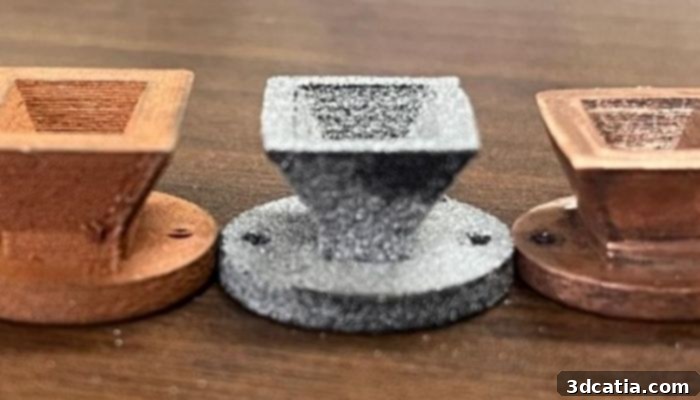
3D printed antenna components, illustrating the results of advanced additive manufacturing research (Photo credits: PUCV Strategic Communication Department).
Innovating Antenna Manufacturing with Pellet 3D Printing
One of the most significant achievements of this groundbreaking research lies in the meticulous formulation and production of specialized pellets. These advanced composite pellets boast an impressive concentration of metal and ceramic particles, ranging from 70% to 90%. This high loading percentage is not arbitrary; it is carefully engineered to provide the optimal balance of electrical conductivity (from metal particles) and dielectric properties (from ceramic particles) that are paramount for high-frequency applications. The particle size within these pellets was precisely controlled, ensuring it was perfectly suited for the extrusion process inherent in pellet-based 3D printing. This fine-tuning resulted in a final product exhibiting ideal physicochemical and electrical characteristics, crucial for stable and efficient antenna performance.
Beyond the material itself, the PUCV researchers have optimized the entire manufacturing workflow. Their proposed process offers several profound advantages over conventional methods. Firstly, it dramatically reduces material losses, a common issue in subtractive manufacturing and even some additive techniques. By extruding precisely what is needed, waste is minimized, contributing to both cost savings and environmental benefits. Secondly, the process significantly optimizes manufacturing times. The inherent speed and agility of 3D printing, combined with tailored material preparation, allow for rapid prototyping and production cycles, accelerating the development pipeline for new antenna designs. Thirdly, and perhaps most futuristically, the process integrates artificial intelligence (AI) to enhance printing standards. AI algorithms can monitor and adjust printing parameters in real-time, predicting and correcting potential defects, optimizing layer adhesion, and ensuring consistent quality across batches. This intelligent control elevates the precision and reliability of the 3D printed antennas, making them suitable for demanding telecommunication environments.
Rigorous Testing and Performance Validation
To rigorously validate the feasibility and performance of this innovative process and material combination, the PUCV team moved beyond theoretical models to practical application. They successfully printed functional prototypes of high-frequency antenna systems using their proprietary metal-ceramic composite material. These prototypes were not merely demonstration pieces; they were subjected to a comprehensive battery of tests designed to evaluate their physicochemical and electrical characteristics under real-world conditions. This included detailed analyses of dielectric properties, such as permittivity and loss tangent, which are critical indicators of how well a material can store and dissipate electrical energy at high frequencies. Measurements of conductivity and impedance matching were also crucial to ensure efficient signal transmission with minimal reflection loss.
A significant aspect of the validation process involved extensive debinding and sintering studies. Since the initial pellets are polymer-based composites, the polymer acts as a binder during the printing phase, providing structural integrity. However, for the final antenna to exhibit optimal electrical properties, this polymer binder must be carefully removed, and the metal and ceramic particles must be densified. Debinding is the process of removing this polymeric binder, typically through thermal or solvent-based methods. Sintering then follows, involving heating the debound part to a high temperature, allowing the remaining metal and ceramic particles to fuse and densify, forming a robust, electrically functional structure. These steps are incredibly delicate, as improper debinding can lead to cracks or warpage, and insufficient sintering can result in high porosity and poor electrical performance. The researchers performed extensive studies to ensure the antenna structures maintained their integrity throughout these post-processing stages, achieving the desired densification and microstructure critical for high-frequency operation.
Dr. Dreidy Vásques, the esteemed project leader, underscored the methodical approach taken by her team: “Our proposal focuses on developing and analyzing these two types of materials, printing the parts, removing the polymer, and, finally, analyzing their properties to develop antenna prototypes.” This statement highlights the iterative and comprehensive nature of their research, spanning from fundamental material science to advanced manufacturing and rigorous performance validation. It’s a testament to their commitment to delivering a fully realized and functionally superior solution for antenna production.
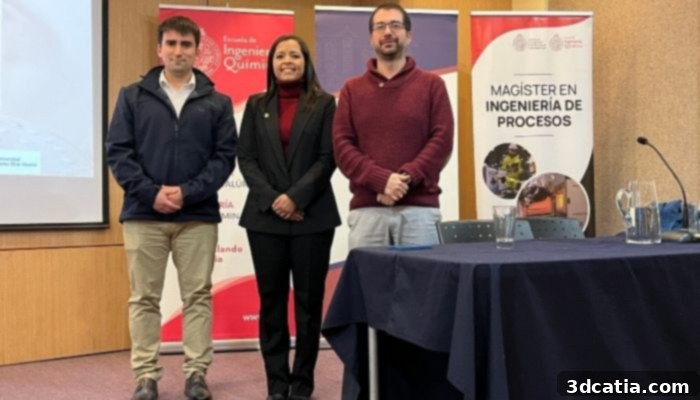
From left to right, Rodrigo Ruz, researcher and student in Process Engineering; Dr. Dreidy Vásquez, project director; and Dr. Francisco Pizarro, project co-director, showcasing the interdisciplinary team behind the advanced 3D printed antenna project (photo credits: School of Chemical Engineering).
A Green Revolution: Sustainability and Circular Economy in Antenna Manufacturing
Beyond the impressive technical capabilities, the PUCV project champions a profound ecological vision. The new manufacturing method is inherently designed to facilitate the reuse of thermoplastics or polymers, thereby promoting a robust circular economy within the realm of antenna production. Traditionally, manufacturing often generates significant waste, with materials frequently discarded after initial use or processing. However, by embracing additive manufacturing with specialized polymer-based composites, the potential to reclaim, reprocess, and reuse these thermoplastic binders becomes a tangible reality. This not only dramatically reduces the environmental footprint associated with manufacturing but also lessens the reliance on virgin raw materials, conserving precious resources.
This focus on a circular economy has far-reaching implications. It means less material going into landfills, reduced energy consumption in material extraction and processing, and a significant decrease in carbon emissions throughout the product lifecycle. For an industry that is constantly expanding to meet global communication needs, integrating such sustainable practices from the ground up offers a powerful model for responsible industrial growth. The ability to locally produce highly customized antennas using recycled or recyclable materials also has strategic advantages, reducing supply chain complexities and fostering regional manufacturing capabilities. This approach is particularly relevant in the context of global efforts to combat climate change and transition towards more sustainable industrial practices, positioning PUCV’s research at the forefront of environmentally conscious technological advancement.
Future Prospects and Industry Impact
The successful completion of this project in early September marks a significant milestone. While the researchers are currently in the process of developing the patent for their innovative method and materials, which naturally necessitates keeping some specific details confidential, the implications of their work are already clear. This technology holds immense potential to disrupt traditional antenna manufacturing, offering unparalleled flexibility in design, rapid iteration capabilities, and significantly lower production costs for high-performance components.
The ability to 3D print custom high-frequency antennas opens doors to numerous applications across diverse sectors. Imagine specialized antennas perfectly integrated into the aerodynamic structures of drones for enhanced communication, or bespoke antenna arrays designed for intricate medical implants requiring precise signal transmission. From advanced radar systems and satellite communication modules to the next generation of 5G and 6G infrastructure, the flexibility and cost-effectiveness offered by this additive manufacturing approach could accelerate innovation and deployment. Furthermore, the sustainable aspect addresses a growing demand for eco-friendly electronics, aligning with corporate social responsibility goals and regulatory pressures for greener manufacturing. As the patent development progresses, the world eagerly awaits the full disclosure of this promising technology, which stands to redefine how we design, produce, and deploy critical telecommunication infrastructure.
What are your thoughts on PUCV’s innovative use of 3D printing for high-frequency antennas and its potential impact on sustainable manufacturing? Share your insights and join the discussion in a comment below or connect with us on our social media channels: LinkedIn, Facebook, and Twitter. Don’t miss out on the latest advancements in additive manufacturing—sign up for our free weekly newsletter here to get cutting-edge 3D printing news delivered straight to your inbox! You can also explore all our compelling videos and interviews on our dedicated YouTube channel.