
PRVOK: The Czech Republic’s Pioneering 3D Printed Floating House Redefines Sustainable Construction
In a remarkable demonstration of architectural innovation and technological prowess, the Czech Republic recently unveiled its first house featuring 3D printed walls, a truly groundbreaking structure that adds a unique twist to modern living: it floats! This extraordinary project, named PRVOK, stands as a testament to how rapidly 3D printed houses are transitioning from futuristic concepts into tangible realities, profoundly reshaping the landscape of the construction industry. Conceived and brought to life by the visionary Scoolpt architectural firm, PRVOK is not merely a building; it represents a potential revolution for construction practices within the Czech Republic and beyond. Spanning a cozy yet efficient area of 43 square meters, this unique dwelling elegantly showcases the immense possibilities inherent in large-scale additive manufacturing and offers a compelling glimpse into the future of sustainable and adaptable construction. To delve deeper into the intricacies and aspirations behind this pioneering endeavor, we had the privilege of speaking with Jiří Vele, a key engineer and architect on the Scoolpt team, whose insights illuminate the journey from concept to a floating, livable reality.
3DN: Can you introduce yourself and elaborate on your journey and relationship with 3D printing?

My name is Jiří Vele, and I am proud to be the lead engineer and architect driving the PRVOK project. I am also a dedicated member of the innovative Scoolpt team. My journey into the world of architecture and advanced manufacturing began formally two years ago when I successfully completed my Master’s degree in architecture from the prestigious Technical University of Prague. During my academic career, I quickly became fascinated by the transformative potential of Fused Deposition Modeling (FDM) 3D printers. This technology proved incredibly useful for my studies, particularly when there was a pressing need to rapidly produce intricate prototypes of architectural models. The cost of acquiring a commercial 3D printer was prohibitive at the time, which spurred me to take a more hands-on approach: I decided to design and build my own FDM machine from scratch. This initial foray into hardware development ignited a profound passion. Over the subsequent two years, I refined my skills and developed an additional ten printers, culminating in my current role overseeing and running the bustling 3D printing center at the Faculty of Architecture. It was approximately a year ago that my focus shifted dramatically towards applying the principles of additive manufacturing on a much grander scale, specifically venturing into large-scale 3D concrete printing, which ultimately paved the way for projects like PRVOK.
3DN: Can you tell us more about the PRVOK project and the specific additive manufacturing technologies utilized in its construction?
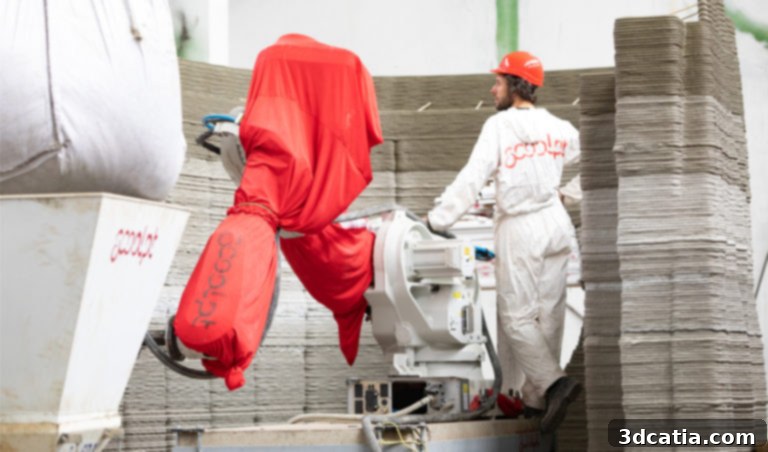
PRVOK represents a monumental milestone as the very first 3D printed house ever realized in the Czech Republic. My profound hope is that this pioneering project will serve as a powerful demonstrator, effectively highlighting the myriad advantages of large-scale 3D printing and its vast, untapped potential within the critical construction sector. The core of our construction methodology for PRVOK relies on a sophisticated concrete 3D printing system. This system integrates an industrial robotic arm, a specialized pump, and a high-efficiency mixer, all working in concert. The process begins with a computer system interpreting intricate architectural data, much like a traditional builder reads blueprints, but with unparalleled precision. This digital blueprint then meticulously guides the robotic nozzle, which extrudes the concrete material layer by layer to the target location with sub-millimeter accuracy. This level of precision is virtually unattainable through conventional construction methods. The concrete material itself, which forms the structural integrity of the house, is not off-the-shelf. It is a highly specialized blend, meticulously adapted for the unique demands of 3D printing, and represents the culmination of an intensive two-year research and development effort. This innovative concrete formulation incorporates a precise combination of advanced additives, including accelerators to control setting times, plastic fibers to enhance tensile strength and reduce cracking, and plasticizers to improve flowability and workability. These carefully selected additives are crucial; they imbue the concrete with the necessary rheological properties – specifically, high extrudability for smooth deposition and rapid setting to support subsequent layers without collapsing – making it exceptionally suitable for robust, large-format 3D printing applications.
3DN: The actual printing of the house only took an astonishing 48 hours. What do you believe is PRVOK’s broader impact on the 3D printing industry and construction as a whole?
While the incredible speed of PRVOK’s core structure printing—achieved in just 48 hours—is certainly impressive and a highlight of the project, I believe its immediate impact on the global 3D printing industry might not be as monumental as some might assume at first glance. It’s important to recognize that similar ambitious projects, utilizing ever-larger and more sophisticated domestic 3D printers, are currently being developed and deployed across various continents. The field of construction additive manufacturing is a rapidly evolving global landscape. Therefore, rather than a singular, transformative shift for the entire industry, I view PRVOK’s primary significance as an educational tool and a powerful public showcase. Its real impact lies in its ability to captivate the general public, ignite conversations, and tangibly demonstrate what is not only possible but already achievable with current additive manufacturing technologies. It helps demystify the process and makes the concept of 3D printed homes more accessible and understandable to a wider audience, from potential homeowners to policymakers. By illustrating the speed, efficiency, and design flexibility that large-scale 3D printing offers, PRVOK encourages greater acceptance and curiosity. This increased public awareness is crucial for fostering innovation, attracting investment, and accelerating the broader adoption of these cutting-edge construction methods, even if it’s just one project among many trailblazers worldwide. It’s about inspiring the next wave of engineers, architects, and builders to push the boundaries even further.

The Prvok manufacturing process, showcasing the robotic concrete extrusion.
3DN: How do you envision the future trajectory and widespread adoption of concrete 3D printing in the construction sector?
Looking ahead, I anticipate that it will likely take another five to ten years for concrete 3D printing to become a truly integral and widely accepted part of standard construction processes. While the technology is advancing at an incredible pace, achieving widespread integration requires overcoming various challenges, including regulatory hurdles, material standardization, and economic scalability. Initially, I don’t foresee us printing entire, colossal buildings solely using this method. Instead, I believe the more immediate and practical potential lies in its application for printing specific, complex architectural components. Think about elements like intricately designed stairs, custom wall panels with unique textures, or specialized structural supports that are difficult, costly, or time-consuming to produce with traditional methods. These applications allow the technology to demonstrate its value in niche areas, where its advantages in design freedom, material optimization, and rapid fabrication truly shine. This phased integration will allow the industry to gradually adapt, refine techniques, and build confidence in the technology’s reliability and cost-effectiveness. Furthermore, as the technology matures, we can expect to see improvements in print speed, material variety, and automation, paving the way for even more ambitious projects. The inherent waste reduction and potential for using recycled or locally sourced materials also positions concrete 3D printing as a crucial component of future sustainable building practices, contributing to a greener construction industry.
3DN: Do you have a final message or a particular vision you’d like to share with our readers regarding 3D printing’s potential?
Indeed, I believe that the true, untapped potential of large-scale 3D printing lies in its capacity to revolutionize construction in exceptionally challenging and hard-to-reach environments – places where the logistical complexities are immense and, more importantly, where the lives of human builders can be at significant risk. Consider extreme locales such as the desolate landscapes of Antarctica, vast deserts with scarce resources, or even the ultimate frontiers of space, like the Moon and Mars. In these scenarios, traditional construction methods are either prohibitively expensive, logistically impossible, or simply too dangerous. This is where additive manufacturing presents a game-changing solution. The ability to utilize in-situ resources – for example, lunar regolith on the Moon or locally available sand in deserts – to print structures autonomously or semi-autonomously before human crews even arrive offers an unparalleled advantage. Imagine habitats, research stations, or critical infrastructure being printed and prepared, enhancing safety and dramatically reducing the resource burden and risk associated with transporting conventional building materials across vast distances or into hostile environments. This vision extends beyond mere shelter; it encompasses the creation of protective barriers, landing pads, and vital facilities that can sustain life and scientific exploration in the harshest conditions imaginable. The strategic deployment of 3D printing in these extreme settings isn’t just about efficiency; it’s about enabling human expansion and scientific discovery safely and sustainably, making the seemingly impossible, possible.
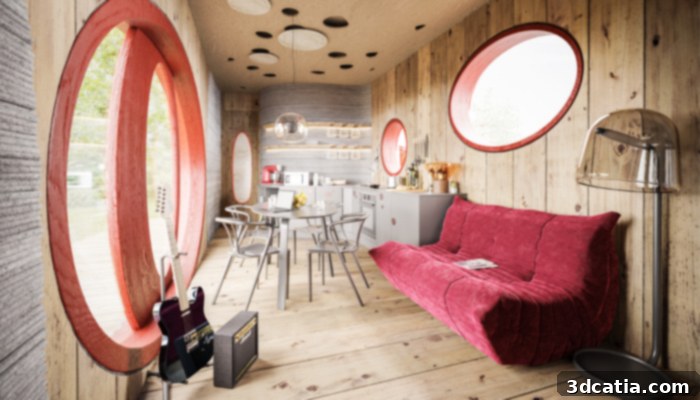
The interior of Prvok, demonstrating functional and innovative design within a 3D printed structure.
The PRVOK project undeniably stands as a beacon of innovation in the burgeoning field of construction 3D printing. We’re eager to hear your thoughts on this revolutionary floating house and its implications for the future of architecture and sustainability! Please share your insights and comments below, or connect with us on our vibrant Facebook and Twitter pages. And remember to subscribe to our free weekly Newsletter to receive all the latest news, breakthrough research, and inspiring stories from entrepreneurs shaping the world of 3D printing, delivered directly to your inbox!