
Unlocking the Potential: Ceramic 3D Printing Market Set for Explosive $3.6 Billion Growth by 2028
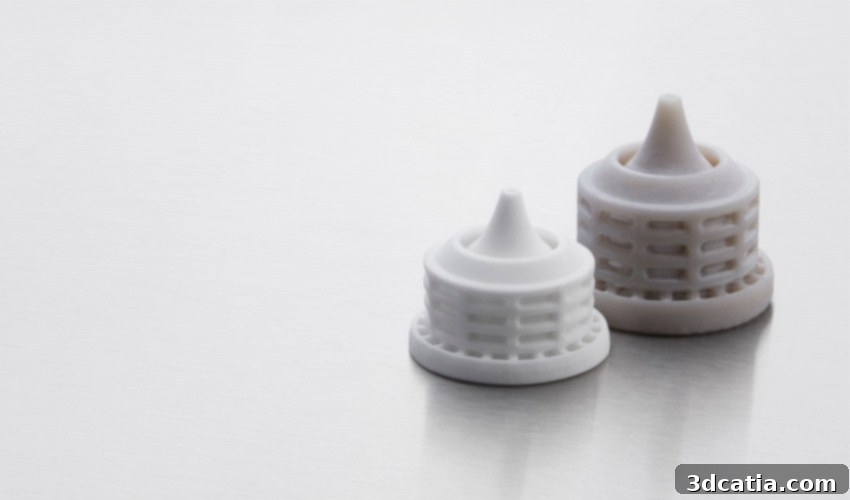
The landscape of additive manufacturing is continuously evolving, with various materials and technologies vying for prominence across industrial sectors. Among these, ceramic 3D printing is emerging as a critical force, poised for remarkable expansion. SmarTech Publishing, a respected American research firm specializing in industrial additive manufacturing, recently released its second comprehensive report on this burgeoning field. The findings are nothing short of transformative: the global ceramic 3D printing market is projected to generate an astounding $3.6 billion within the next decade, by 2028. This substantial forecast underscores the growing recognition of ceramics’ unique properties and the technological advancements making their additive fabrication increasingly viable. The report also meticulously addresses the distinct challenges inherent to this technology – hurdles that differ significantly from those encountered in the more established plastic additive manufacturing sector, signaling a unique developmental path for ceramic AM.
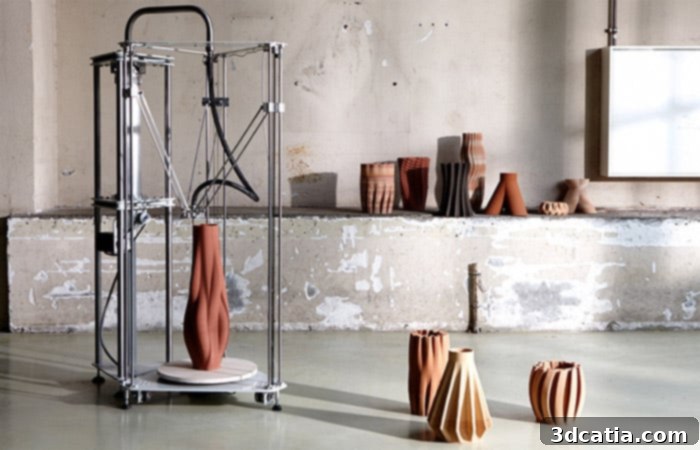
For many years, the spotlight in additive manufacturing has often shone brightly on 3D metal printing, a segment that has indeed experienced a technological boom and continues to present highly promising growth prospects. However, SmarTech Publishing’s latest insights reveal that metal may not be the sole sector destined for such meteoric rise. According to their detailed analysis, the global revenues for ceramic 3D printing were estimated at $98 million in 2018. This figure, while significant, pales in comparison to the projected $3.6 billion by 2028, representing an exponential growth trajectory that demands attention. This impressive forecast highlights the increasing industrial adoption and maturation of ceramic additive manufacturing processes. Pioneering companies such as 3DCeram, a French leader in ceramic AM, ClayXYZ, known for its accessible clay-based extrusion systems, and WASP, an Italian innovator exploring various AM applications including large-scale ceramic structures, are at the forefront of this revolution. These companies, among others, are actively pushing the boundaries of what is possible with ceramic materials, from highly specialized industrial components to artistic and architectural applications.
Driving Forces and Key Predictions for Ceramic 3D Printing’s Future
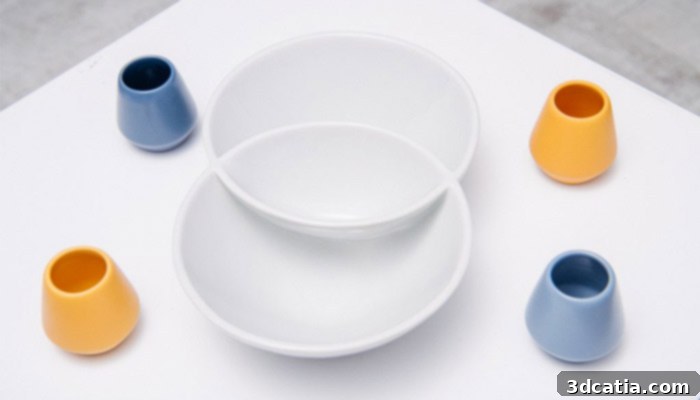
SmarTech Publishing’s second comprehensive report provides an invaluable deep dive into the professional and industrial ceramic 3D printing market. It offers a panoramic view, encompassing the diverse range of available technologies, from material extrusion and binder jetting to photopolymerization processes like stereolithography (SLA) and digital light processing (DLP) adapted for ceramic slurries. The study meticulously analyzes the evolution of ceramic materials used in AM, ranging from traditional, easily printable clays to highly technical and advanced ceramic solutions such as alumina, zirconia, silicon carbide, and hydroxylapatite, each offering distinct properties suited for specific applications. Furthermore, the report chronicles the myriad applications being developed and implemented across various industries, highlighting the global presence of numerous key players who are driving innovation. These include industry leaders like Lithoz, renowned for its ceramic 3D printing systems; 3D Ceram, a specialist in high-performance ceramic parts; Admatec, focusing on technical ceramics; Prodways, with its diverse AM solutions; Tethon 3D, innovating in ceramic materials; 3D Systems, a major additive manufacturing conglomerate; and voxeljet, a pioneer in binder jetting. These manufacturers, alongside many others, have astutely recognized the immense potential that additive manufacturing brings to ceramic production. This includes the ability to achieve unprecedented levels of geometric complexity and intricate internal structures, a key advantage that traditional ceramic manufacturing methods simply cannot match. This capability is paramount for creating components with optimized performance, reduced weight, and enhanced functionality. Currently, ceramic 3D printing is experiencing significant adoption across a multitude of high-stakes sectors, including aerospace, where lightweight and heat-resistant components are crucial; automotive, for durable engine parts and sensors; marine, for corrosion-resistant components; energy, for high-temperature and wear-resistant applications; electronics, for intricate insulators and substrates; and critically, in the medical and dentistry sectors, for biocompatible implants, prosthetics, and custom dental devices.
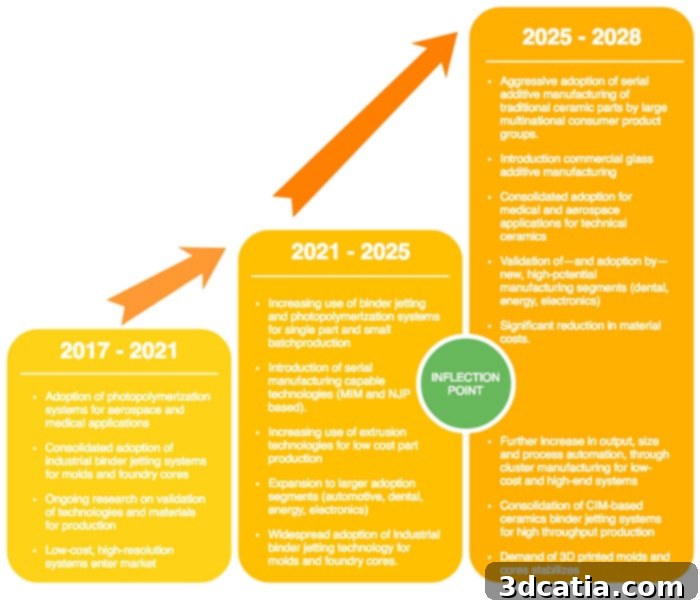
The trajectory of ceramic 3D printing adoption is anticipated to undergo a significant transformation post-2025. This period is expected to mark a critical phase where all the primary ceramic additive manufacturing technologies will reach a level of maturity. This maturation signifies not only enhanced reliability and precision but also sufficient market penetration and infrastructure to reliably support the production of serial parts on an industrial scale. This projected evolution closely mirrors the developmental path observed in additive manufacturing for metals, which has transitioned from primarily prototyping to robust serial production. The SmarTech study suggests that the increasing integration and optimization of processes such as ceramic injection molding (CIM) will play a pivotal role in accelerating this trend. CIM offers a proven pathway for high-volume production of complex ceramic parts, and its synergy with 3D printing could lead to even higher production efficiencies while simultaneously driving down manufacturing costs. This combination promises to unlock new economic models for ceramic part fabrication, making customized and complex ceramic components more accessible and cost-effective than ever before. This shift towards mass customization and efficient serial production is a testament to the technology’s evolving capabilities and its potential to revolutionize traditional ceramic manufacturing. The following diagram provides a more accurate visualization of these compelling forecasts and the expected growth curve, illustrating the market’s anticipated progression toward widespread industrial adoption.
In its conclusive forecast, SmarTech Publishing posits a profound insight: 3D printed ceramic pieces are not merely replicating existing ceramic components; rather, they are inherently adding greater value to ceramics as a material category. The core essence of 3D printing in this context is to create enhanced value for ceramics, pushing beyond conventional limitations. This value addition manifests in several critical ways: enabling previously impossible geometries for superior functionality, facilitating rapid prototyping and iteration cycles, drastically reducing material waste through net-shape or near-net-shape manufacturing, and opening doors for material innovation through custom compositions and microstructures. The ability to produce lightweight, custom-designed, and high-performance ceramic components for specialized applications will cement 3D printing’s role as an indispensable technology. As industries continue to demand more advanced materials with tailored properties, ceramic 3D printing will be instrumental in meeting these complex requirements, fostering new product development and engineering solutions. The complete and in-depth study, offering comprehensive data and analysis on the ceramic additive manufacturing market, is available for those seeking further insights. You can find the full report HERE.
The rapid evolution of the 3D ceramic printing market represents a thrilling chapter in the broader story of industrial additive manufacturing. We are witnessing the maturation of technologies, the expansion of material capabilities, and the broadening of applications across high-value sectors. The projected $3.6 billion market by 2028 is a clear indicator of the transformative power and economic impact that ceramic 3D printing is set to wield. This technology promises not only innovative production methods but also fundamentally redefines what is achievable with one of the most versatile and durable material classes available. As manufacturers continue to push boundaries, the integration of ceramic AM into mainstream industrial processes will undoubtedly accelerate, bringing forth a new era of high-performance, complex, and customized ceramic components. What are your thoughts on the future and continuous evolution of the 3D ceramic printing market? We encourage you to share your perspectives and insights in the comments section below, or engage with us on our vibrant Facebook and Twitter pages. Stay ahead of the curve and don’t miss out on the latest advancements and breaking news in the additive manufacturing world. Make sure to sign up for our free weekly Newsletter, delivering all the essential updates in 3D printing directly to your inbox!