
Carbon 3D Secures $200M Funding to Revolutionize Industrial 3D Printing and Manufacturing with Adidas Partnership
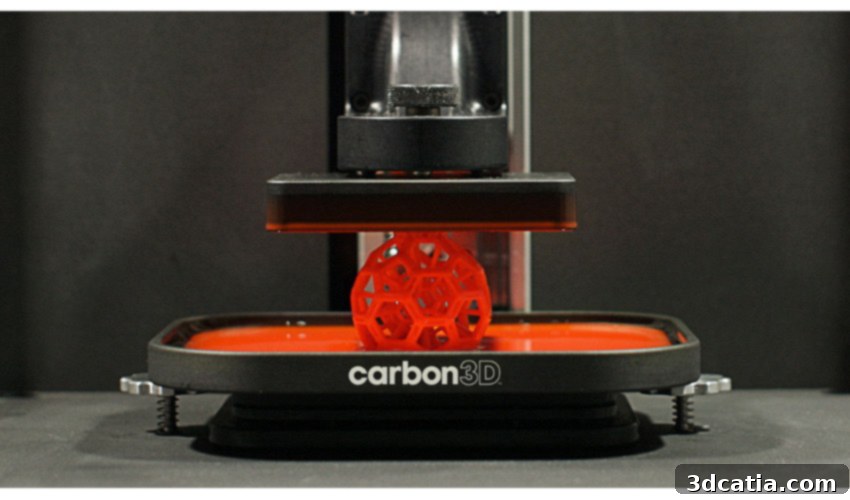
Carbon 3D has cemented its position as a leading innovator in the additive manufacturing space, recently announcing a significant $200 million funding round. This substantial investment, garnered from prominent firms like Baillie Gifford, Fidelity Management, and Archina Capital, alongside strategic partners such as GE Ventures, underscores the growing confidence in Carbon’s transformative 3D printing technology. Many will recall Carbon 3D from their captivating TED Talk, which posed the groundbreaking question, “What if 3D printing could be 100 times faster?” This question resonated globally, highlighting their proprietary Continuous Liquid Interface Production (CLIP) technology, which promises to accelerate 3D printing from a prototyping tool to a robust solution for high-volume, end-use part manufacturing. This latest funding infusion, bringing their total capital raised to an impressive $420 million, is not merely financial backing; it’s a strategic endorsement of their vision to redefine the future of design and production across various industries. The company anticipates announcing further rounds of investment in 2018, signaling an aggressive expansion and a firm belief in their market trajectory.
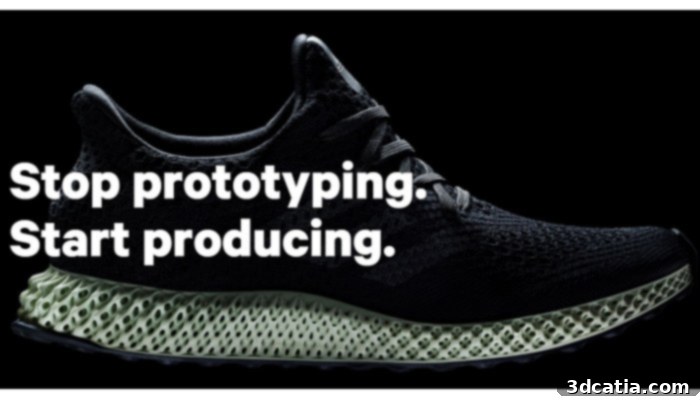
The Adidas Futurecraft 4D trainer showcases the potential of Carbon 3D’s technology in consumer goods.
Carbon 3D & Adidas: Pioneering the Future of Footwear Manufacturing
One of Carbon 3D’s most high-profile and impactful collaborations is with global sportswear giant Adidas, a partnership that is actively reshaping the landscape of athletic footwear manufacturing. As CEO Joseph DeSimone articulated in an interview with TechCrunch, “what’s quite clear is we have momentum with a lot of customers. We’re making millions of pairs of shoes with Adidas, and as we do that, we’re learning a lot about what it takes to manufacture.” This statement reflects a company brimming with confidence and strategic insight, actively engaged in a real-world crucible of high-volume production. Their joint effort focuses on producing the groundbreaking Adidas Futurecraft 4D trainers, an initiative that moves 3D printing from bespoke prototypes into the realm of mass-produced consumer goods.
The initial rollout of the Futurecraft 4D shoes, set at 5,000 pairs, represents a calculated step towards grander ambitions. Carbon’s confidence in their ability to scale effectively is a direct challenge to the traditional limitations of additive manufacturing. Unlike conventional 3D printing technologies such as Fused Deposition Modeling (FDM), which build objects layer-by-layer and can be constrained by speed, material properties, and surface finish for end-use applications, Carbon’s CLIP technology offers significantly enhanced scalability. This distinction is critical because it addresses the core challenge of transitioning from low-volume customisation to high-volume manufacturing with industrial-grade reliability and consistency. The partnership with Adidas is a testament to Carbon’s technological prowess and its potential to disrupt established supply chains and production methodologies within the footwear industry, paving the way for on-demand, customized, and performance-optimized products.
Carbon 3D’s ambitions extend far beyond the initial limited runs. CEO Joseph DeSimone has outlined bold plans to significantly ramp up production, targeting hundreds of thousands of pairs of 3D printed shoes in the coming year, with projections soaring into the millions by 2019. These targets are not just aspirational; they are backed by tangible investments and technological advancements. The recently secured $200 million funding round is pivotal to realizing these objectives, enabling Carbon to further refine its CLIP technology, expand its fleet of state-of-the-art 3D printing machines, and bolster its global operational capabilities to meet the anticipated surge in demand. This substantial capital injection also empowers Carbon to invest heavily in research and development, particularly in material science, to create new resins with diverse properties suitable for a broader range of industrial applications. Furthermore, the funding will facilitate the expansion of their customer success teams and global infrastructure, ensuring seamless integration and support for their growing list of enterprise clients. The cumulative funding of $420 million highlights Carbon’s substantial war chest, solidifying its position as a major force capable of driving significant transformation within the global manufacturing sector.
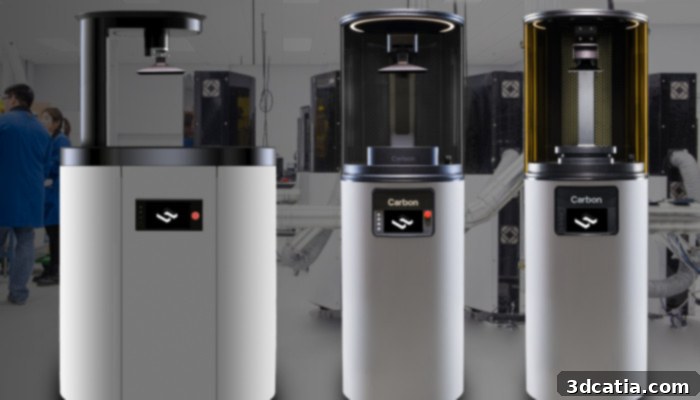
Carbon 3D’s printers are designed for industrial-scale manufacturing.
Unlocking Unprecedented Speed and Scalability in Additive Manufacturing
Carbon 3D has undeniably introduced one of the most compelling advancements in 3D printing technology in recent memory. Their seminal TED Talk vividly illustrated the potential for 3D printing to overcome its historical bottleneck: speed. By demonstrating a process that is orders of magnitude faster than traditional methods, Carbon has ignited hope that additive manufacturing can finally break through the barriers that have historically confined it to prototyping and niche applications. This breakthrough, driven by their Continuous Liquid Interface Production (CLIP) technology, involves projecting a continuous sequence of UV images through an oxygen-permeable window into a reservoir of photopolymer resin. This ingenious method creates objects continuously from a liquid resin bath, eliminating the layer-by-layer approach that characterizes most other 3D printing processes, such as FDM or Stereolithography (SLA). The result is not only dramatically faster print times but also isotropic mechanical properties and exceptionally smooth surface finishes, which are crucial for producing functional, end-use parts.
The impact of Carbon’s innovation extends beyond mere speed. It addresses the critical issue of scalability, which has long been the Achilles’ heel of the 3D printing industry. Traditionally, scaling 3D printing operations for mass production has been challenging due to slow build rates, limited material options, and extensive post-processing requirements. Carbon’s integrated approach, encompassing advanced hardware, intelligent software, and a robust ecosystem of proprietary materials, is designed to overcome these hurdles. Their ability to rapidly produce high-quality components with repeatable results at an industrial scale has the potential to inspire a new wave of innovation across the additive manufacturing sector, prompting other companies to develop and commercialize 3D printers capable of even greater efficiency and versatility. This shift is vital for industries like automotive, aerospace, medical, and consumer electronics, where the demand for rapid iteration, customized parts, and efficient supply chains is ever-increasing.
The path to truly industrial-scale 3D printing is arduous, and the industry is watching closely to see if Carbon can indeed meet the ambitious supply levels it has set for itself. The very essence of 3D printing’s public perception is often tied to slow, expensive, and non-scalable processes. Carbon 3D is actively working to dismantle this perception by delivering proven solutions that demonstrate high-volume production capabilities, most notably through its partnership with Adidas. Their success hinges on not only maintaining their technological edge but also on developing a comprehensive ecosystem that supports widespread adoption—including material development, software integration for workflow optimization, and a robust service network. If Carbon can continue to prove its ability to deliver on these fronts, it stands to fundamentally alter the manufacturing landscape, making on-demand, digitally fabricated products a mainstream reality rather than a futuristic concept. The continuous innovation in material science, allowing for the creation of resins with varied properties from rigid plastics to flexible elastomers, further expands the applicability of their technology across diverse product categories.
For those interested in delving deeper into Carbon 3D’s journey and insights, the TechCrunch interview with CEO Joseph DeSimone provides a comprehensive overview of their strategy and can be viewed here. Additionally, Carbon 3D’s foundational TED Talk, which sparked global excitement about the future of accelerated 3D printing, is available for viewing here. These resources offer invaluable context into the company’s vision and the technological breakthroughs it has championed.
What are your thoughts on Carbon 3D’s groundbreaking $200 million funding round and its potential to revolutionize industrial manufacturing? We invite you to share your perspectives and engage in the conversation by leaving a comment below, or by connecting with us on our Facebook and Twitter pages! Stay informed about all the latest developments and critical news in the rapidly evolving world of 3D printing by signing up for our free weekly Newsletter, delivered straight to your inbox.