
Revolutionizing Regenerative Medicine: 3D Printing Liquid Crystal Elastomers for Advanced Tissue Mimicry
Groundbreaking research emanating from the University of Colorado Denver is setting a new course for regenerative medicine, centered around the development of advanced 3D printed liquid crystal elastomers (LCEs) engineered with incredibly complex structures. The primary aim of this innovative study is to meticulously construct materials that can accurately mimic the sophisticated physical and mechanical properties of natural biological tissues, most notably cartilage. For many years, scientists and engineers across the globe have been actively exploring and expanding the potential of 3D printing technologies for a myriad of patient treatments and therapeutic applications. A key advantage that additive manufacturing inherently offers in the medical domain is its unparalleled capacity to achieve intricate structural complexity and bespoke geometries, which are often impossible with traditional manufacturing methods. In the context of this specific research, the team at CU Denver harbors significant hope that their pioneering technique will facilitate the creation of highly patient-specific implants. These customized medical devices are envisioned to provide effective and integrated solutions for replacing tissues that have been severely damaged or permanently lost due to traumatic injury or debilitating disease, thereby offering a personalized pathway to recovery and improved quality of life.
The inherent challenge in the field of tissue engineering lies in the unique and dynamic properties of biological tissues. Unlike many conventional synthetic substances, natural tissues possess a remarkable combination of flexibility, robust strength, elasticity, and critical shock-absorbing capabilities, rendering them extraordinarily difficult to accurately emulate. Cartilage serves as an excellent illustration of this complexity; it is an exceptionally hard-wearing tissue, capable of enduring immense mechanical stress and repetitive motion throughout a person’s lifespan, yet it retains sufficient softness and flexibility to enable smooth joint articulation and provide essential cushioning. Consider, for example, the intricate components of the human spine: these discs must be simultaneously strong enough to bear significant body weight and flexible enough to allow for a wide range of motion, all while critically protecting the delicate neural tissue of the spinal cord. Chris Yakacki, a principal researcher deeply involved in this significant study, underscored the formidable nature of this challenge, commenting, “The spine is full of challenges and it’s a hard problem to solve. People have tried making synthetic spinal tissue discs and they haven’t done a good job of it.” Traditional synthetic materials frequently fail to adequately replicate the viscoelastic behavior and dynamic mechanical responses characteristic of native tissues, often leading to issues such as poor integration, accelerated wear, and suboptimal long-term patient outcomes.
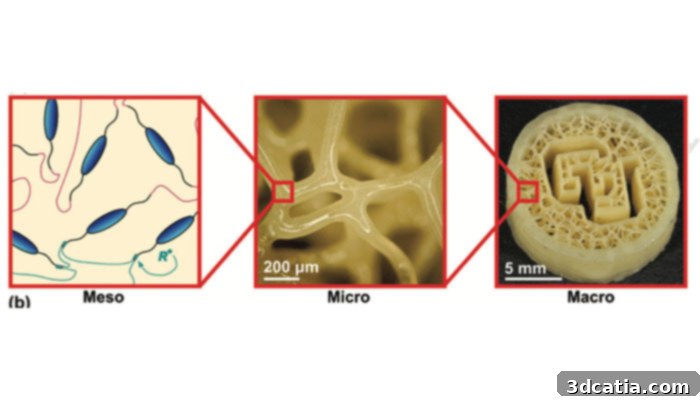
The hierarchical structure of 3D printed liquid crystal elastomers observed at different magnifications, designed to intricately mimic biological tissues like cartilage. | Image via CU Denver News
The Core Innovation: Advancing Biomedical Implants with 3D Printed Liquid Crystal Elastomers
The intricate details of this pioneering methodology were comprehensively presented in a study published in the esteemed scientific journal, *Advanced Materials*. The dedicated team of researchers meticulously elucidated their approach, which centers on the innovative utilization of liquid crystal elastomers (LCEs) to fabricate sophisticated structures capable of accurately imitating the nuanced properties of biological tissue. More precisely, their work involved leveraging the precision and versatility of Digital Light Processing (DLP) 3D printing technology. DLP operates on a principle fundamentally similar to Stereolithography (SLA), in that it employs a photopolymerization process to construct an object layer by layer. This is achieved by projecting ultraviolet (UV) light onto a photosensitive liquid resin, causing it to solidify selectively. The paramount advantage of DLP in this specialized context is its capacity for exceptionally high resolution and fine detail, which is absolutely crucial for manufacturing delicate and geometrically precise structures intended for direct implantation within the human body, where biocompatibility and structural integrity are non-negotiable. During the printing phase, the researchers specifically opted for a photocurable main-chain liquid crystal elastomer (LCE) resin, a material uniquely formulated to be compatible with the DLP printing process. Following a comprehensive suite of mechanical tests, this specialized LCE resin exhibited truly remarkable performance characteristics. The team reported that it demonstrated “12 times greater rate-dependence and up to 27 times greater strain-energy dissipation compared to those printed from a commercially available photocurable elastomer resin.” These impressive quantitative results highlight the LCE resin’s superior ability to respond dynamically to varying loads and to effectively absorb and dissipate mechanical energy, rendering it an outstanding candidate for biomimetic applications requiring resilience and flexibility.
The profound implications of these findings are self-evident: the developed LCE material exhibits exceptional shock-absorbing and energy-dissipating qualities. This makes it extraordinarily well-suited for applications in dynamic joints or as protective structures throughout the human body, such as articulating surfaces in knees and hips, intervertebral discs in the spine, or even advanced components within prosthetic limbs that demand inherent damping and resilience. As Chris Yakacki further elaborated, simplifying the underlying science for a broader audience, “Everyone’s heard of liquid crystals because you stare at them in your phone display. And you’ve likely heard of liquid crystal polymers because that’s exactly what Kevlar is. Our challenge was to get them into soft polymers, like elastomers, to use them as shock absorbers.” This insightful analogy effectively bridges the gap between everyday technology and cutting-edge materials science, emphasizing the ingenuity involved in successfully integrating the unique, ordered molecular structure of liquid crystals—typically found in rigid or semi-rigid materials—into a soft, flexible elastomer matrix. The resulting hybrid material combines the optimal characteristics of both worlds: the precise responsiveness and molecular order of liquid crystals with the remarkable elasticity and deformability of elastomers. This advanced degree of material complexity, made achievable through the precision of additive manufacturing, directly translates into a significant advantage for personalized medicine. It means that the resulting implantable structures can be fully customized and precisely adapted to an individual patient’s unique anatomical features, representing a monumental departure from conventional, ‘one-size-fits-all’ medical devices that frequently necessitate compromises in terms of fit and overall long-term function. Consequently, the final implantable product, expertly engineered to mimic the natural structure and biomechanical properties of native cartilage, holds the potential to integrate flawlessly and perform optimally within a person’s specific anatomical framework, vastly improving therapeutic outcomes.
Beyond their immediate mechanical benefits, the judicious selection of liquid crystal elastomers offers an exciting pathway towards creating truly smart and responsive biomaterials. LCEs constitute a unique class of responsive polymers that possess the inherent ability to undergo significant shape changes or alterations in their mechanical properties when exposed to various external stimuli, such as changes in temperature, specific wavelengths of light, or applied electric fields. While the current research has strategically prioritized their outstanding mechanical damping capabilities, the intrinsic responsive nature of LCEs opens a plethora of intriguing avenues for future developments in biomedical engineering. One could envision next-generation implants that subtly adapt their stiffness or elasticity based on fluctuations in body temperature, or even sophisticated devices that respond to externally applied magnetic fields to fine-tune their properties post-implantation for optimal performance. This unprecedented level of dynamic control and adaptability is virtually unattainable with traditional synthetic materials and represents a transformative leap towards truly biomimetic constructs that do more than merely replicate static form. The capacity to precisely engineer and fine-tune the material’s properties at a microscopic, molecular level, guided by the fundamental principles of liquid crystal ordering, enables an unparalleled command over the macroscopic behavior of the 3D printed object, making these materials exceptionally well-suited for the complex, dynamic, and ever-changing environment of biological systems within the human body.
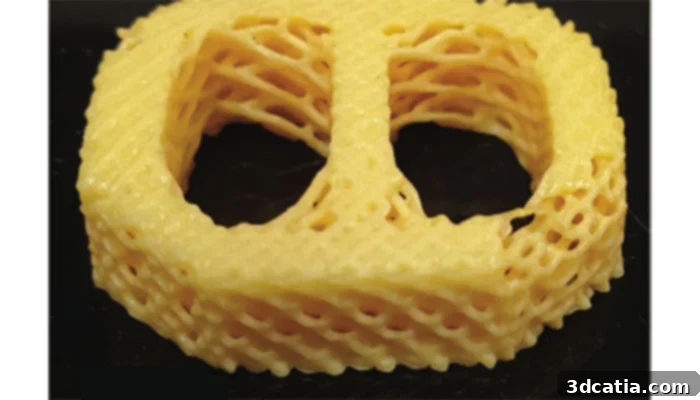
A detailed view of the intricate 3D printed liquid crystal elastomer structure, highlighting its potential for mimicking the complex architecture of natural biological tissues. | Image via CU Denver News
Future Outlook and Broader Implications for Regenerative Medicine
The significant advancements spearheaded by the University of Colorado Denver team carry immense promise for the broader landscape of regenerative medicine and tissue engineering. While the immediate and primary focus of this groundbreaking research is on the replacement of damaged cartilage and the repair of spinal disc components, the fundamental principles and methodologies established here could be readily extended to an expansive array of other soft tissue engineering applications. This includes, but is by no means limited to, sophisticated meniscus repair, robust ligament and tendon reconstruction, or even the development of advanced components for soft robotics specifically designed for intricate medical procedures and rehabilitation. The unparalleled ability to precisely control the internal architecture and tailor the mechanical response of a material through advanced 3D printing techniques, seamlessly combined with the distinctive and responsive properties of LCEs, creates an incredibly powerful and versatile platform for engineering biological substitutes that are not only functionally superior but also perfectly tailored to the unique physiological requirements of each individual patient. This research not only offers a highly viable and innovative solution to long-standing challenges in orthopedic and reconstructive surgery but also fundamentally pushes the boundaries of what is currently considered achievable in the realm of personalized healthcare. Future research endeavors will undoubtedly concentrate on rigorous long-term biocompatibility studies, comprehensive *in vivo* testing to assess performance within living organisms, and continuous optimization of the printing process to adapt it for various complex clinical scenarios. These crucial steps will ultimately propel these exciting lab-based breakthroughs closer to widespread and impactful clinical adoption. The potential to fully restore function, alleviate chronic pain, and significantly improve the quality of life for countless patients suffering from debilitating tissue damage is truly revolutionary, marking a new and promising chapter in the synergistic convergence of advanced materials science, cutting-edge additive manufacturing, and biomedical engineering.
For those keenly interested in delving further into the precise details and scientific intricacies of this groundbreaking study, more comprehensive information is readily available HERE. We warmly invite you to share your insightful thoughts and perspectives on the incredible potential that 3D printing technologies hold for the future of replacing and regenerating complex biological tissues, such as cartilage. Join the vibrant conversation by leaving your comments and opinions below, or connect with us and engage with our community on our active social media platforms, including Facebook and Twitter. To ensure you stay completely informed and receive all the very latest developments and breaking news from the dynamic world of 3D printing, we encourage you to sign up for our free weekly Newsletter, delivering cutting-edge insights directly to your inbox!