

Nanoscale 3D Printing Breakthrough: Engineering Super-Strong Metals with Designed Disorder
The world of 3D printing, or additive manufacturing, continually pushes the boundaries of what’s possible, from constructing vast architectural structures to fabricating intricate components at an microscopic level. However, understanding and controlling material behavior at the smallest scales—the nanoscale—is often the most critical factor distinguishing groundbreaking success from disappointing failure. This deep dive into the atomic and molecular arrangements of materials is precisely where researchers at the California Institute of Technology (Caltech) have made a monumental discovery. Their innovative work has unveiled a novel technique for 3D printing metals that exhibit unprecedented strength, far surpassing similarly sized parts created with traditional methods. What’s even more fascinating is that these incredibly durable components are often invisible to the naked eye, opening up a universe of possibilities for advanced engineering.
This pivotal research emerged from the esteemed laboratory of Julia R. Greer, a distinguished Professor of Materials Science, Mechanics, and Medical Engineering, who also directs the Kavli Nanoscience Institute at Caltech. Known for her pioneering work in the mechanics of architected materials and nanostructures, Professor Greer’s lab has consistently been at the forefront of exploring how materials behave when their dimensions shrink to the nanometer scale. Building upon a series of meticulous experiments conducted in 2022, Greer’s team initially developed a sophisticated fabrication process capable of printing micro-sized metal objects—structures barely thicker than a few sheets of paper. This year, their relentless pursuit of miniaturization and material understanding has seen them push these boundaries even further, successfully transitioning their 3D printing capabilities from the micro-scale directly into the far more challenging and intriguing nano-scale.
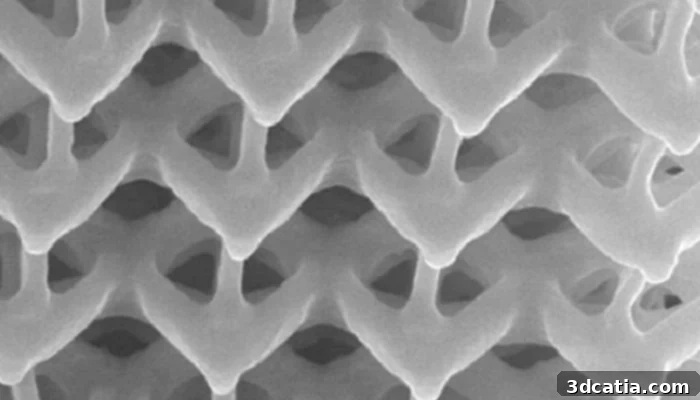
The nanoscale 3D printed lattice structure, demonstrating the intricate design at extreme miniaturization.
The progression from micro to nanoscale represents a significant leap, shrinking the 3D printed parts to dimensions a thousand times smaller than their previous experimental creations. This reduction in scale, however, yielded a profoundly unexpected and counter-intuitive result. The team observed that the smaller the printed object, the more atomic disorder was present within its material structure. In macroscopic or even micro-scale constructions, such atomic disorder—often manifested as voids, misalignments, or grain boundary irregularities—is typically considered a significant flaw, indicative of low-quality construction, and a precursor to material weakness, fatigue, and eventual breakage. Yet, at the nanoscale, this seemingly “disorderly” arrangement of atoms defied conventional materials science wisdom. Instead of weakening the material, this inherent atomic irregularity resulted in parts that were three to five times stronger than their counterparts with more ‘orderly’ arranged atomic structures. This discovery fundamentally challenges long-held principles in materials engineering and opens up new avenues for designing and fabricating ultra-strong, lightweight materials.
Creating Super-Stable Objects Through Engineered Nanoscale ‘Defects’
The groundbreaking process behind these super-strong nanoscale metals is as intricate as it is innovative. It begins with a specialized hydrogel, a polymer renowned for its exceptional ability to absorb vast quantities of water. This hydrogel acts as a temporary scaffold, which is then precisely shaped using a laser. The laser meticulously cures and hardens the photosensitive material into the desired complex three-dimensional geometries. Once the hydrogel structure is formed, the next critical step involves introducing metal ions, specifically nickel, through a liquid solution. The hydrogel’s porous nature allows it to absorb these metal ions effectively, integrating them into its structure. Subsequently, the material is exposed to heat, a crucial phase where the hydrogel scaffold is burned away, leaving behind a pristine, nano-structured metal object. The final, and arguably most ingenious, step involves a chemical stripping process designed to remove or convert any residual oxygen from within the nascent metal structure. This step intentionally introduces a series of irregularities—microscopic pores and atomic misalignments—into the metal lattice. Paradoxically, these very ‘defects,’ typically considered detrimental in materials science, are what contribute significantly to the object’s vastly superior strength and durability.
Professor Greer elaborates on this phenomenon, stating, “There are all these thermal and kinetic processes occurring simultaneously during this process, and they lead to a very, very messy microstructure. You see defects like pores and irregularities in the atomic structure, which are typically considered to be strength-deteriorating defects. If you were to build something out of steel, say, an engine block, you would not want to see this type of microstructure because it would significantly weaken the material.” Her insight highlights the revolutionary nature of their finding. While such imperfections would indeed compromise the integrity of larger structures, at the nanoscale, these irregularities, particularly the evenly distributed pores, function as a form of internal reinforcement. These nanoscale boundaries and defects allow the material to deform and distribute stress more effectively rather than succumbing to brittle fracture. This unique behavior at the atomic level gives the material remarkable support and resilience due to the uniform dispersion of these engineered ‘deformations’ throughout the entire object, preventing localized stress concentrations that lead to failure.
Wenxin Zhang, the lead research author and a mechanical engineering student, provides a deeper scientific explanation for this enhanced toughness: “Usually, the deformation carrier in metal nanopillars—that is, a dislocation or slip—propagates until it can escape at the outer surface. But in the presence of interior pores, the propagation will quickly terminate at the surface of a pore instead of continuing all the way through the entire pillar. As a rule of thumb, it’s harder to nucleate a deformation carrier than to let it propagate, explaining why the present pillars may be stronger than their counterparts.” In simpler terms, in a perfectly ordered material, cracks or deformations (dislocations) can travel unchecked, leading to catastrophic failure. However, with the strategically introduced pores, these dislocations encounter internal barriers. Each pore acts as a sink, absorbing the propagating stress and effectively preventing the crack from spreading throughout the entire structure. This increased difficulty in initiating new deformation and the interruption of existing ones are key to the extraordinary strength observed in these nanoscale 3D printed metals.
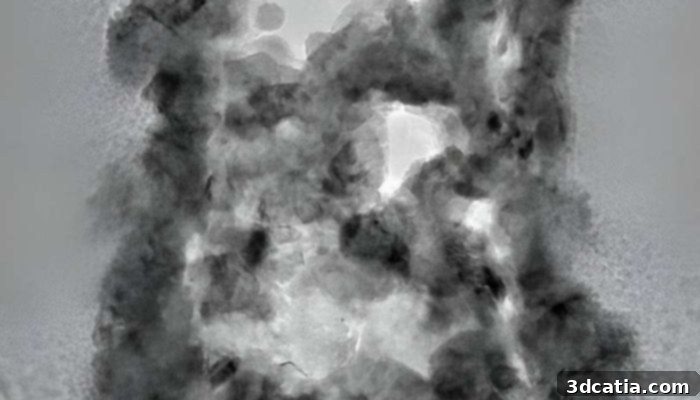
Evenly distributed, these nanoscale defects allow the 3D printed object to be less brittle and withstand significantly more stress and deformation.
This pioneering research from Caltech provides a captivating glimpse into the potential of designing and manufacturing materials at scales effectively imperceptible to the human eye. The ability to create super-strong metal components at the nanoscale—where traditional material properties often break down or behave unpredictably—has profound implications for numerous industries. Professor Greer and her dedicated team are optimistic that this breakthrough could lead to a wide array of applications where the increased durability and unique mechanical properties of 3D printed metals at the nanoscale can unlock entirely new avenues for scientific study, technological innovation, and product development. Imagine micro-robotics with unparalleled resilience, high-performance electronics with integrated, ultra-strong components, advanced medical implants that are both miniature and incredibly robust, or even aerospace components that achieve unprecedented strength-to-weight ratios. This work represents a significant step forward in our understanding of materials science and the future of nanoscale additive manufacturing. For those interested in delving deeper into the specifics of their research, further information can be found HERE on the Caltech news website.
What are your thoughts on Caltech’s revolutionary research into nanoscale 3D printed metal? How do you envision these super-strong, miniature components transforming various industries? Share your insights and predictions in a comment below or join the conversation on our LinkedIn, Facebook, and Twitter pages! Don’t forget to sign up for our free weekly Newsletter here to receive the latest 3D printing news directly to your inbox. You can also explore all our informative videos on our dedicated YouTube channel for more additive manufacturing content.
*All Photo Credits: Caltech