
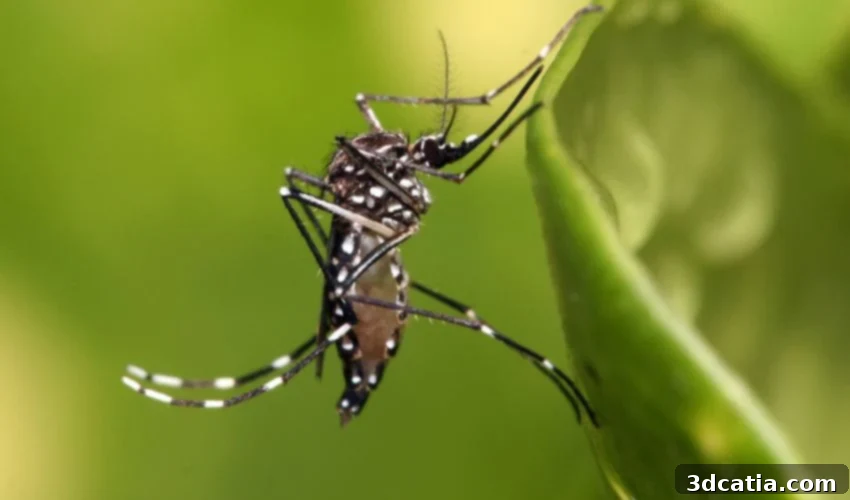
Revolutionizing Mosquito Control: 3D Printed Canisters Offer a Sustainable Weapon Against Deadly Diseases
The mosquito, an insect often dismissed as a mere nuisance, surprisingly holds the title of the deadliest animal on Earth. Annually, these tiny vectors are responsible for approximately 750,000 human deaths, primarily by transmitting a host of devastating diseases. This staggering statistic underscores the urgent global imperative to develop effective and sustainable mosquito control strategies. While traditional methods frequently involve toxic chemicals with environmental drawbacks, groundbreaking research now offers a promising alternative: a coolable, 3D printed canister designed for the mass sterilization of *Aedes aegypti* mosquitoes. This innovative approach promises to significantly curb their populations and mitigate the associated health risks, all while embracing a more eco-friendly methodology.
The *Aedes aegypti* mosquito, commonly referred to as the yellow fever mosquito, is a notorious carrier of severe arboviruses, including dengue, Zika, chikungunya, and yellow fever. Originating in Africa, this formidable insect has expanded its geographical reach to encompass tropical, subtropical, and even temperate regions across the globe, amplifying its capacity for widespread destruction. In the United States, for instance, the Centers for Disease Control and Prevention (CDC) reports that *Aedes aegypti* populations thrive and reproduce throughout much of the southern states, extending northward to New Jersey and westward to California. Similarly, in Europe, the European Centre for Disease Prevention and Control (ECDC) has issued alerts concerning the mosquito’s persistent northwards and westwards migration, a trend exacerbated by lengthening summers and an increase in warming and flood events linked to climate change.
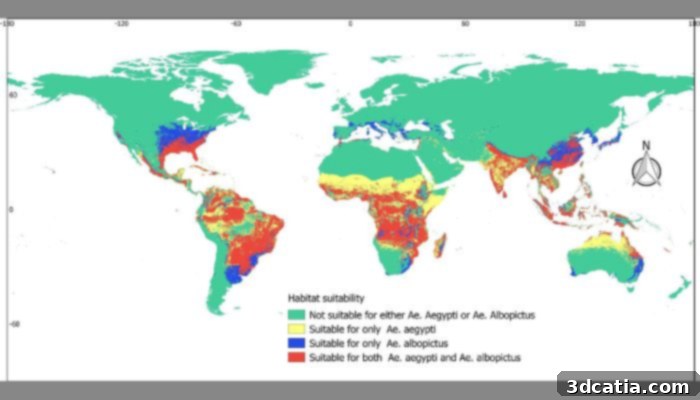
The expanding global range of the yellow fever mosquito (Image Credits: Samson Leta, Tariku Jibat Beyene, Eva M. De Clercq, Kebede Amenu, Moritz U.G. Kraemer, Crawford W. Revie, International Journal of Infectious Diseases)
The unchecked spread of *Aedes aegypti* and the difficult-to-treat diseases it transmits represent a grave public health challenge. Andrea Ammon, Director of the ECDC, recently highlighted the escalating threat: “In recent years, we have observed a geographical expansion of invasive mosquito species into previously unaffected areas within the EU/EEA. If this pattern continues, we can anticipate a rise in cases and potentially fatalities from diseases such as dengue, chikungunya, and Zika viruses, and under specific conditions, West Nile virus. Our collective efforts must therefore concentrate on effective mosquito population control, enhanced surveillance systems, and the enforcement of personal protective measures.” Her statement underscores the critical need for innovative, scalable, and environmentally sound solutions to manage mosquito populations.
Addressing these critical concerns is precisely the focus of a groundbreaking study conducted by the Insect Pest Control Laboratory, a joint initiative of the FAO/IAEA Centre of Nuclear Techniques in Food and Agriculture, located in Vienna, Austria. Their research introduces a pioneering approach centered around a specially designed coolable 3D printed canister. This innovative device facilitates the compact immobilization and containment of approximately 100,000 adult mosquitoes for subsequent mass radiation sterilization. This technique, known as the Sterile Insect Technique (SIT), has emerged as a safe, highly effective, and environmentally friendly method for suppressing and ultimately eradicating problematic insect pest populations, including the rapidly spreading *Aedes aegypti* mosquito, without relying on harmful pesticides.
The Sterile Insect Technique (SIT) is a form of pest control that involves rearing large numbers of sterile insects, typically males, which are then released into the pest population. These sterile males mate with wild females, but no offspring are produced, thereby reducing the population over time. SIT is highly species-specific, targeting only the nuisance insect without harming beneficial insects or the wider ecosystem. It has been successfully used for decades to manage various agricultural pests and disease vectors, offering a sustainable alternative to chemical insecticides. The key to SIT’s success lies in the ability to mass-produce, sterilize, and release target insects efficiently and cost-effectively, which is where the new 3D printed canister plays a transformative role for mosquito control programs.
Designing and Producing the Innovative 3D Printed Canister
The ingenuity of this solution lies in the sophisticated design and production of the 3D printed canister itself. This circular device is ingeniously composed of two overlapping compartments housed within an external cold ring. This unique configuration ensures sustained chilling throughout the canister, a critical feature for the sterilization process. Adult *Aedes aegypti* males are introduced into the canister, where they are effectively immobilized by the cold temperatures, preventing their escape. Once immobilized, the mosquitoes are subjected to precise irradiation treatments. The presence of the cold ring during irradiation is crucial, as it significantly boosts the survival rate of the mosquitoes, ensuring a sufficient number remain viable for release. Experimental results have definitively shown that this irradiation process substantially reduces mosquito fertility. The combination of cold immobilization and targeted irradiation within this coolable canister represents a major leap forward, simplifying and enhancing the efficiency of mass irradiation procedures essential for effective sterile insect technique (SIT) programs.
In terms of its physical realization, the canister was produced using Fused Deposition Modeling (FDM) 3D printing technology, specifically with PLA (Polylactic Acid) filament on an UltiMaker S3 3D printer. The design carefully incorporates two stacked compartments, along with four distinct sections engineered to be precisely inserted into an external plastic ring. This outer ring is then filled with cold-conditioned phase change material packs, which are responsible for maintaining the optimal chilling temperatures within the canister. The decision to leverage 3D printing for this project was driven by several compelling advantages, most notably cost-effectiveness. Additive manufacturing drastically reduced both prototyping and production expenses compared to traditional manufacturing methods. Furthermore, the global proliferation of 3D printers in recent years has made this technology far more accessible worldwide. This accessibility is a key factor that will enable the widespread implementation and expansion of this project, particularly in developing countries where mosquito-borne diseases pose the most severe public health threats, making local production feasible and economically viable.
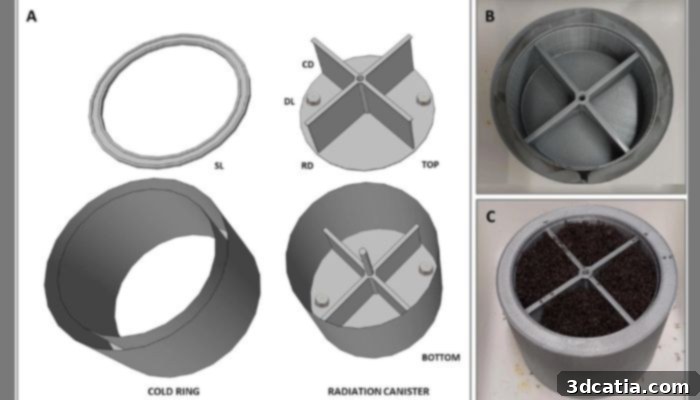
The innovative coolable 3D printed canister for sterile insect technique (photo credits: Balestrino, F., Bimbilé Somda, N.S., Samuel, M. et al)
While the initial findings are exceptionally promising, researchers acknowledge that further investigation and validation are essential to fully optimize and scale this technology. Nevertheless, the prospects are bright. The research team envisions this 3D printed canister becoming an indispensable tool for the efficient management of mosquito production, sterilization, and subsequent release operations within SIT programs. Ultimately, this innovation holds immense potential to significantly contribute to global efforts aimed at preventing the spread of debilitating and often fatal diseases such as yellow fever, dengue, and Zika. By offering a sustainable, non-toxic, and economically viable method of mosquito control, this technology could safeguard countless lives and improve public health outcomes across vulnerable populations worldwide. For those interested in delving deeper into the technical specifics and full methodology, the comprehensive study is openly accessible on Nature HERE.
What are your thoughts on this revolutionary coolable 3D printed canister? Do you believe it will be an effective solution in significantly reducing mosquito populations and the diseases they carry? We invite you to share your insights in a comment below or join the discussion on our LinkedIn, Facebook, and Twitter pages! Don’t miss out on the latest advancements in additive manufacturing—sign up for our free weekly newsletter here, delivering the freshest 3D printing news directly to your inbox! You can also explore all our compelling videos on our YouTube channel.
*Cover Photo Credits: Muhammad Mahdi Karim, GFDL 1.2