
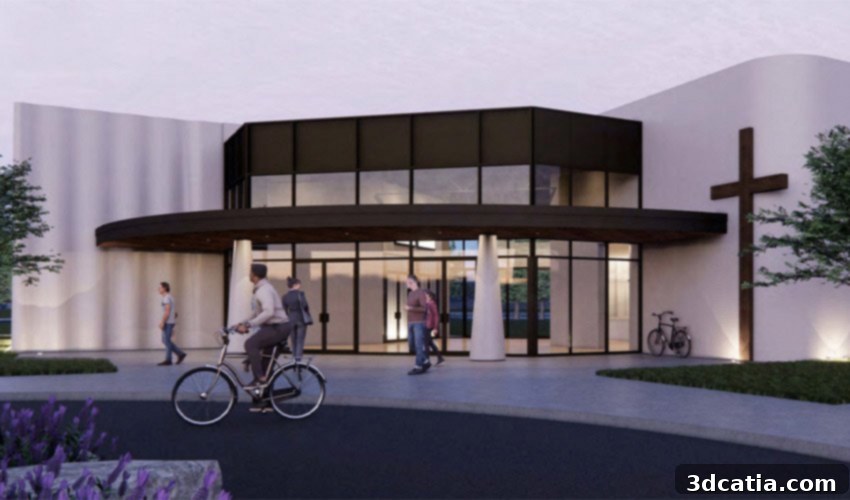
Pioneering Sacred Architecture: The First 3D Printed Church in California
The landscape of architecture and construction is rapidly evolving, with additive manufacturing, commonly known as 3D printing, at its forefront. While we have grown accustomed to witnessing the emergence of 3D printed houses, innovative bridges, and even ephemeral pop-up stores, a significant milestone has remained elusive: the design and construction of a religious building using this transformative technology. That is, until now. Breaking new ground, the Lake California Community Church has commissioned what is set to become the world’s first 3D printed church. This ambitious project, taking root in California, heralds a new era for both religious architecture and the broader construction industry, demonstrating the vast potential of additive manufacturing.
This landmark initiative is the result of a strategic partnership between the Lake California Community Church, the seasoned American general contractor Don Ajamian Construction, and the innovative 3D printing specialist, Emergent 3D. This collaboration marks a significant departure from traditional building methods, promising to redefine how sacred spaces can be conceived and brought to life. The decision to embrace 3D printing was driven by compelling advantages that traditional construction simply could not match, addressing long-standing challenges faced by the community.
Jim Laxson, the pastor of Lake California Community Church, eloquently articulated the driving force behind this pioneering move, stating, “We’ve been trying to build a church for 20 years now and now, with 3D printing, we’re going to be able to build it more economically.” This sentiment highlights a critical factor in the adoption of 3D printing for construction: economic viability. For many communities, the financial burden of constructing a new place of worship using conventional techniques can be prohibitive, often leading to decades-long delays. Additive manufacturing offers a pathway to significantly reduce these costs, making previously unattainable projects a reality.
Don Ajamian, from Don Ajamian Construction, strongly concurs with the economic benefits, but also emphasizes that the advantages of additive manufacturing extend far beyond mere cost reduction. He pointed to a remarkable architectural feature enabled by the technology: “the 3D printed interior walls were designed to provide perfect acoustics by directing sound waves directly to the audience.” This innovative approach ensures optimal sound propagation throughout the sanctuary. Ajamian further elaborated on this acoustical triumph, suggesting that the pastor may not even require a microphone to address the entire congregation effectively. This intrinsic design capability, allowing for intricate, performance-optimized geometries that would be complex and costly to achieve with traditional methods, profoundly enhances the worship experience, ensuring every word and note resonates clearly with attendees, even those in the farthest pews.
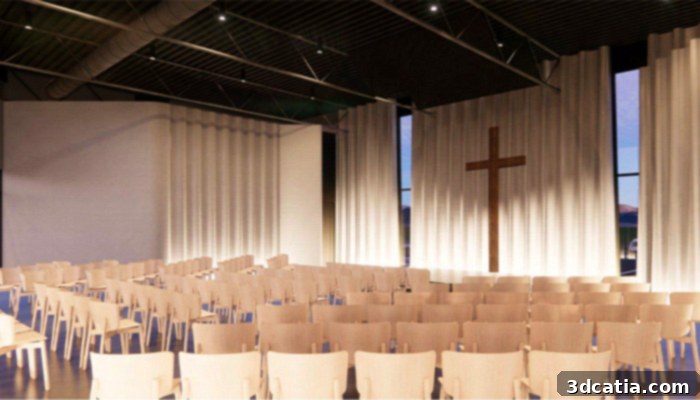
The meticulously designed interior of the 3D printed church, optimized for superior acoustics (photo credits: Don Ajamian Construction)
Unlocking the Potential: Why 3D Printing for Church Construction?
The decision by Lake California Community Church to engage Emergent 3D for their new sanctuary was predominantly driven by the promise of minimized construction costs. This strategic choice has certainly proven its worth, with project teams reporting an impressive approximately 10% reduction in overall costs. This significant saving is primarily attributed to optimized material usage and streamlined labor requirements inherent to the 3D printing process. To bring this vision to life, both Don Ajamian Construction and Emergent 3D selected COBOD’s advanced 3D printing solutions. COBOD, a global leader in construction 3D printing technology, is renowned for its robust and scalable systems, frequently deployed in large-format construction projects worldwide, making it an ideal choice for a structure of this scale and significance.
Beyond the immediate financial benefits, additive manufacturing offers substantial time savings, enabling the Lake California Community Church to realize its two-decade-long dream much faster than would be possible with conventional building methods. This accelerated timeline is a game-changer, reducing project durations from months or even years to mere weeks for the printing phase. Don Ajamian elaborated on this efficiency: “So I do not need to, for example, bring a bunch of stucco guys to put stuff on the outside or put siding on it. I don’t need to bring a bunch of drywall people in to drywall the inside wall. Literally, when these things get printed, that wall is finished other than the paint.” This insight underscores one of the most transformative aspects of construction 3D printing: the ability to consolidate multiple traditional construction steps into a single, automated process. The printer lays down the wall, which is structurally sound and aesthetically complete, largely eliminating the need for extensive plastering, siding, or drywall installation. This not only saves time but also significantly reduces labor costs and the complexity of coordinating multiple specialized trades.
Advancing Construction: The Technological Edge of 3D Printing
The construction of the Lake California Community Church leverages state-of-the-art 3D printing technology, specifically COBOD’s robust systems. These industrial-scale printers utilize a gantry system, precisely extruding a proprietary, concrete-based material layer by layer to form the building’s walls. This methodical process allows for intricate designs and seamless integration of structural elements. The material itself is engineered for rapid curing and exceptional durability, ensuring the church will be a resilient and long-lasting structure. The digital design workflow, from architectural blueprints to the printer’s execution, ensures unparalleled precision and minimal waste, further contributing to the project’s efficiency and sustainability.
The ability of 3D printing to create complex geometries not only enhances acoustics but also opens up new possibilities for architectural expression. Architects are no longer limited by the constraints of traditional molds or labor-intensive hand-building techniques. This freedom enables the creation of organic shapes, intricate patterns, and optimized structural forms that can improve both the aesthetic appeal and functional performance of a building. For a religious structure, this means the potential to design spaces that are not only structurally sound but also deeply symbolic and inspiring, tailored precisely to the spiritual needs of the community.
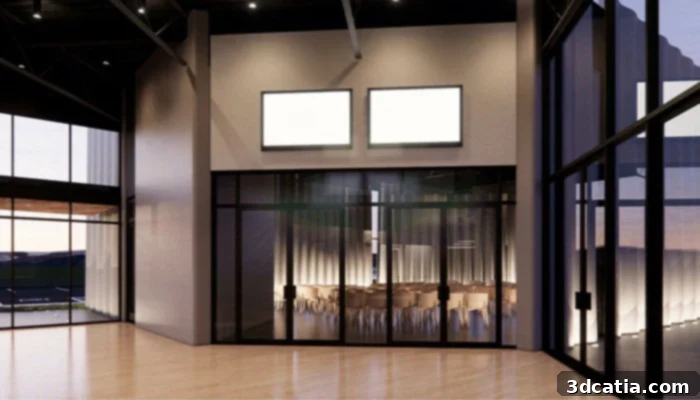
The future site of the pioneering 3D printed church, ready for additive manufacturing to commence (Photo Credits: Don Ajamian Construction)
Sustainability and the Future of Sacred Spaces
Beyond economic and time efficiencies, this project also underscores the inherent sustainability advantages of construction 3D printing. The process dramatically reduces material waste, as concrete is extruded only where needed, unlike traditional methods that often involve significant offcuts and discarded materials. Furthermore, the potential for using locally sourced or recycled aggregates in the printing mixture further lowers the environmental footprint. The expedited construction process also leads to reduced energy consumption on the job site and minimizes disruption to the surrounding environment. This commitment to sustainable building practices aligns with a growing global imperative for eco-friendly construction solutions, positioning the Lake California Community Church not just as an architectural marvel but also as a model for responsible development.
This pioneering 3D printed church serves as a powerful case study for the wider adoption of additive manufacturing in the construction sector. It demonstrates that the technology is mature enough for complex, public-facing projects, capable of delivering high-quality, durable, and aesthetically pleasing structures. The success of this endeavor is likely to inspire other religious organizations, educational institutions, and public bodies to explore 3D printing for their future infrastructure needs. It paves the way for a future where custom-designed, rapidly deployable, and cost-effective buildings become the norm, particularly benefiting communities in remote areas, disaster zones, or those facing rapid population growth.
As of the initial announcement, the project was progressing steadily. Following the completion of essential site grading, the actual 3D printing of the church structure was anticipated to commence in the summer of 2022. This phase marks the tangible realization of years of planning and innovative collaboration between the Lake California Community Church, Don Ajamian Construction, and Emergent 3D. The journey from conceptual design to a fully functional sacred space is a testament to the dedication and forward-thinking vision of all parties involved, charting an exciting new course for architectural innovation.
What are your thoughts on this groundbreaking use of 3D printing for constructing religious buildings? How do you envision the future of architecture with additive manufacturing? We invite you to share your perspectives and comments below, or engage with us on our Linkedin, Facebook, and Twitter pages! Don’t miss out on the latest advancements in 3D printing technology – sign up for our free weekly Newsletter here to get breaking news delivered straight to your inbox! You can also explore all our insightful videos on our dedicated YouTube channel.
*Cover Photo Credits: Don Ajamian Construction