
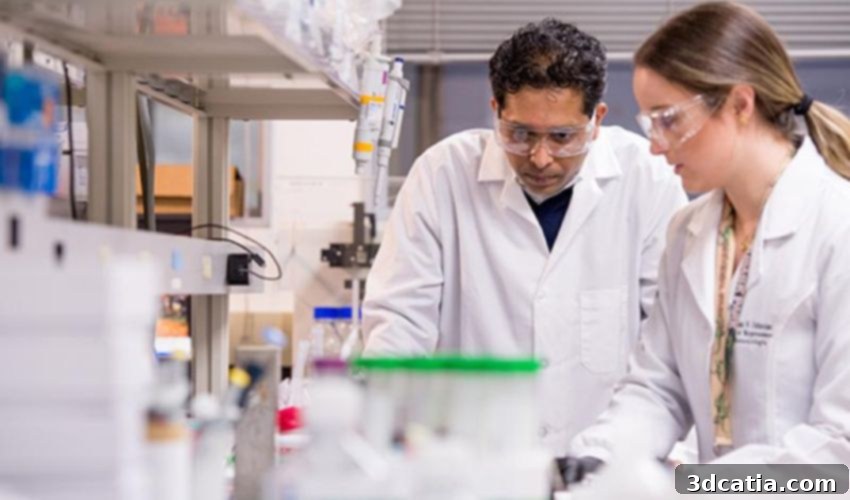
Pioneering Advances: 3D Bioprinting Creates Hair Follicles in Lab-Grown Human Skin for Regenerative Medicine and Drug Testing
Hair, an often-overlooked yet incredibly complex biological structure, presents a curious paradox in human perception. While its presence is highly coveted on the scalp, where it often thins with age, it is simultaneously deemed superfluous and aesthetically undesirable on many other parts of the body, leading to constant efforts to remove it. Yet, beyond mere aesthetics, nature’s design is remarkably intricate; the fine hairs and their associated follicles across our skin play a far more critical role than commonly acknowledged. These microscopic structures are not just anchors for hair strands; they are dynamic mini-organs crucial for overall skin health and bodily functions. For instance, hair follicles are integral to producing sweat, which is vital for thermoregulation – the body’s ability to maintain a stable internal temperature. They also harbor precious stem cells, which are fundamental to the skin’s remarkable capacity for healing and regeneration after injury. Moreover, in dermatological research and medical applications, hair follicles on the skin surface serve as crucial pathways for the absorption of various medicines and cosmetics, making their presence indispensable in comprehensive dermatological tests and efficacy studies.
For decades, the scientific community has strived to develop advanced reconstructed skin models for these critical medical tests. These models are designed to mimic human skin in a laboratory setting, allowing for controlled experiments without resorting to animal testing. However, despite significant advancements, these conventional skin models have consistently faced limitations in terms of their biological complexity and structural completeness. A glaring gap has always been the inability to fully develop and integrate functional hair follicle units within these artificial skin constructs. This omission significantly limits their utility, as a model without hair follicles cannot accurately replicate the skin’s full range of physiological responses or its interaction with topical substances. The advent and steady evolution of 3D bioprinting technologies, however, represent a monumental leap forward. This innovative approach holds the promise of bridging this long-standing gap, enabling the creation of biologically and physiologically representative skin models that are far more akin to natural human skin. Such sophisticated models would be incomparably better suited for rigorous efficacy studies, drug development, and cosmetic testing than any currently available alternatives. It is precisely at this intersection of unmet need and technological innovation that a groundbreaking study by researchers at the Rensselaer Polytechnic Institute (RPI) makes its profound contribution.
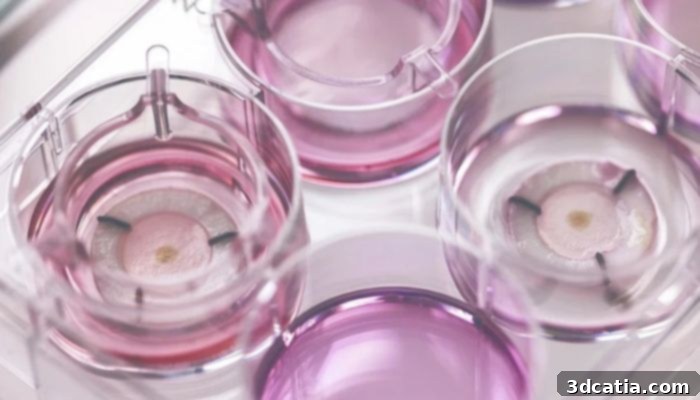
Until now, skin models from the laboratory have been incomplete and lack hair follicles (photo credits: Chanel)
Revolutionizing Tissue Engineering: The RPI Breakthrough in 3D Bioprinted Skin
Under the visionary leadership of Dr. Pankaj Karande, an esteemed Associate Professor of Chemical and Bioengineering at RPI, a team of dedicated scientists has achieved an unprecedented feat: the successful incorporation of hair follicles into lab-grown human skin tissue using advanced 3D printing techniques for the very first time. This pioneering achievement marks a significant milestone in regenerative medicine and tissue engineering, offering a tantalizing glimpse into a future where 3D bioprinting could fundamentally transform drug testing protocols and even facilitate more effective skin transplants. Dr. Karande’s work is not merely an incremental step; it represents a paradigm shift, showcasing the immense potential of integrating engineering principles with life sciences to address critical human health challenges. As Shekhar Garde, Ph.D., dean of the Rensselaer School of Engineering, aptly remarked, “Dr. Karande’s work is a great example of advances being made by RPI researchers at the interface of engineering and life sciences with impact on human health.” He further emphasized the transformative nature of this research, stating, “Bringing multichannel 3D printing to the biological realm is opening exciting opportunities that would have been hard to imagine in the past.” This sentiment underscores the profound implications of this technology, which promises to unlock previously unimaginable possibilities in biomedical research and clinical applications.
The Innovative Methodology: Crafting Hair Follicles in 3D Bioprinted Tissue
The seminal findings of this study were published in October 2023 in the prestigious journal Science Advances under the compelling title “Incorporation of hair follicles in 3D bioprinted models of human skin.” What distinguishes this research from earlier attempts in tissue engineering is its unique ability to successfully integrate functional hair follicles within engineered skin models, a feat previously unattained. Furthermore, the innovative printing technology employed by the RPI team played a pivotal role in this breakthrough. Dr. Karande elucidated the core principle behind their approach, explaining, “The reconstruction of hair follicles using human-derived cells has historically been a challenge. Some studies have shown that if these cells are cultured in a three-dimensional environment, they can potentially originate new hair follicles or hair shafts, and our study builds on this work.” This foundational understanding guided their methodology, leading to a sophisticated process for fabricating these complex structures.
For their ingenious approach, the researchers meticulously cultivated both skin and follicle cells in the laboratory. This initial step of cell expansion was critical to ensure an adequate supply of viable, printable cells for the subsequent bioprinting process. Once sufficient quantities were obtained, these laboratory-grown cells were then carefully processed into a specialized bio-ink. This involved mixing each distinct cell type with a precise combination of proteins and other biocompatible materials. The resulting bio-ink needed to possess specific rheological properties—fluidity, viscosity, and printability—to be effectively extruded by the 3D printer. This custom-formulated bio-ink was then applied to a wafer-thin needle, a component of a sophisticated multichannel 3D bioprinter. This advanced printing system allowed the researchers to precisely deposit layers of skin cells, simultaneously creating intricate channels designed specifically for the controlled deposition of hair cells. This simultaneous, multi-material printing enabled the direct embedding of hair cells within the developing skin construct, forming the foundation of future follicular structures.
Over a carefully monitored period, these precisely engineered channels surrounding the initial hair cell depositions gradually filled with adjacent skin cells. This organic process elegantly mimicked the natural follicular structure found in human skin, where various cell types work in concert to form a functional hair follicle. This intricate interplay of cells within the 3D bioprinted construct is central to the study’s success. Dr. Pankaj Karande further elaborated on the significance of this achievement, stating, “Our work is a proof-of-concept that hair follicle structures can be created in a highly precise, reproducible way using 3D-bioprinting. This kind of automated process is needed to make future biomanufacturing of skin possible.” This emphasis on precision, reproducibility, and automation highlights the study’s potential to scale up this innovative technique for broader applications in biomedical manufacturing and therapeutic development.
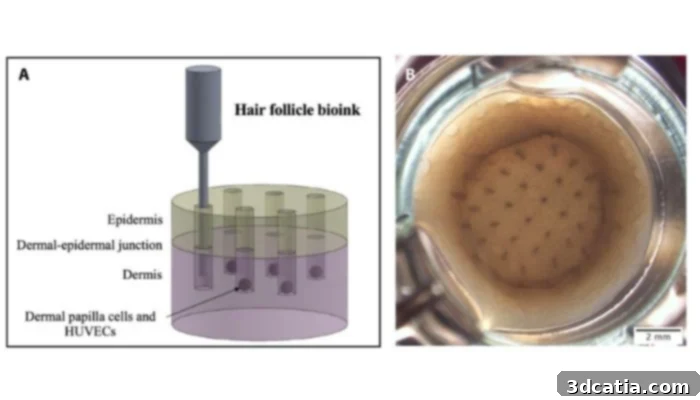
3D bioprinting of hair follicles in the skin. (A) Schematic representation of the printing of hair follicle structures within the reconstructed skin models. (B) Live image of a cultured skin model on day 2 (photo credits: Science Advanced)
The Path Forward: 3D Bioprinting for Future Transplants and Advanced Testing
While this research represents an extraordinary leap forward, the current iteration of the 3D-printed skin tissue, complete with its integrated hair follicles, has a limited lifespan of approximately two to three weeks. This short duration, while sufficient for initial proof-of-concept, is not yet long enough to allow for the full development and maturation of hair shafts, which typically takes a more extended period. Consequently, the technology is not yet at a stage where it can produce fully functional skin grafts capable of growing hair, a critical requirement for certain regenerative medicine applications. Nevertheless, the groundbreaking results of this study unequivocally demonstrate significant progress in this ambitious direction. The RPI researchers are acutely aware of these limitations and are actively focusing their future efforts on extending the lifespan and viability of the engineered skin tissue. The goal is to create conditions that allow the hair follicles to continue maturing, ultimately enabling their use in more comprehensive drug tests, advanced cosmetic product evaluations, and potentially, viable skin transplants for patients in need.
The implications of this advancement are profound for both the pharmaceutical and cosmetic industries. Carolina Catarino, Ph.D., the first author of the study, highlighted this potential, commenting, “Right now, contemporary skin models — the engineered structures that mimic human skin — are quite simple. Increasing their complexity by adding hair follicles would give us even more information about how skin interacts with topical products.” Indeed, the ability to create more complex and biologically relevant skin models, complete with intricate structures like hair follicles, would provide an unprecedented platform for testing the efficacy and safety of new drugs and cosmetic formulations. This would lead to more accurate predictions of human responses, potentially reducing the need for animal testing and accelerating the development of innovative treatments. Furthermore, in the realm of regenerative medicine, this technology could revolutionize the treatment of severe burns, alopecia, and various skin conditions by providing personalized, functional skin grafts that better integrate with the patient’s body and even restore natural hair growth.
What is unequivocally clear is that this pioneering proof-of-concept work has dramatically bolstered the applicability and potential of 3D bioprinting across numerous scientific and medical domains. The integration of 3D bioprinting into tissue engineering is contributing significantly to a deeper and more nuanced understanding of not only skin development but also the formation and function of crucial auxiliary structures such as blood vessels, sweat glands, and sebaceous glands. Dr. Deepak Vashishth, Ph.D., Director of the Shirley Ann Jackson, Ph.D. Center for Biotechnology and Interdisciplinary Studies, eloquently summarized the broader impact of Dr. Karande’s laboratory, stating, “Dr. Karande’s lab is at the forefront of skin tissue engineering. This team has already successfully printed skin with working blood vessels, and this latest research is an exciting next step in developing and testing better treatments for burns and other skin conditions.” This continuous innovation solidifies RPI’s position as a leader in advanced biomedical research. For those interested in delving deeper into the specifics of this groundbreaking study, the full publication can be accessed HERE.
Conclusion: The Transformative Potential of 3D Bioprinting in Dermatology
The development of 3D bioprinted skin complete with integrated hair follicles represents a monumental leap in tissue engineering and regenerative medicine. This innovative research not only addresses a critical limitation in existing lab-grown skin models but also opens up unprecedented avenues for advanced drug discovery, personalized medicine, and more accurate cosmetic testing. While challenges such as extending tissue viability remain, the progress achieved by Dr. Karande’s team at RPI underscores the immense transformative potential of 3D bioprinting in understanding and treating a wide array of skin conditions. This technology promises a future where complex biological structures can be precisely engineered, leading to better treatments, reduced reliance on animal testing, and ultimately, improved human health outcomes.
What are your thoughts on 3D printed hair follicles in lab-grown skin and its potential impact? We invite you to share your insights and comments below or engage with us on our LinkedIn, Facebook, and Twitter pages! Don’t forget to sign up for our free weekly Newsletter here to receive the latest 3D printing news straight to your inbox! You can also find all our compelling videos on our YouTube channel for further exploration of this exciting field.
*Cover Photo Credits: Pankaj Karande, left, and Carolina Catarino, right (RPI)