
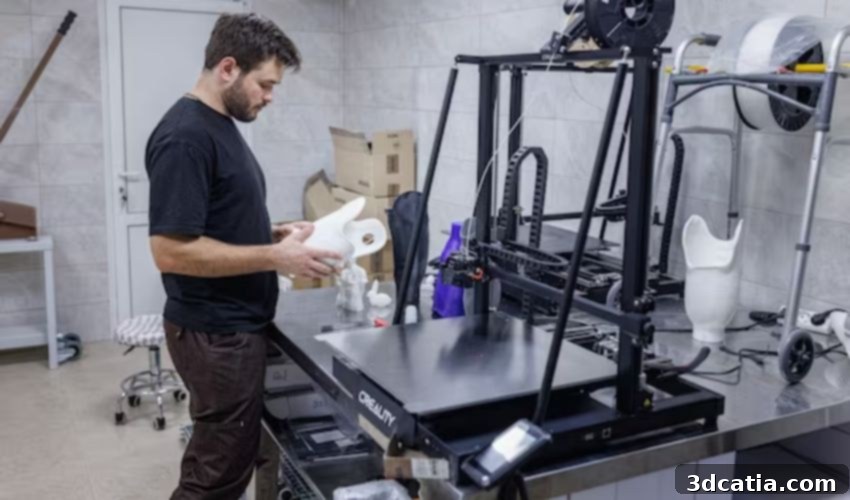
3D Printing Powers Hope: Canadian Aid Delivers Rapid Prosthetics to Ukraine’s War Victims
The relentless conflict in Ukraine has created an unprecedented humanitarian crisis, turning vast swathes of the countryside into deadly landscapes. Approximately 174,000 sq km (67,182 sq mi) remain heavily contaminated with hidden landmines and unexploded ordnance, posing an ongoing, severe threat. These insidious remnants of war indiscriminately cause death and life-altering injuries, affecting not only soldiers on the front lines but also innocent civilians – including children – who inadvertently wander into these perilously dangerous zones. In this grim reality, the search for hope and practical solutions becomes paramount. Additive manufacturing, or 3D printing, has emerged as a versatile and vital tool in Ukraine’s struggle, aiding in diverse capacities from essential vehicle repairs and the production of defensive weapons to significant civilian aid projects, and critically, assisting the wounded. The escalating numbers of war-related injuries, particularly limb losses, have underscored an urgent need for advanced prosthetic solutions, an area where 3D printing offers groundbreaking potential.
The tragic consequence of widespread limb loss has led to a skyrocketing demand for prosthetic arms and legs, essential for individuals striving to regain their independence and mobility after suffering catastrophic injuries. Recognizing this critical need, international support has poured into Ukraine, often leveraging the transformative capabilities of 3D printing technology. Earlier this year, we highlighted the commendable efforts of the Canadian nonprofit organization, the Victoria Hand Project, and their inspiring “Hands for Ukraine” initiative. This project was dedicated to fundraising and establishing infrastructure for the local 3D printing of prosthetics within Ukraine, making a tangible difference in the lives of many amputees. Building on this momentum, another prominent Canadian organization has now stepped forward, significantly boosting these efforts by donating a state-of-the-art suite of 3D printers to the Ukrainian aid organization, Unbroken. This pivotal contribution aims to dramatically enhance the capacity for 3D printing life-changing prosthetics for both injured adults and children across Ukraine, symbolizing a continued commitment to humanitarian aid and technological innovation in the face of adversity.
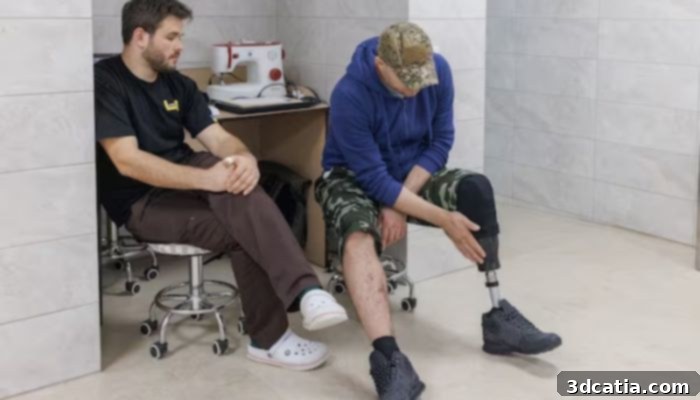
Kostiantyn Nykypanchuk (left) and Serhii Yevtushenko (right) test out the first of the 3D printed prostheses made by the donated 3D printers.
Unbroken stands as a critical pillar of support and hope within Ukraine, a dedicated organization committed to facilitating the recovery and reintegration of those severely wounded by the ongoing conflict. Its comprehensive approach extends far beyond simply providing prosthetics, encompassing vital surgeries, intensive physical rehabilitation training, and extensive psychological support to help individuals navigate their profound injuries. The scale of the humanitarian crisis is staggering: Unbroken has reported that since Russia’s full-scale invasion began in 2022, over five thousand adults and children have tragically lost limbs. This devastating statistic underscores the immense pressure on medical and humanitarian services. The latest and highly impactful donation of 3D printers comes from the Canadian Temerty Foundation, established by Jim Temerty, a distinguished Ukrainian-Canadian entrepreneur and philanthropist. His commitment reflects a deep personal connection and a profound dedication to supporting his ancestral homeland during its darkest hour, providing crucial resources that promise to revolutionize prosthetic care for countless Ukrainians.
Upon their arrival in Ukraine, the advanced 3D printers donated by the Temerty Foundation are being swiftly set up and meticulously operated by a team of highly skilled local technicians at Unbroken’s facilities. This strategic placement of on-site 3D printing capabilities represents a paradigm shift in the manufacturing process for prosthetics. Traditionally, the production of custom prostheses could take several days, sometimes even weeks, due to complex manufacturing workflows and supply chain challenges. However, with the integration of these cutting-edge 3D printers, Unbroken’s team can now dramatically slash manufacturing times, bringing them down from an average of three days to an astonishingly efficient eight hours. This rapid turnaround is crucial for patients, enabling quicker fittings, adjustments, and ultimately, faster access to essential mobility aids. Kostiantyn Nykypanchuk, one of the dedicated 3D printer operators, expressed immense satisfaction with the initial results, stating, “We did a lot of tests and are happy with the results.” Echoing this sentiment and looking towards the future, Dr. Peter Derkach, a Canadian-Ukrainian physician who played an instrumental role in the installation and comprehensive training, emphasized the long-term vision: “We are just beginning, really. We want to build on their capabilities as the war will require a great increase in prostheses production.” This forward-thinking approach highlights the necessity of scaling production to meet the ever-growing demand for prosthetics as the conflict regrettably continues.
The impact of these rapid, 3D printed prosthetics quickly manifested in inspiring displays of human spirit and resilience. After the successful production of the first few prostheses, several grateful recipients, including veterans and civilians, participated in a deeply symbolic charity race through the bustling streets of Kyiv. This event transcended a mere athletic competition; it was a powerful affirmation of hope and national pride, met with resounding cheers from an outpouring of supportive crowds. Affectionately dubbed the “world’s longest marathon,” the event’s name served as a poignant, stark reminder of the prolonged duration since Russia’s initial invasion of Ukraine in 2014, underscoring the enduring struggle. Serhii Yevtushenko, a brave veteran who participated, shared his profound satisfaction with his new prosthetic, stating, “I had no problem with my new Canadian leg.” His sentiment resonated deeply with many veterans, articulating a powerful desire to return to active duty, to continue serving and defending their cherished homeland. Such stories are not just about physical recovery; they represent a holistic return to purpose, dignity, and active participation in their nation’s defense and recovery. For those wishing to delve deeper into Serhii’s journey and the broader initiative, additional details can be found HERE.
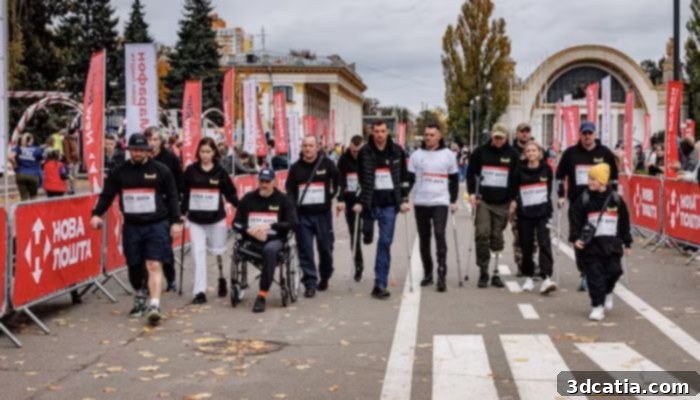
The World’s Longest Marathon event in Kyiv, where many veterans and civilians walked and ran on new 3D printed prosthetics.
The deployment of 3D printing technology for prosthetic limbs in Ukraine represents more than just a medical intervention; it signifies a profound shift towards localized, rapid, and customized humanitarian aid. This innovative approach allows for prosthetics to be tailored precisely to each individual’s needs, vastly improving fit, comfort, and functionality, which are crucial for effective rehabilitation and long-term well-being. Beyond the immediate provision of limbs, this initiative fosters self-sufficiency and builds local expertise in advanced manufacturing within Ukraine. As operators like Kostiantyn Nykypanchuk gain invaluable experience, the country’s capacity for medical innovation grows, potentially extending to other vital medical devices and even future reconstruction efforts. The collaboration between international philanthropists like Jim Temerty and dedicated local organizations like Unbroken exemplifies the global solidarity with Ukraine, transforming cutting-edge technology into tangible hope and restoring agency to those who have sacrificed so much. The adaptability and efficiency of 3D printing stand as a testament to its power in addressing urgent humanitarian needs, setting a precedent for future disaster relief and conflict zone support.
The extraordinary potential of 3D printing to provide prosthetic limbs for individuals affected by the war in Ukraine offers a beacon of hope and a pathway to renewed independence. What are your thoughts on how this innovative technology is transforming lives amidst conflict? We invite you to share your perspectives in a comment below or join the conversation on ourLinkedIn,Facebook, andTwitter pages! For the latest advancements in 3D printing news delivered straight to your inbox, don’t forget to sign up for our free weeklyNewsletter here. You can also explore all our insightful videos on ourYouTube channel.
*All photo credits: ANTON SKYBA/THE GLOBE AND MAIL