
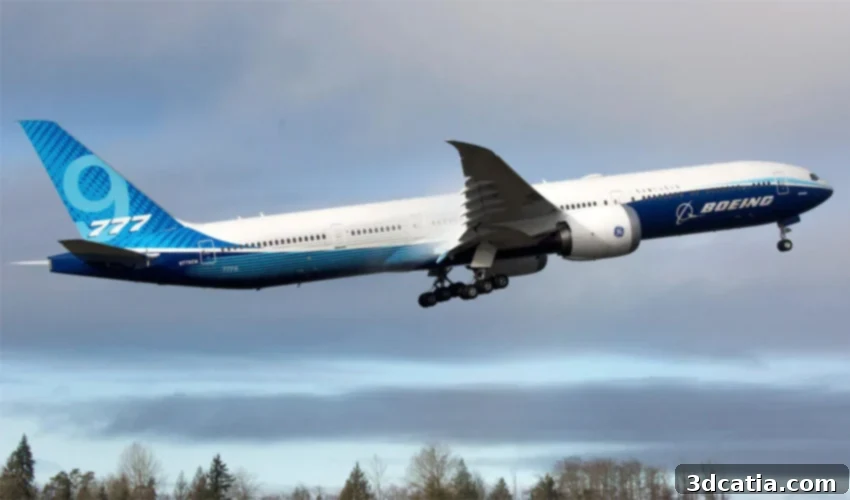
Boeing 777X: Revolutionizing Aerospace with 3D Printing and Unrivaled Efficiency
The aerospace industry is witnessing a transformative era, and at its forefront is the Boeing 777X, a marvel of modern engineering that recently completed its inaugural long-haul flight. This impressive twin-engine aircraft is not merely a successor to Boeing’s highly successful 777 series; it represents a monumental leap forward in aircraft design, fuel efficiency, and manufacturing innovation. What truly sets the 777X apart and underscores its significance for the future of aviation is the unprecedented integration of advanced manufacturing technologies, particularly 3D printing. Its powerful GE9X engines, developed by GE, incorporate over 300 3D printed parts, meticulously produced at GE’s Additive Technology Center in West Chester, Ohio, and Avio Aero facilities in Cameri, Italy. These components range from intricate temperature sensors and advanced fuel mixers to highly efficient heat exchangers, each contributing to the engine’s groundbreaking performance and the aircraft’s overall sustainability.
Boeing’s long-standing interest in additive manufacturing has matured significantly over the years, evolving from an initial focus on spare parts production to a strategic integration into core manufacturing processes. The introduction of the Boeing 777X serves as compelling evidence of this strategic pivot. As the largest and most economical twin-engine jetliner on the market, the 777X leverages cutting-edge technology to achieve remarkable operational efficiency. This includes a projected 10% reduction in fuel emissions compared to its competitors, a critical advantage for airlines grappling with rising fuel costs and increasing environmental regulations. By embracing 3D printing, Boeing and GE are not only pushing the boundaries of what’s possible in aircraft design but also laying the groundwork for more sustainable and cost-effective air travel.

The Boeing 777X, a culmination of years of advanced engineering and design, marks a new chapter in aviation.
The Boeing 777X: Redefining Modern Air Travel and Efficiency
The Boeing 777X is designed to elevate the standards of commercial aviation, building upon the legacy of the highly successful 777 while introducing a host of innovations. One of its most distinctive features is its advanced aerodynamic profile, characterized by a larger wingspan and unique foldable wingtips. This increased wingspan, extending up to 72 meters, enhances aerodynamic efficiency, allowing for greater lift and reduced drag, which directly translates into lower fuel consumption. The ingenious foldable wingtips enable the aircraft to maintain compatibility with existing airport gates and taxiways, striking a perfect balance between performance and practicality. This design ingenuity allows airlines to operate the 777X from a wider range of airports without requiring significant infrastructure upgrades, providing greater operational flexibility and cost savings.
Beyond its exterior, the 777X promises an unparalleled passenger experience, often described as “the flying experience of the future.” The cabin interiors have been meticulously redesigned to maximize comfort and convenience. Passengers will benefit from larger windows, offering enhanced views and a greater sense of spaciousness. The wider cabins provide more personal space, creating a more relaxed and enjoyable environment for long-haul journeys. Furthermore, redesigned overhead bins offer more convenient access to luggage, streamlining the boarding and deplaning processes. These enhancements, combined with a quieter cabin environment and advanced air filtration systems, contribute to a superior journey for the up to 384 passengers it can accommodate. The successful completion of its first long-haul flight from Everett to Seattle served as a crucial validation of these design philosophies, confirming the aircraft’s readiness for commercial service and its potential to set new benchmarks in air travel.
Pioneering Power: The GE9X Engines and Additive Manufacturing Integration
At the heart of the Boeing 777X’s exceptional performance lies the GE9X engine, developed in close collaboration between Boeing and GE. This powerhouse engine is not just the largest commercial aircraft engine ever built, with a fan diameter of 3.4 meters, but also a showcase of advanced manufacturing prowess, particularly laser powder bed fusion and other additive technologies. The integration of over 300 3D printed components within the GE9X is a testament to the revolutionary capabilities of additive manufacturing in producing complex, high-performance parts that would be impossible or prohibitively expensive to create using traditional methods.
A prime example of this innovation is the use of 3D printed metal fuel nozzles. These components feature intricate internal geometries that optimize fuel atomization and combustion, leading to significantly lower fuel consumption and reduced emissions. Traditional manufacturing techniques struggle to achieve such complex internal channels, which are crucial for maximizing engine efficiency. Similarly, several other critical components, including temperature sensors, fuel mixers, and heat exchangers, leverage additive manufacturing. For instance, 3D printing allows for the consolidation of multiple parts into a single, integrated component, reducing assembly time, minimizing potential failure points, and further decreasing weight—a paramount objective in aerospace design. The ability to create complex internal latticework structures also enables engineers to design parts that are simultaneously lighter and stronger, precisely where material is needed.
Furthermore, the GE9X engines incorporate advanced carbon fiber composite fan blades and their enclosures. While not directly 3D printed in the conventional sense, the design freedom enabled by advanced manufacturing principles played a role in optimizing their structure. The use of these lightweight, high-strength composites allowed GE to reduce the number of fan blades from 22 to 16, decreasing overall engine weight and improving aerodynamic performance and noise reduction. These composite structures are crucial for handling the immense forces generated by the massive engine while contributing to the aircraft’s impressive fuel efficiency. Such innovations are carefully developed and tested at GE’s state-of-the-art facilities, like Avio Aero in Cameri, Italy, which specialize in advanced aerospace component manufacturing.
Ted Ingling, GE9X programme manager, succinctly articulated the profound impact of these technologies: “The Boeing 777X flight test programme with the GE9X will validate the performance objectives and benefits of this aircraft/engine combination. The GE9X is the most fuel-efficient jet engine that GE has ever produced. We have found additive manufacturing to be very powerful, especially in the early stages of development, where it allows the design team to rehearse concepts much more quickly.” Ingling’s statement highlights a critical advantage of additive manufacturing: its ability to accelerate the design iteration process. Engineers can rapidly produce and test prototypes of complex parts, quickly identifying optimal designs and making adjustments with unprecedented speed. This agile development cycle significantly reduces the time and cost associated with bringing innovative aerospace components to market, proving invaluable for a project as ambitious as the GE9X engine.
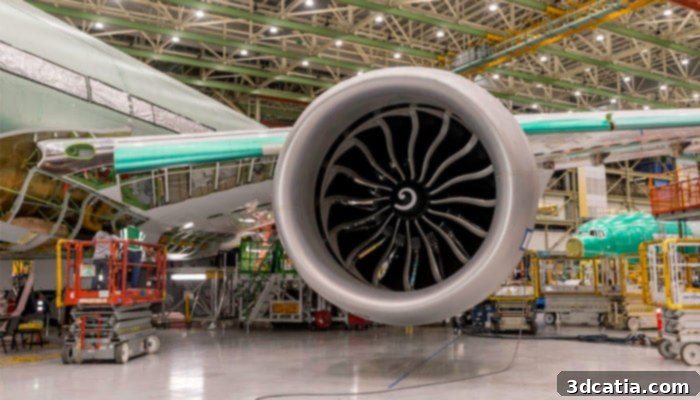
The GE9X engine stands as a testament to engineering excellence and additive manufacturing’s potential in high-performance applications.
The Broader Impact: Additive Manufacturing’s Role in Aerospace’s Future
The widespread adoption of additive manufacturing in a flagship aircraft like the Boeing 777X signals a significant paradigm shift within the aerospace industry. This shift extends beyond individual component benefits to encompass broader implications for supply chain management, design freedom, and the very economics of aircraft production. By enabling the creation of highly complex, optimized parts on demand, 3D printing reduces reliance on traditional tooling and long lead times associated with conventional manufacturing. This translates to more resilient and localized supply chains, crucial for an industry with stringent safety and performance requirements. Furthermore, the ability to rapidly produce spare parts using additive techniques promises to revolutionize Maintenance, Repair, and Overhaul (MRO) operations, reducing ground time for aircraft and improving operational efficiency for airlines globally.
Looking ahead, the success of additive manufacturing in the GE9X engines paves the way for even more extensive integration of 3D printing in future aircraft designs. Engineers are now empowered with unprecedented design freedom, allowing them to create intricate internal structures, topology-optimized components, and multi-functional parts that were previously unimaginable. This capability will further drive down weight, enhance performance, and contribute to more fuel-efficient and environmentally friendly aircraft. However, the adoption of additive manufacturing in aerospace is not without its challenges. The rigorous certification processes required for airworthiness demand extensive testing and validation of materials and processes to ensure the highest levels of safety and reliability. Both Boeing and GE have invested heavily in overcoming these challenges, establishing robust quality control and qualification frameworks that are setting new industry standards for additively manufactured parts. Their collaborative efforts demonstrate that with meticulous engineering and stringent validation, 3D printing is unequivocally ready to play a pivotal role in the future of air travel.
Conclusion: A Glimpse into Tomorrow’s Skies
The Boeing 777X, with its record-breaking GE9X engines, stands as a beacon of innovation, demonstrating how advanced technologies like 3D printing are fundamentally reshaping the aerospace landscape. From significantly enhanced fuel efficiency and reduced emissions to an unparalleled passenger experience and expedited development cycles, the 777X embodies the future of commercial aviation. Its first long-haul flight represents not just a milestone for Boeing but a testament to the power of collaborative engineering and a clear indication that sustainable, efficient, and technologically advanced air travel is not just a vision, but a rapidly approaching reality. As the global demand for air travel continues to grow, aircraft like the 777X will be instrumental in meeting this demand responsibly, setting new standards for performance, cost-effectiveness, and environmental stewardship.
What are your thoughts on the groundbreaking innovations within the Boeing 777X and the transformative role of 3D printing in modern aircraft development? We invite you to share your perspectives in a comment below or join the conversation on our Facebook and Twitter pages! For all the latest news and advancements in additive manufacturing delivered straight to your inbox, don’t forget to sign up for our free weekly Newsletter.