
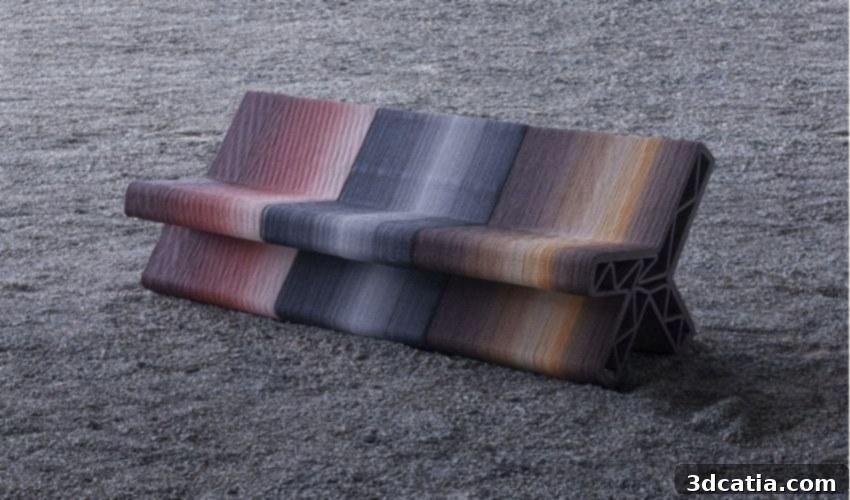
Revolutionizing Sustainability: BENTU DESIGN’s 3D-Printed Furniture from Construction Waste
The global construction industry, a colossal engine of development and infrastructure, is paradoxically also one of the world’s most significant contributors to environmental degradation, primarily through its staggering waste output. Estimates suggest that between 2 to 3 billion tons of construction and demolition waste (CDW) are generated annually, accounting for an alarming 30% to 35% of all waste produced on Earth. This enormous volume comprises a diverse array of materials: discarded bricks, broken concrete, splintered wood, various rubble, plastics, metals, and more, much of which ends up in landfills, contributing to soil and water pollution, habitat destruction, and greenhouse gas emissions. The sheer scale of this problem underscores an urgent need for innovative, sustainable solutions that can transform this environmental burden into valuable resources, shifting towards a more circular economy within the building sector.
In a pioneering effort to address this critical issue, the innovative design studio BENTU DESIGN has embarked on a visionary project to repurpose this colossal amount of waste through the transformative power of 3D printing. Their groundbreaking initiative, aptly named “Inorganic Growth,” seeks to convert discarded construction materials into a viable, 3D-printable medium for creating functional and aesthetically pleasing street furniture. This bold concept not only diverts waste from landfills but also imbues it with new life and purpose. So far, the project has successfully yielded a range of striking chairs and stools, each meticulously 3D-printed using an impressive 85% recycled waste material. This demonstrates a remarkable commitment to sustainability, proving that high-quality design can emerge directly from what was once considered refuse, challenging conventional notions of material value and production processes.
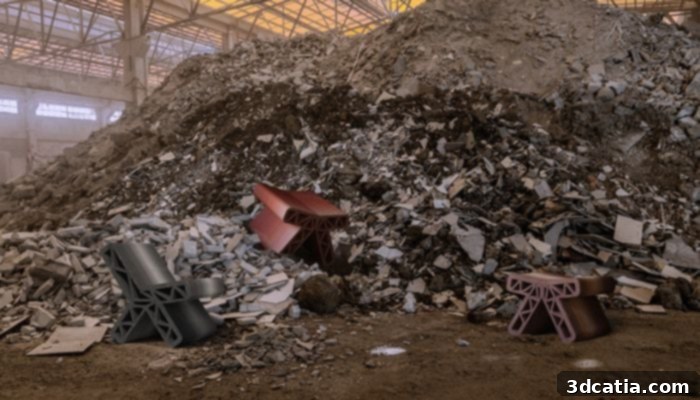
Construction waste is gathered on site, marking the first step in its journey towards transformation into sustainable furniture.
A Pioneering Localized Workflow for Sustainable Manufacturing
One of the most innovative aspects of BENTU DESIGN’s “Inorganic Growth” project is its meticulously crafted and entirely localized workflow. This approach significantly minimizes the environmental impact typically associated with material sourcing and processing. The Chinese studio strategically collects construction and demolition waste directly from demolition sites nestled within urban villages. This immediate proximity to the source material is not merely a logistical convenience; it is a core tenet of their sustainable philosophy. Once collected, the diverse array of waste materials undergoes a rigorous multi-stage processing routine: crushing, grounding, and meticulous sorting. What makes this process truly revolutionary is that it is all executed within a specialized, mobile processing unit, which is ingeniously set up directly on-site at the demolition location.
This fully localized workflow offers an unparalleled advantage in terms of environmental sustainability and operational efficiency. By eliminating the need for long-distance transportation of bulky waste materials to a centralized processing facility, BENTU DESIGN drastically reduces associated carbon emissions. Furthermore, it minimizes the energy consumption linked to logistics and alleviates the strain on local infrastructure that heavy transportation would otherwise impose. This model exemplifies a true circular economy in action, where resources are utilized and repurposed within the immediate ecosystem, closing the loop on waste generation. The on-site processing also fosters a more agile and responsive production cycle, allowing for quicker turnaround times and a direct connection between the source of waste and the creation of new products, thereby enhancing the overall eco-efficiency of the entire operation.
The ultimate objective of this intensive on-site processing is to transform the raw construction waste into an extremely fine powder, precisely sized between 0 to 3 mm. This specific particle size is crucial for ensuring the material’s suitability for 3D printing applications, as it directly impacts flowability, print quality, and structural integrity. This meticulously prepared powder is then expertly blended with various industrial byproducts, such as silica fume, ash, or slag powder—often sourced from industries like steel manufacturing. These additives are not merely fillers; they play a vital role in enhancing the mechanical properties of the composite material, acting as binders and strength enhancers. The combination results in a robust, consistent, and highly adaptable material that is perfectly suited for use in advanced 3D printing processes. This ingenious formulation not only gives new life to construction waste but also addresses the challenge of industrial byproduct disposal, turning two waste streams into a single, valuable resource for sustainable manufacturing.
BENTU DESIGN Opts for FDM: Marrying Sustainability with Aesthetic Innovation
For the realization of their ambitious “Inorganic Growth” project, the forward-thinking BENTU DESIGN group strategically chose Fused Deposition Modeling (FDM) as their preferred 3D printing technology. FDM, a widely adopted additive manufacturing process, operates by extruding melted thermoplastic or composite material layer by layer to build a three-dimensional object. This method is particularly well-suited for handling a diverse range of materials, including complex composites like the one BENTU DESIGN developed from recycled construction waste and industrial byproducts. The studio’s specific choice of a dual-extrusion FDM machine further amplifies the creative possibilities, offering enhanced control over the deposition of different material compositions or, crucially in this case, the distribution of pigments. This precision allows BENTU DESIGN to achieve distinct and visually captivating color effects in their finished furniture pieces.
The aesthetic appeal of BENTU DESIGN’s creations is deeply intertwined with their sustainable origins. The unique color palette of the “Inorganic Growth” furniture is not achieved through artificial dyes but is derived organically from the inherent hues of the construction waste mixture itself. For instance, the presence of crushed bricks lends warm, earthy red tones, while pulverized concrete contributes a spectrum of grays. Fragments of ceramic waste introduce subtle yet striking blue-green elements, creating a natural, variegated effect that is both visually rich and deeply authentic. This deliberate embrace of the material’s natural characteristics ensures that each piece of furniture is truly one-of-a-kind, celebrating the beauty of recycled materials. The dual-extrusion FDM technology allows for the controlled blending and layering of these naturally colored composite materials, enabling BENTU DESIGN to craft intricate patterns and achieve a level of artistic expression that would be challenging with single-extrusion systems. This fusion of advanced manufacturing techniques with a deep respect for resource recovery truly sets their work apart in the realm of sustainable design.
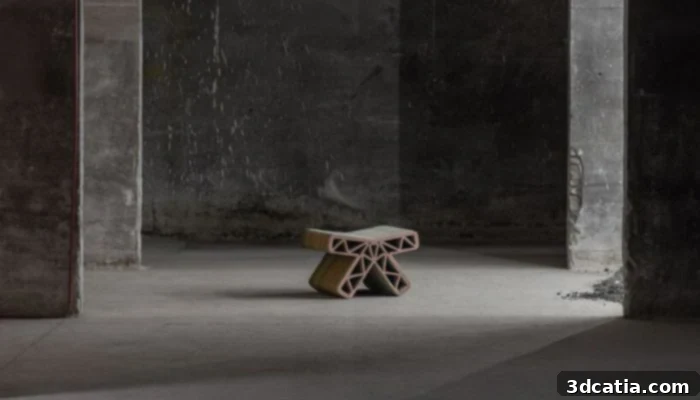
An example of BENTU DESIGN’s unique 3D printed furniture, showcasing the natural colors derived from recycled construction waste.
The tangible outcomes of BENTU DESIGN’s innovative approach are remarkable, both from an environmental and an aesthetic perspective. The furniture pieces produced through the “Inorganic Growth” project boast a significantly reduced material footprint, utilizing approximately 40% fewer raw virgin materials compared to conventional manufacturing methods for similar items. This substantial reduction directly translates into a drastically lower carbon footprint, minimizing the environmental impact throughout the product lifecycle. The entire project is underpinned by a robust closed-loop philosophy, where every component of the process—from waste collection and processing to material formulation and final product creation—is meticulously planned to maximize resource efficiency. Materials are sourced locally, reducing transportation emissions, and critically, the finished pieces are designed with end-of-life recyclability in mind, ensuring that the cycle of reuse can continue indefinitely. This holistic approach exemplifies the principles of a true circular economy.
Beyond their profound environmental benefits, these 3D-printed pieces are undeniably original and strikingly beautiful. The inherent variation and organic textures derived from the recycled construction waste ensure that each chair and stool possesses a truly one-of-a-kind design. This unique aesthetic challenges the often-held perception that recycled products must compromise on style or quality. Instead, BENTU DESIGN demonstrates that sustainability can be a catalyst for exceptional design, producing furniture that is not only eco-friendly but also distinct, contemporary, and highly desirable. Their work serves as a powerful testament to the potential of leveraging advanced manufacturing techniques like 3D printing to transform societal challenges into opportunities for innovation, inspiring a new generation of designers and manufacturers to rethink material consumption and production methods. By turning what was once considered urban blight into functional art, BENTU DESIGN is not just making furniture; they are crafting a narrative of hope for a more sustainable future. To delve deeper into their inspiring work and explore their full portfolio, please visit their official website by clicking HERE.
What are your thoughts on BENTU DESIGN’s groundbreaking initiative to transform construction waste into functional, aesthetic 3D-printed furniture? We’d love to hear your perspective! Share your comments below or engage with us on our LinkedIn or Facebook pages. Don’t miss out on the latest advancements and news in the world of additive manufacturing; make sure to sign up for our free weekly Newsletter to have all the essential 3D printing updates delivered directly to your inbox. For a visual journey into the innovations shaping our future, you can also explore all our fascinating videos on our dedicated YouTube channel.
*All Photo Credits: Bentu Design