
Revolutionizing E-Waste: UNSW’s Micro-Factory Transforms Electronic Waste into Sustainable 3D Printing Filaments
In a significant stride towards environmental sustainability and a circular economy, the Center for Sustainable Materials Research and Technology (SMaRT Center) at the University of New South Wales (UNSW) in Australia has officially launched a pioneering micro-factory dedicated to the advanced recycling of electronic waste, commonly known as e-waste. This innovative facility is set to breathe new life into discarded electronics by processing them into high-quality 3D printing filaments. This groundbreaking initiative not only addresses the escalating problem of e-waste but also offers a tangible solution to mitigate the immense environmental footprint left by consumer electronic goods on our planet. By transforming what was once considered hazardous waste into valuable resources, UNSW is paving the way for a more sustainable future in manufacturing and consumption.
The convergence of 3D printing technology and ecological principles is rapidly gaining momentum across various sectors, driving the development of products and services that are inherently more environmentally friendly. From the automotive industry exploring sustainable materials and manufacturing processes to corporations implementing robust recycling solutions, the global push for green innovation is undeniable. Many projects worldwide are demonstrating the versatility and potential of additive manufacturing in promoting sustainability. For instance, cities like Amsterdam have embraced 3D printing to create street furniture from collected plastic waste, transforming urban refuse into functional public amenities. Similarly, companies such as Armor 3D are leading the charge with their OWA filaments range, offering recycled and recyclable materials for 3D printing, underscoring a broader industry shift towards responsible resource management. These examples highlight a collective effort to move beyond traditional linear economies towards more regenerative models, where waste is not merely disposed of but reimagined as a valuable input for new creations.
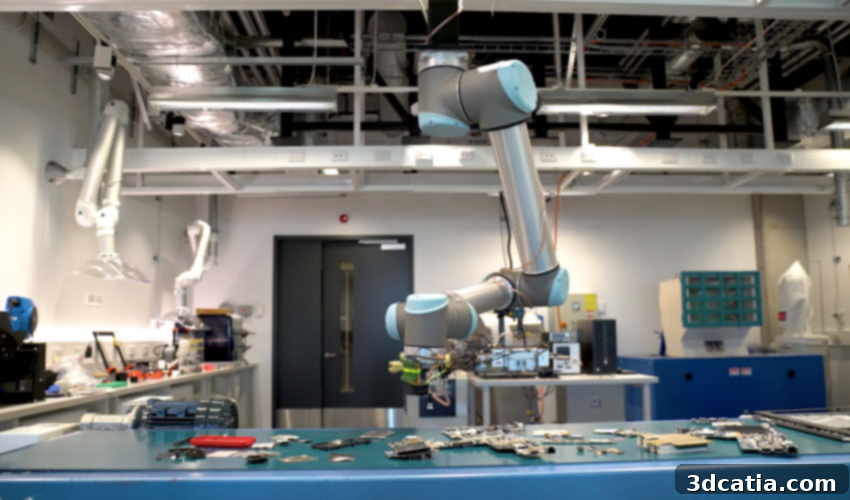
A meticulous sorting of electronic waste is the crucial first step in the recycling process.
Addressing the E-Waste Epidemic: From Toxic Burden to Economic Opportunity
The scale of the electronic waste problem is truly staggering and represents one of the most pressing environmental challenges of our time. According to a concerning study conducted by the United Nations University, Oceania alone generated an astonishing 15.2 kg of electronic waste per capita in 2014. Furthermore, this alarming trend showed an increase of 63% in e-waste generation between 2010 and 2015, culminating in a colossal 12.3 million tons globally. This relentless accumulation of discarded electronics, laden with toxic chemicals and valuable metals, poses severe threats to environmental health and human well-being if not managed properly. Traditional disposal methods often lead to harmful substances leaching into soil and water, while informal recycling practices expose workers to dangerous conditions.
The SMaRT Center’s micro-factory project emerges as a powerful and pragmatic response to this escalating crisis. It offers not just a recycling solution, but a transformative approach to the electronic product lifecycle. By creating value from waste rather than simply producing more toxic refuse, the micro-factory promotes a “virtuous” cycle where discarded electronics are re-integrated into the manufacturing stream. The core innovation lies in transforming these complex waste streams into viable 3D printing filaments, which can then be used to manufacture a wide array of new, useful objects. This paradigm shift moves us away from a linear “take-make-dispose” model towards a circular economy, conserving precious resources and significantly reducing the environmental footprint of our consumption habits.
Professor Veena Sahajwalla’s Vision: Local Solutions for Global Challenges
Professor Veena Sahajwalla, the esteemed Director of the SMaRT Center, articulates the profound impact and potential of this initiative with conviction. “Our e-waste micro-factory and another under development for other consumer waste types offer a cost-effective solution to one of the greatest environmental challenges of our age, while delivering new job opportunities to our cities but more importantly to our rural and regional areas, too,” she states. Her vision extends beyond mere waste management; it encompasses a holistic approach to sustainable development. The modular design and compact footprint of these micro-factories enable them to be deployed where waste is generated and stockpiled, offering decentralized recycling capabilities. This localized approach drastically reduces the need for costly and carbon-intensive transportation of waste to distant processing facilities. Professor Sahajwalla emphasizes that “Using our green manufacturing technologies, these micro-factories can transform waste where it is stockpiled and created, enabling local businesses and communities to not only tackle local waste problems but to develop a commercial opportunity from the valuable materials that are created.” This highlights the dual benefit of environmental stewardship and economic empowerment for communities, fostering a sense of ownership and responsibility for their waste streams.
The implementation of such micro-factories signifies a crucial step towards urban mining – the process of recovering valuable raw materials from discarded products and buildings. E-waste, in particular, is a rich source of precious metals like gold, silver, and palladium, as well as critical raw materials such as rare earth elements, which are vital for modern electronics. By capturing these resources through advanced recycling, reliance on virgin mining can be reduced, thereby conserving natural resources and minimizing the environmental degradation associated with traditional extraction methods. The SMaRT Center’s approach is a testament to how innovative technology, combined with a forward-thinking vision, can transform seemingly insurmountable environmental problems into sustainable economic opportunities.
Professor Veena Sahajwalla proudly presents the micro-factory to Australian Minister for the Environment, Gabrielle Upton, showcasing a beacon of sustainable innovation.
The Modular Micro-Factory: A Blueprint for Distributed Recycling
One of the most remarkable features of these micro-factories is their ingenious modular design. This inherent flexibility allows them to be integrated into diverse settings, some as compact as 50 square meters. Such adaptability is crucial for deploying recycling infrastructure in urban centers, remote towns, or even within existing industrial complexes, offering unparalleled convenience and efficiency. The modularity also means that different units can be configured to process specific types of waste, optimizing resource recovery for various material streams. This bespoke approach ensures that each module is tailored to extract maximum value from the specific waste it handles, ranging from complex electronic assemblies to common plastic refuse.
The operational flow within an e-waste micro-factory is a testament to cutting-edge engineering and automation. For instance, the recycling process for electronic devices like laptops and smartphone cases typically begins with an initial dismantling stage, where components are separated. Following this, advanced robotic systems are employed to meticulously identify and sort useful elements from the general waste stream. These intelligent robots can distinguish between various plastics, metals, and precious components, ensuring efficient recovery. Subsequently, another critical module utilizes a small, precisely controlled furnace to transform these sorted parts into new raw materials. This controlled temperature process is vital for breaking down complex materials safely and effectively, preventing the release of harmful toxins while maximizing the yield of reusable substances.
Beyond general e-waste processing, other modules within the micro-factory are specifically designed for particular raw material types. For example, highly specialized units are dedicated to recovering metal alloys from printed circuit boards (PCBs). These recovered metals can then be refined and reused to create new metal components for various manufacturing processes, closing the loop on valuable metallic resources. Simultaneously, plastic waste, which constitutes a significant portion of e-waste, undergoes a transformation in dedicated modules. Here, plastics are processed and extruded into different types of filaments, specifically engineered for compatibility with Fused Deposition Modeling (FDM) 3D printers. This direct conversion into print-ready material makes the recycled plastic immediately usable, fueling a localized and sustainable manufacturing ecosystem.
Forging Ahead: Partnerships and the Future of Sustainable Manufacturing
The University of New South Wales, through its pioneering SMaRT Center, continues to push the boundaries of sustainable materials research and technology. Recognizing the complexity and collaborative nature of addressing global waste challenges, the university is actively seeking diverse partnerships with companies, governmental organizations, and associations. These collaborations are essential for scaling up the micro-factory concept, developing new recycling pathways for various waste streams, and integrating these innovative solutions into broader industrial and community frameworks. By fostering a network of collaborators, UNSW aims to accelerate the adoption of green manufacturing technologies and drive a more profound impact on environmental sustainability. Further insights into this transformative initiative, including visual demonstrations of the micro-factory in action, can be found in the video below or by visiting the university’s official website, where detailed information on their ongoing research and future plans is available.
The advent of e-waste micro-factories represents a critical turning point in how society perceives and manages waste. It demonstrates that with innovation and strategic planning, waste can indeed be transformed from a liability into a valuable asset, contributing significantly to both environmental protection and economic growth. This model not only addresses the immediate problem of escalating e-waste but also provides a framework for creating new industries, fostering local job creation, and promoting a truly circular economy. It empowers communities to manage their own waste streams, unlocking the hidden value within discarded materials and driving sustainable practices at a grassroots level. As global environmental concerns mount, initiatives like the UNSW SMaRT Center’s micro-factory offer a beacon of hope and a practical pathway towards a more resilient and sustainable future for all.
What are your thoughts on this revolutionary initiative? Do you believe these micro-factories could be widely adopted across the globe? Share your perspectives and insights in a comment below or join the conversation on our Facebook and Twitter pages! For all the latest breaking news and developments in the world of 3D printing, don’t forget to sign up for our free weekly Newsletter, delivered straight to your inbox!