
Revolutionizing Automotive Manufacturing: How Audi Sport Accelerates Production with 3D Printing and Fixturemate
The automotive industry is in a perpetual state of evolution, with manufacturers continually seeking innovative solutions to enhance production efficiency, reduce costs, and accelerate the development cycle of new vehicles. Amidst this relentless drive for innovation, 3D printing, commonly known as additive manufacturing, has emerged as a truly transformative technology, increasingly integrated into the intricate workflows of leading carmakers worldwide. A prime example of this paradigm shift can be observed at Audi Sport‘s state-of-the-art Böllinger Höfe facility in Germany. This renowned center, globally recognized for its meticulous craftsmanship and the development of high-performance vehicles, including the iconic Audi R8 and the groundbreaking fully electric E-Tron GT, recently embraced additive manufacturing to surmount a significant and persistent production challenge. This strategic adoption has not only set new benchmarks in automotive excellence but has also dramatically improved operational agility within their advanced manufacturing processes.
The introduction of the highly anticipated Audi E-Tron GT, a pinnacle of electric vehicle engineering and sophisticated design, presented a unique set of manufacturing complexities. Its bespoke production model necessitated the creation of nearly 200 distinct specialized tools, intricate jigs, and custom fixtures. Traditionally, the procurement and development of such a vast array of bespoke production aids would entail an extensive investment of both valuable time and significant financial resources, often stretching lead times and introducing potential bottlenecks into the assembly line. These conventional methods frequently involved lengthy design cycles, external sourcing, and considerable expenditure. However, Audi Sport, with its forward-thinking and innovative approach, sought a more agile and efficient pathway. By strategically integrating advanced 3D printing technologies alongside Trinckle’s pioneering Fixturemate software, the company has successfully revolutionized its entire workflow. This strategic adoption has not only streamlined operations but has also unlocked unprecedented levels of efficiency, significantly reduced production costs, and fostered a more responsive and adaptable manufacturing environment, critical for high-performance electric vehicles.
A cornerstone of the E-Tron GT’s manufacturing success lies in its intensive degree of customization, where each vehicle is meticulously tailored to meet the precise specifications and desires of individual customer orders. This bespoke manufacturing philosophy inherently demands a production process that is not only highly efficient but also exceptionally adaptable and flexible to accommodate unique variations. The judicious adoption of 3D printing has emerged as a pivotal enabler, dramatically enhancing Audi Sport’s ability to meet these rigorous demands for personalization and precision. Central to this transformation is Trinckle’s Fixturemate software, a powerful and intuitive tool that has profoundly streamlined the design and engineering of custom fixtures. What once required hours of intricate design work using traditional CAD (Computer-Aided Design) software can now be accomplished with remarkable speed, reducing the time needed for each design from several hours to an astonishingly brief 10 to 20 minutes. This user-friendly interface democratizes the creation of precise, highly functional components, eliminating the need for extensive, specialized CAD expertise that was previously a prerequisite for such complex tasks. The ability to rapidly design and iterate fixtures on demand provides Audi Sport with unparalleled agility, allowing for quick adjustments and improvements in the production line, ultimately enhancing both product quality and delivery times for their highly individualized vehicles.
Cem Guelaylar, a dedicated 3D Printing Expert at Audi Sport, eloquently articulated the profound benefits reaped from the implementation of the Fixturemate software. He highlighted the dramatic reduction in design time, stating, “We put our parts in Fixturemate and bring the fixture out of this software in minutes. Normally, in classic construction, we need [two to four] hours, depending on the size of the part.” This significant decrease in design lead time is not merely an incremental improvement; it represents a fundamental shift in the pace of production readiness, enabling rapid prototyping and deployment of essential tools. Furthermore, Guelaylar emphasized the software’s remarkable ease of use and accessibility: “Fixturemate is very easy to use. We can bring trainees and show them how to use the fixturemate software, and they can directly work with it and bring the fixtures in a short time.” This aspect is particularly crucial in a dynamic manufacturing environment, as it facilitates rapid onboarding of new personnel and promotes a more distributed design capability across the production team. It transforms what was once a specialized, potentially bottlenecked process into an efficient, collaborative endeavor, accelerating tool creation and empowering a broader range of skilled workers to contribute directly to the production of essential jigs and fixtures, thus bolstering the overall operational resilience and innovation capacity of the Audi Sport facility.
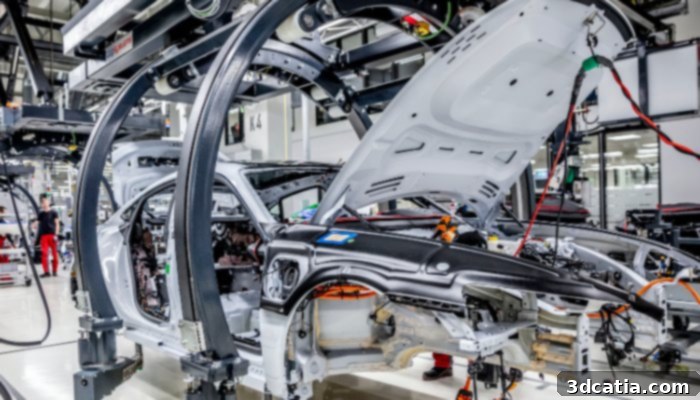
The efficiency gains afforded by this innovative software are of paramount importance for Audi Sport, an organization where meticulous assembly precision is not just a preference but an absolute necessity, directly influencing the overarching quality, consistency, and ultimately, the safety and performance of each handcrafted vehicle. In the intricate assembly of the E-Tron GT, for instance, custom-designed jigs and fixtures produced through 3D printing play a critical role in ensuring that every component, down to the smallest detail like the head-up display unit, is perfectly aligned and precisely positioned. This unwavering commitment to precision guarantees optimal functionality, enhances the driver’s safety through flawless component integration, and significantly elevates the overall user experience, reinforcing Audi’s long-standing reputation for engineering excellence and luxury. These custom tools eliminate potential human error, standardize assembly processes to meet stringent specifications, and maintain the rigorous quality controls expected from a luxury performance automobile manufacturer. The ability to rapidly produce such precise, application-specific tools in-house provides Audi Sport with an unparalleled advantage in maintaining its exacting standards while simultaneously accelerating its production timelines and adapting swiftly to design changes.
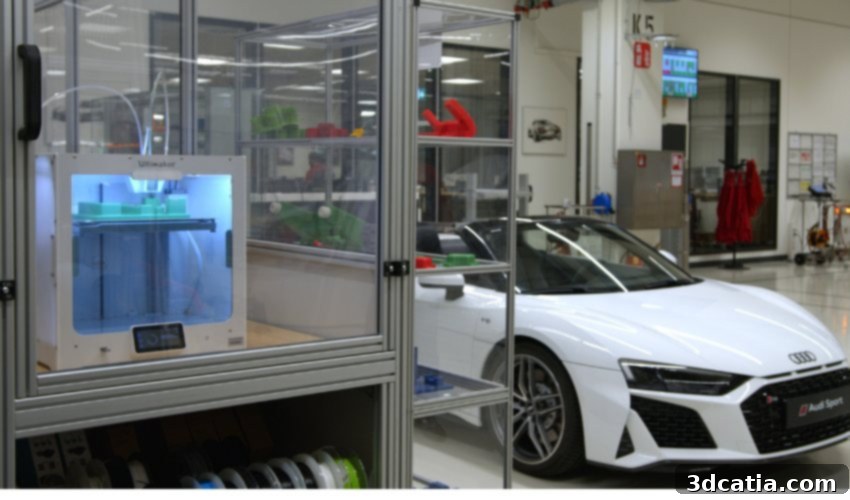
Further bolstering Audi Sport’s significantly improved workflow is the seamless integration of UltiMaker S series 3D printers directly into their manufacturing ecosystem. This strategic move has enabled the facility to transition from relying on external suppliers for essential tools and fixtures to producing them entirely in-house, a shift that has dramatically truncated lead times and injected unparalleled agility into their operations. Audi reports truly transformative results: what previously took weeks or even months to procure from external suppliers can now be conceptualized, designed, printed, and deployed within a single day. This astonishing reduction in lead time translates directly into substantial cost savings, exceeding an estimated 80% compared to traditional outsourcing methods. This financial benefit is a clear testament to the economic viability and efficiency of additive manufacturing for specialized tooling in a high-volume, high-precision environment. The ability to respond to immediate production needs with such speed and cost-effectiveness is invaluable, as eloquently highlighted by an Audi Sport representative: “3D printing helped us to get these tools in a very short time. The workers come to us and say, I need a fixture to assemble the cars. It takes one day to get this tool in his hand.” This responsiveness not only streamlines the assembly process but also minimizes downtime, optimizes resource allocation, and fosters an environment where continuous improvement and rapid problem-solving are integral parts of the daily operation at the Böllinger Höfe facility, proving the tangible benefits of in-house additive manufacturing.
Beyond sheer speed and impressive cost-effectiveness, the inherent flexibility offered by 3D printing has empowered Audi Sport to experiment with and deploy a diverse range of materials, each meticulously tailored to the specific demands of various applications within the E-Tron GT’s complex production line. This material versatility is a critical advantage that traditional manufacturing often struggles to match. For instance, the use of robust and flexible materials like TPU95a allows for the creation of durable, ergonomic tools that can withstand repetitive use and intricate geometries, while also providing a degree of cushioning or grip where needed, protecting sensitive car parts during assembly. Simultaneously, the adoption of ESD-safe PLA (Electrostatic Discharge safe Polylactic Acid) has proven indispensable for the production of tools and fixtures specifically intended for handling sensitive electronic components. ESD-safe materials are crucial in preventing electrostatic discharge, which can cause irreparable damage to delicate electronics, impacting vehicle reliability and safety. This careful selection and utilization of specialized materials ensure both the structural integrity and the functional safety of the tools, directly contributing to the flawless production of complex electronic systems within the vehicles, and guaranteeing strict compliance with stringent industry standards for quality, safety, and electromagnetic compatibility. This adaptability in material choice ensures that every tool is perfectly suited for its intended purpose, optimizing both performance and longevity in the demanding automotive manufacturing environment, reflecting Audi’s commitment to cutting-edge solutions.
The comprehensive integration of 3D printing into Audi Sport’s Böllinger Höfe facility signifies a profound evolution in modern automotive manufacturing. It showcases a forward-thinking approach that embraces advanced technologies not merely as supplementary tools but as foundational elements for enhancing productivity, enabling unparalleled customization, and fostering continuous innovation. The synergy between Trinckle’s Fixturemate software for rapid design and UltiMaker’s reliable S series 3D printers for efficient in-house production has created a powerful, agile, and cost-effective ecosystem. This ecosystem allows Audi Sport to not only meet the intricate demands of producing highly customized, high-performance electric vehicles like the E-Tron GT but also to proactively address future manufacturing challenges with unprecedented agility and confidence. The dramatic reductions in lead times, the significant cost savings exceeding 80%, and the ability to produce highly precise, application-specific tools on demand illustrate the compelling return on investment and the strategic advantage that additive manufacturing provides in the competitive automotive landscape. As the automotive industry continues its rapid transformation towards electrification and personalization, Audi Sport’s pioneering adoption of 3D printing serves as a compelling case study, highlighting how these technologies are not just improving existing processes but fundamentally redefining the possibilities of vehicle production, paving the way for more efficient, sustainable, and innovative manufacturing practices across the sector and beyond.
What are your thoughts on Audi’s innovative strides and the increasing adoption of 3D printing in the automotive sector? We invite you to share your insights in a comment below or join the conversation on our LinkedIn, Facebook, and Twitter pages. Don’t miss out on the latest advancements and industry news; sign up for our free weekly newsletter here to receive the freshest 3D printing news directly in your inbox! Additionally, you can explore all our engaging videos and exclusive content on our YouTube channel.
*All Photo Credits: UltiMaker