
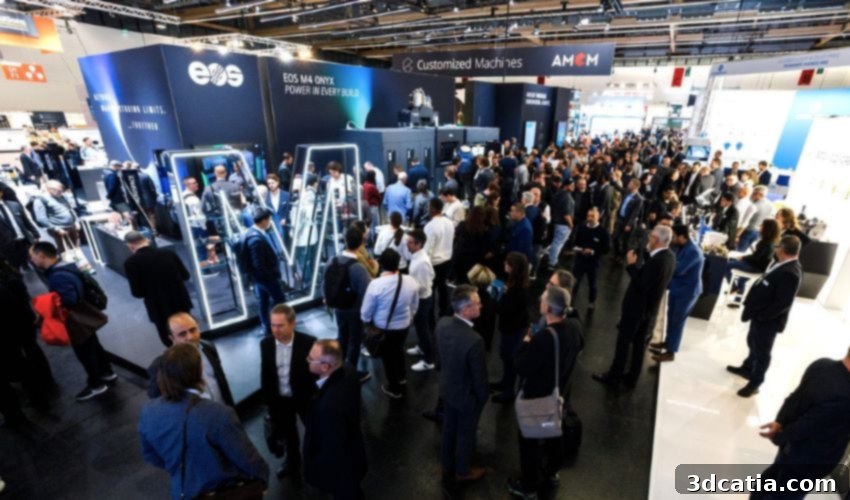
Formnext 2025: A Deep Dive into Additive Manufacturing Trends and Innovations
The tenth anniversary edition of Formnext has concluded, offering a valuable opportunity to assess the advancements, trajectory, and emerging trends within the additive manufacturing industry. This report provides a comprehensive overview of the significant events that unfolded at Formnext 2025, highlighting key takeaways and offering our perspectives on the show.
While the global climate remains complex, with ongoing geopolitical tensions, Formnext 2025 defied expectations. Despite a slight decrease in the number of exhibitors (804 compared to 864 in 2024) and some notable absences, the event was a resounding success. Organizers reported a strong attendance of 38,282 visitors across the 50,000-square-meter exhibition space, with an impressive 47% originating from international locations – an 11% increase compared to the previous year.
Several prominent trends emerged during Formnext 2025. Metal additive manufacturing continued to be a dominant force, with numerous announcements showcasing advancements in various metal 3D printing processes. The significant presence of Chinese manufacturers in the desktop polymer 3D printing sector was undeniable, building upon their already strong position in 2024. Furthermore, the event underscored the growing importance of mature and validated additive manufacturing applications, highlighting the industry’s transition towards integrating 3D printing technologies into increasingly demanding industrial environments.
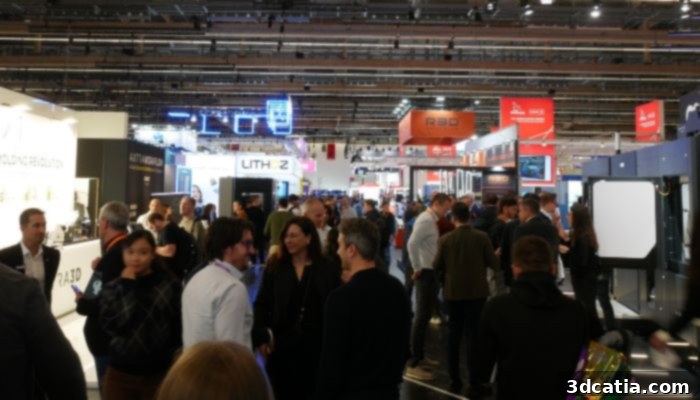
Many visitors walked the aisles of the trade show
Formnext 2025: Key Highlights and Announcements
Before delving into our observations and highlighting noteworthy trends, let’s review some of the key announcements that punctuated the four days of Formnext 2025. This year’s event provided a valuable opportunity to examine the role of additive manufacturing in the architecture and construction industries. A dedicated area, organized by BE-AM, showcased a range of applications, demonstrating the potential of 3D printing technologies in these sectors, including concrete and recycled plastics. Visitors were able to see structures built from innovative materials such as fishing nets and date pits, showcasing the versatility of the technology.
Formnext 2025 also celebrated innovation through the Formnext Awards, recognizing outstanding achievements across six categories: Design, AMbassador, (R)evolution, Rookie, Start-up, and Sustainability. We had the pleasure of meeting the winner of the Start-Up Award, PERFI Technologies. Stay tuned for our exclusive interview with them! A complete list of winners can be found HERE.
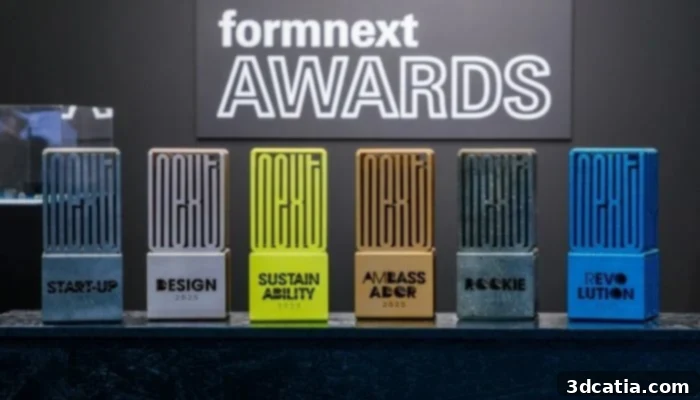
The trophies from this year. (Photo credits: Copyright Mesago Messe Frankfurt, Marc Jacquemin)
The Enduring Strength of Metal Additive Manufacturing and the Rise of Robotic Processes
The significance of metal 3D printing technologies is a recurring theme, and this year was no exception. Metal additive manufacturing remains a critical area of focus within the industry, evidenced by the numerous exhibitors—more than a dozen—that introduced their new metal 3D printers, encompassing a wide array of printing processes. The primary drivers behind this trend are the pursuit of enhanced productivity and improved repeatability. The industry’s emphasis on industrialization underscores the goal of seamlessly integrating metal 3D printing into existing value chains.
Manufacturers are also striving to achieve greater build volumes. Gefertec showcased a WAAM (Wire Arc Additive Manufacturing) machine capable of producing parts with dimensions of 1,200 x 1,200 x 1,200 mm. AddUp announced plans for a future solution with a build volume of 750 x 750 x 1,000 mm, while EOS increased the build plate size on its latest 3D printer by 25%. These are just a few examples illustrating that metal additive manufacturing has reached a new level of maturity and capability.
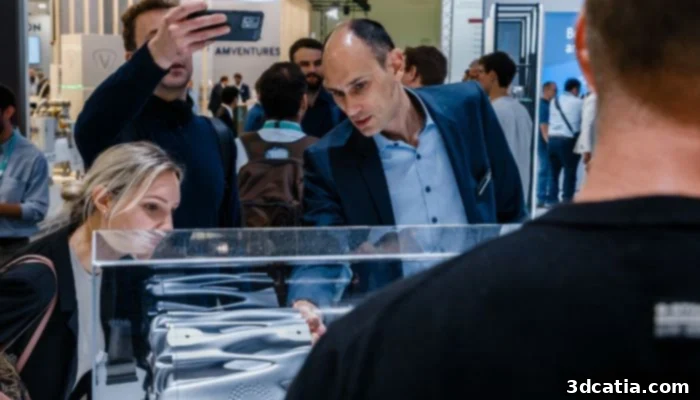
Metal additive manufacturing was at the heart of discussions at the show (Photo credits: Mesago)
Beyond metal, advancements were also evident in polymer 3D printing, particularly in the integration of robotic arms. We observed numerous robotic arms throughout the exhibition, whether mounted on 3D printers housed within containers or incorporated into open robotic systems. This trend reflects the industry’s commitment to consolidating its achievements and technological innovations, driving towards greater maturity. Companies such as Caracol, WASP, CMS, Breton, and Moi Composites, all of which are Italian, presented solutions capable of producing large, complex, and durable structures. An interesting aspect of these solutions is their material compatibility, enabling users to utilize recycled and recyclable polymers, as well as carbon fiber or glass fiber-reinforced plastics.
The Ascendance of a Structured Asian Market in 3D Printing
A notable observation at Formnext 2025 was the vibrant activity in Hall 12.1, specifically in aisles C and D on the south side. The booths of Bambu Lab, Creality, and Elegoo were consistently bustling with visitors, demonstrating the success of Chinese manufacturers in meeting the demand for desktop 3D printing solutions. This trend extends beyond desktop printers; industrial manufacturers from China, such as BLT, Farsoon, and E-Plus 3D, also had prominent displays. In total, Formnext 2025 featured 95 exhibitors from China, compared to 54 from the United States and 39 from France, highlighting the growing influence of the Asian market in the additive manufacturing landscape.
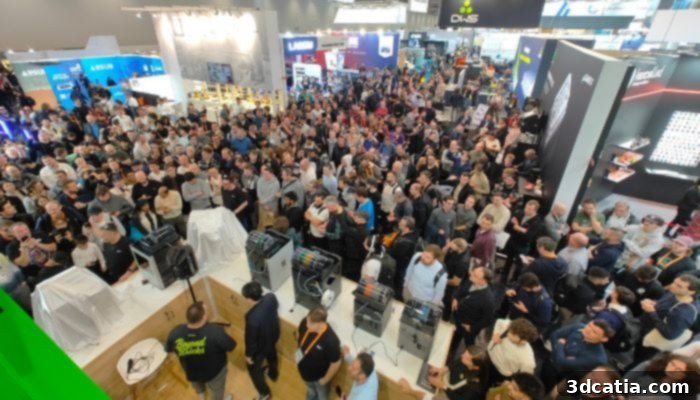
View from the Bambu Lab stand before the launch of a new printer (Photo credits: 3Dnatives)
The Growing Maturity of Additive Manufacturing Applications
Sascha F. Wenzler, Vice President of Formnext, emphasized the growing maturity of the industry during the opening of the event, stating, “This year, Formnext is showcasing more applications and more materials, with a real emphasis on maturity. Exhibitors are presenting a wider range of parts, with sectors such as aerospace, defense, medical, and mechanical engineering clearly standing out.” Indeed, the sheer number of finished parts on display was remarkable, with some exhibitors opting to showcase applications rather than the machines themselves. These parts represented real-world applications across diverse industries, facing a wide range of operational constraints. Significant representation was seen from the aerospace, rail, and medical sectors.
This growing maturity was further reinforced by the conversations we had throughout the event. While there were initial concerns about the impact of recent market challenges and the absence of some key players, the overall sentiment remained positive. Historically, Arburg, Nexa3D, and Forward AM have maintained a strong presence at Formnext, and their absence was noted. The lack of representation from Markforged, nTop, Roboze, and Photocentric was also somewhat surprising. Additionally, the presence of brands like UltiMaker was less prominent this year, reinforcing observations regarding the structuring of the Asian market.
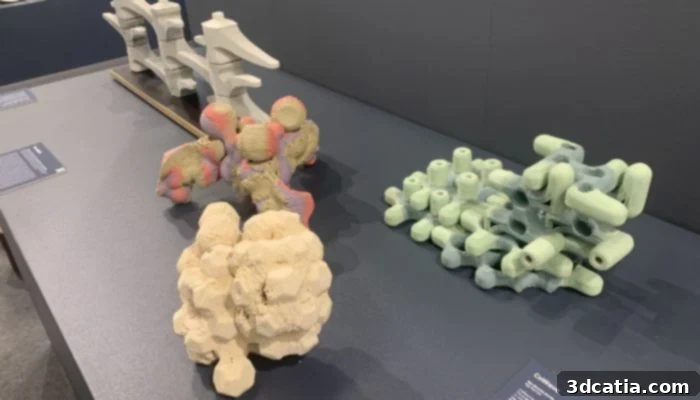
Examples of 3D printed pieces at the BE-AM booth
Despite these absences, we left Formnext 2025 with a very positive impression and a sense of constructive progress. Exhibitors consistently expressed satisfaction with the quality of discussions and interactions they experienced. There is a palpable feeling that the market is experiencing a slight upturn, and the coming years will be crucial for the continued development of the industry. While rapid growth is unlikely, a gradual and sustainable expansion is anticipated.
It is important to remember that additive manufacturing currently represents only a small fraction of the broader manufacturing market. It will be fascinating to observe how 3D printing technologies are further integrated into this larger ecosystem in the future. We have also witnessed a growing trend toward solutions that combine 3D printing with traditional manufacturing techniques, presenting a significant opportunity for innovation. We anticipate seeing even more hybrid machines at next year’s event!
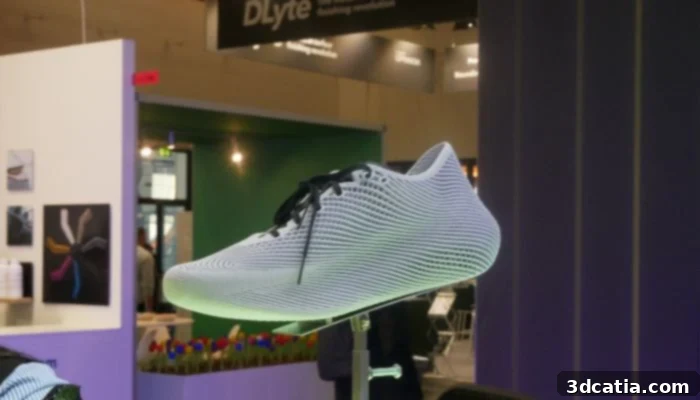
Some stands only presented applications (Photo credits: 3Dnatives)
One thing is certain: we eagerly anticipate the eleventh edition of Formnext, scheduled to take place from the 17th to the 20th of November, 2026. If you attended Formnext 2025, please feel free to share your thoughts and experiences in the comments section below. You can also connect with us on Facebook or LinkedIn! Plus, don’t forget to subscribe to our free weekly Newsletter to stay up-to-date on the latest 3D printing news. You can also find all our videos on our YouTube channel.