
Aston Martin DBR22: How 3D Printing Drives the Future of Luxury Automotive Design
The allure of advanced technology has steadily drawn numerous companies within the automotive sector towards the transformative power of additive manufacturing. From iconic brands like Bugatti and Porsche, to volume manufacturers such as Chevrolet, a growing consensus sees 3D printing as an indispensable tool. This technology is being embraced across the entire spectrum of vehicle design and production, from everyday buses to the most exclusive luxury automobiles. This widespread adoption underscores additive manufacturing’s critical role in addressing modern automotive challenges, offering unprecedented flexibility in design, rapid prototyping capabilities, and the potential for significant weight reduction, all crucial for enhancing performance and efficiency.
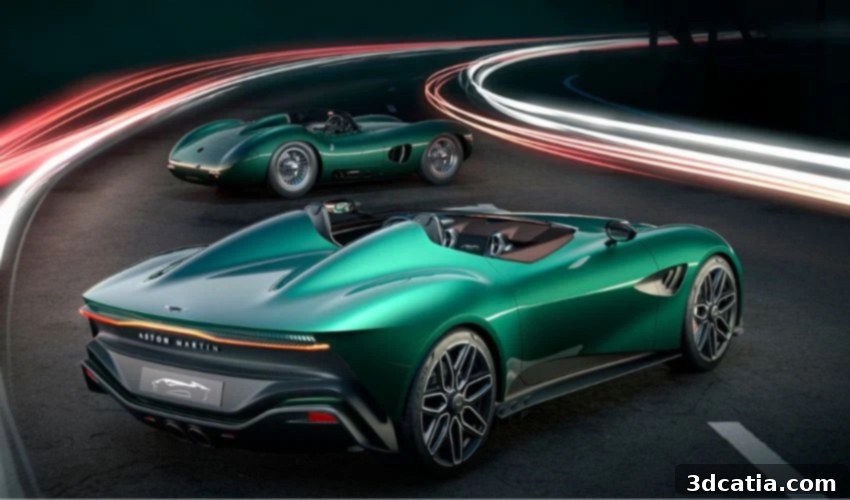
Recently, the spotlight shone brightly on the esteemed British luxury car manufacturer, Aston Martin. At the prestigious Pebble Beach Concours d’Elegance, held from August 19 to 22 in California, the company unveiled its latest masterpiece: the DBR22. This extraordinary vehicle was conceived as a special tribute to celebrate the tenth anniversary of Q by Aston Martin, the brand’s bespoke division dedicated to crafting unique supercars. The DBR22 immediately captured attention not only for its breathtaking design, which harks back to Aston Martin’s rich racing heritage, but also for its remarkable lightness – a characteristic significantly enhanced by the strategic integration of 3D printed components. This innovative move by Aston Martin is a clear indicator of how even the most traditional luxury automotive brands are leveraging cutting-edge manufacturing techniques to push the boundaries of performance and design, setting new benchmarks for the industry.
The DBR22: A Fusion of Heritage and High-Tech Innovation
The DBR22 stands as a testament to Aston Martin’s unwavering commitment to blending its storied past with the innovations of tomorrow. Designed with a clear focus on agility, speed, and an immersive driving experience, the vehicle embodies the spirit of classic open-cockpit sports cars while incorporating futuristic technologies. The choice to utilize 3D printing for critical structural elements is a pivotal aspect of its engineering philosophy. This advanced approach allows for the creation of geometries that would be impossible or impractical to achieve with conventional manufacturing methods, contributing directly to both the car’s aesthetic appeal and its dynamic performance. The DBR22 exemplifies how modern manufacturing techniques can support and enhance traditional automotive craftsmanship, resulting in a vehicle that is both a nod to the past and a leap into the future.
Roberto Fedeli, Aston Martin’s technical director, articulated the profound significance of these advancements in the car’s manufacturing process and features: “Technology is pivotal in the construction of DBR22, with extensive use of carbon fibre throughout, and the use of 3D printing for the manufacture of a structural component. As such DBR22 showcases Aston Martin’s unique capabilities, with world-class design combined with an agile, intelligent approach to engineering and production. For a car that was designed to celebrate the ultimate bespoke customisation service, the engineering developments mean DBR22 truly has the dynamic theatre to match, ensuring the drive is just as addictive as its looks.” Fedeli’s statement highlights a dual advantage: the technological sophistication that enables superior performance through lightweighting and structural optimization, and the intelligent manufacturing approach that seamlessly supports Aston Martin’s renowned bespoke customization services. This synergy ensures that the DBR22 is not just a high-performance machine but also a highly personalized work of art, tailor-made for discerning enthusiasts.
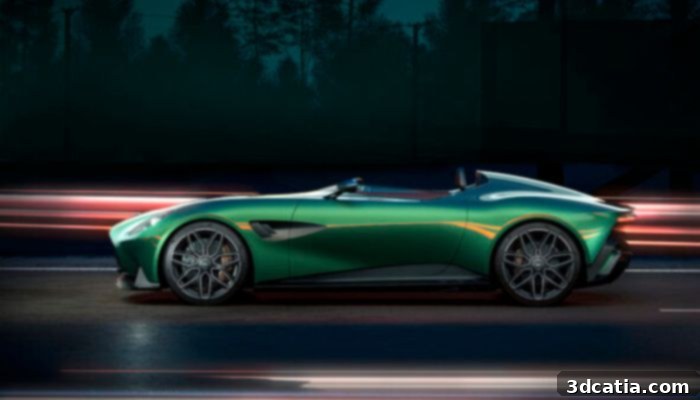
Photo Credits: Aston Martin
Additive Manufacturing and Its Impact on Automotive Engineering
While Aston Martin has not publicly disclosed the specific 3D printing technologies or machines employed for the DBR22, the company confirmed a groundbreaking application: the rear subframe. This marks a significant milestone, as it is the first instance where Aston Martin has utilized additive manufacturing for such a crucial structural component. The decision to use a high-performance composite material, specifically carbon fiber, for this part is a strategic one, chosen for its exceptional strength-to-weight ratio. This material choice is pivotal, as it allows the structural component to offer unparalleled rigidity and durability while significantly contributing to the car’s overall lightness. In a high-performance vehicle like the DBR22, every gram saved translates into improved acceleration, enhanced handling dynamics, and greater overall efficiency, directly impacting the driving experience.
The Rise of Carbon Fiber in Additive Manufacturing
The choice of carbon fiber for the DBR22’s subframe comes as no surprise within the advanced manufacturing landscape. For several years, this material has witnessed a dramatic surge in popularity within the additive manufacturing sector. Its unique properties, enabling the design and production of extremely strong parts while simultaneously reducing their mass, make it ideal for applications where performance and weight are critical factors. The inherent characteristics of carbon fiber — its high tensile strength and low density — are perfectly complemented by the design freedom offered by 3D printing. This combination allows engineers to create intricate internal lattice structures or optimized external geometries that maximize structural integrity while minimizing material usage.
Carbon fiber-filled materials are now omnipresent across a diverse range of industries beyond automotive, including high-performance footwear, competitive cycling, aerospace, and medical devices. The ability to 3D print complex geometries with carbon fiber allows engineers to optimize parts for maximum performance, overcoming the limitations of traditional casting, forging, or machining. This level of design freedom is a true game-changer, enabling the creation of components that are not only lighter and stronger but also integrate multiple functions into a single, cohesive part, further reducing assembly complexity and overall vehicle weight.
Broadening Horizons: 3D Printing in the Modern Automotive Field
As observed across numerous industrial sectors, 3D printing continues to gain significant traction and popularity within the automotive field. When combined with the latest generation of high-performance materials, additive manufacturing technology presents automotive players with an array of unprecedented opportunities in terms of design, rapid prototyping, tooling fabrication, and even end-use production. The case of the DBR22 serves as a prime example of this evolving paradigm, showcasing how bespoke, high-value components can be manufactured with efficiency and precision that were previously unattainable. This is particularly true for luxury and high-performance vehicles, where customization, optimal performance, and limited production runs are paramount, making traditional mass production methods less suitable or cost-effective.
Beyond structural components, 3D printing plays a vital role in various stages of automotive development and production. During the initial prototyping phase, engineers can rapidly iterate designs, testing different configurations of parts like air ducts, interior console elements, or aerodynamic body components within hours or days, rather than weeks or months. This drastically accelerates the development cycle, reduces costs associated with traditional tooling, and allows for extensive design exploration. For specialized tooling and jigs on the assembly line, 3D printing offers custom, on-demand solutions that improve manufacturing efficiency, enhance worker ergonomics, and adapt quickly to design changes. Furthermore, for niche vehicle production, concept cars, or classic car restoration projects, additive manufacturing provides the indispensable means to create rare or discontinued parts without the prohibitive expense of re-tooling or maintaining vast inventories.
Marek Reichman, Aston Martin Chief Creative Officer, beautifully encapsulated the innovative spirit driving the DBR22’s creation: “We set our design systems to “hyper-drive”, pushing the exploration of formalism further and endeavouring to express a future in the here today. Where could we go with the surfaces, proportion and form. Combining this approach with advanced process, technology, and materials, we’ve effectively modernised our racing bloodline and created a new pedigree. DBR22 is a hot-blooded, purebred Aston Martin sports car full of speed, agility and spirit, and a machine that we think will be the basis of many of tomorrow’s icons.” Reichman’s vision vividly underscores how 3D printing acts as a powerful catalyst, empowering designers to transcend conventional manufacturing constraints. It facilitates the realization of complex, organic shapes and optimized internal structures that are simultaneously lighter, stronger, and more aerodynamically efficient. This capability is not merely about making individual parts; it’s about fundamentally reimagining what a vehicle can be, seamlessly blending artistic expression with cutting-edge engineering brilliance to create truly iconic automobiles.
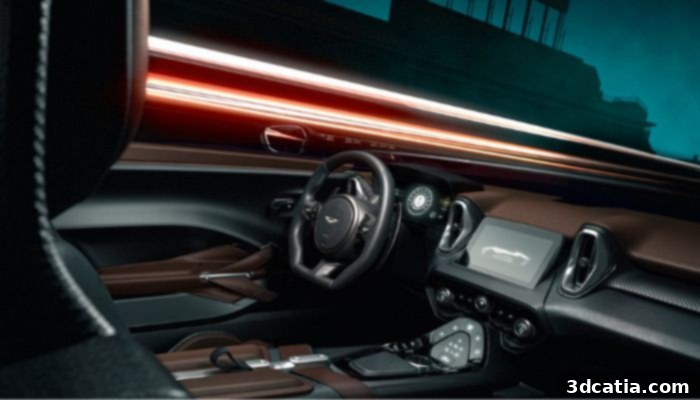
Photo Credits: Aston Martin
The advancements seen in the DBR22 are not isolated incidents but reflect a broader, transformative trend across the high-performance automotive landscape. From Formula 1 teams leveraging 3D printed parts for aerodynamic efficiency and instantaneous weight reduction, to electric vehicle manufacturers utilizing additive manufacturing for optimized battery housings, cooling systems, and innovative cabin designs, the technology is rapidly becoming a cornerstone of innovation. The unparalleled flexibility and precision offered by 3D printing enable engineers to push the boundaries of design and performance, creating vehicles that are not only faster and more efficient but also potentially more sustainable through optimized material use and reduced waste. Aston Martin’s DBR22, with its strategically placed 3D printed structural component, serves as a shining example of how traditional craftsmanship and cutting-edge technology can converge harmoniously to create a truly exceptional driving machine, paving the way for future automotive masterpieces and redefining luxury performance.
For more in-depth information about the DBR22, you can refer to the official press release HERE.
What are your thoughts on the Aston Martin DBR22 and the increasing role of 3D printing in luxury automotive manufacturing? Share your insights by leaving a comment below or engaging with us on ourLinkedIn,Facebook, andTwitter pages! Don’t miss out on the latest 3D printing news; remember to sign up for our free weeklyNewsletter here, delivered straight to your inbox! You can also explore all our video content on ourYouTube channel.
*Cover Photo Credits: Aston Martin