
AI-Driven Breakthroughs: Revolutionizing Titanium 3D Printing for Enhanced Performance and Efficiency
Manufacturing intricate parts from titanium alloys has long been characterized by its inherent complexity, high cost, and time-consuming processes. Even with the advent of advanced techniques like metal 3D printing, the industry has largely relied on a laborious trial-and-error approach to gradually pinpoint optimal manufacturing conditions. This iterative method, while eventually yielding results, significantly slows down production and inflates costs. Despite these challenges, titanium parts are indispensable, holding immense value across critical sectors such as aerospace, defense, and maritime industries due to their exceptional strength-to-weight ratio and corrosion resistance. Recognizing the urgent need to accelerate the production of these high-demand components and drive down associated expenses, researchers at the Johns Hopkins Applied Physics Laboratory (APL) and the Whiting School of Engineering embarked on a quest for innovative solutions. Their efforts have culminated in the development of a groundbreaking technology that leverages artificial intelligence (AI) to enable rapid, stable, and remarkably precise processing of titanium parts specifically for additive manufacturing applications.
This pioneering research by APL underscores a growing trend of integrating AI across diverse scientific and engineering disciplines, exploring its vast potential while carefully considering its inherent risks and implications. The seminal study, titled “Machine learning enabled discovery of new L-PBF processing domains for Ti-6Al-4V,” was published in the prestigious journal *Additive Manufacturing* in December 2024. This publication highlights the transformative opportunities that AI presents for process control and optimization within advanced manufacturing. As indicated by its title, the research team specifically concentrated on the titanium alloy Ti-6Al-4V. This particular alloy is highly prized across numerous industries for its unparalleled combination of high strength, low density, and excellent biocompatibility. The overarching objective of the research was to establish optimal processing conditions that would not only accelerate the additive manufacturing of this critical alloy but also consistently yield end parts characterized by superior precision and enhanced mechanical properties.
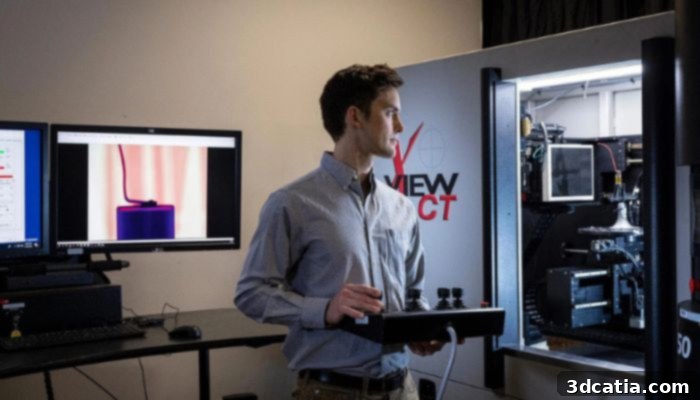
Brendan Croom, a senior materials scientist at Johns Hopkins APL, in the lab (photo credits: Johns Hopkins APL/Ed Whitman)
AI Expands the Horizons of Titanium Alloy Processing
The processing conditions applied during manufacturing inherently dictate the final material properties of any component. For titanium alloys, parameters such as laser power, scanning speed, layer thickness, and hatch spacing are critical determinants of the material’s microstructure, solidification behavior, and ultimately, its mechanical attributes—whether the part is robustly solid, optimally flexible, or prone to brittleness. Achieving the correct configuration of these process parameters is therefore paramount for ensuring the high quality and performance of the end products. Traditionally, this intricate balancing act has been managed through extensive, costly, and time-intensive iterative cycles of trial and error, followed by meticulous adjustments and empirical validation.
To drastically shorten this protracted procedure and conserve valuable resources, the pioneering researchers at APL and the Whiting School of Engineering have engineered sophisticated AI-driven models specifically designed to identify previously unknown or overlooked conditions within Laser Powder Bed Fusion (LPBF) 3D printing processes. The core intelligence of this AI system lies in its ability to discern intricate, hidden patterns and correlations within vast datasets of prior experimental outcomes. Based on this learned intelligence, the AI can then proactively suggest highly promising new approaches for subsequent manufacturing attempts. Brendan Croom, a senior materials scientist at APL and a key figure in this research, emphasized the broader implications of their work: “This isn’t just about manufacturing parts more quickly. It’s about striking the right balance among strength, flexibility, and efficiency. AI is helping us explore processing regions we wouldn’t have considered on our own.” This statement underscores the AI’s capacity to transcend human intuition and conventional wisdom, opening up entirely new frontiers for material processing.
According to the detailed findings of the study, the AI system demonstrated an extraordinary capability to predict the most advantageous processing conditions. These AI-predicted parameters were initially rigorously tested in virtual environments, leveraging advanced simulation techniques, before being physically implemented and validated in the laboratory. The remarkable results derived from these experiments challenge long-held assumptions and established boundaries within additive manufacturing. They definitively illustrate that AI offers completely novel avenues for processing titanium alloys, which in turn unlocks unprecedented possibilities for their subsequent application. The traditional “processing window” for materials like Ti-6Al-4V has often been constrained by empirical knowledge and conservative estimates, leading engineers to avoid certain parameter combinations perceived as risky or detrimental.
“For years, we assumed that certain processing parameters were ‘off-limits’ for all materials because they would result in poor-quality end product,” explained Croom. “But by using AI to explore the full range of possibilities, we discovered new processing regions that allow for faster printing while maintaining — or even improving — material strength and ductility, the ability to stretch or deform without breaking. Now, engineers can select the optimal processing settings based on their specific needs.”
This paradigm shift means that engineers are no longer bound by conventional wisdom. Instead, they can leverage AI-powered insights to precisely tailor manufacturing processes to specific application requirements, choosing settings that optimize for speed, strength, ductility, or a combination thereof. This level of granular control and predictive capability was previously unattainable through traditional methods, heralding a new era of data-driven manufacturing. The ability to increase printing speed without compromising—and in some cases, even enhancing—critical material properties like strength and ductility represents a significant leap forward. This not only promises to reduce manufacturing lead times but also to lower production costs, making high-performance titanium components more accessible and economically viable across industries.
The results of the study are unequivocally promising, particularly for those industries heavily reliant on high-performance titanium parts, which stand to benefit significantly from this leap in processing efficiency. These sectors include, but are not limited to, commercial aviation, advanced aerospace exploration, critical defense applications, and specialized shipbuilding. In aviation, lighter and stronger components translate directly to increased fuel efficiency and operational longevity. For aerospace, AI-optimized titanium parts can withstand extreme conditions, ensuring the reliability of spacecraft and satellite components. Within the defense sector, the ability to rapidly produce customized, high-strength titanium components can enhance the performance and agility of military hardware. Similarly, in shipbuilding, improved corrosion resistance and structural integrity for marine components are vital. While the initial study focused exclusively on the Ti-6Al-4V alloy, the developed AI-driven methodology holds immense potential for broader applicability. The underlying principles and machine learning models could be adapted and extended to optimize the processing of a wide array of other challenging materials, including various high-temperature alloys, nickel-based superalloys, and other advanced materials critical to additive manufacturing, thereby unlocking new capabilities across the advanced materials landscape.
Looking ahead, the research team is committed to further refining its groundbreaking approach. The next phase involves optimizing the machine learning model itself, which may entail exploring more sophisticated algorithms, integrating larger and more diverse datasets, and developing more robust validation techniques. This ongoing optimization could enable the AI to predict even more complex material behaviors, such as the evolution of microstructures under various thermal conditions, the distribution of residual stresses, and the potential for thermal distortion during and after printing. Furthermore, the team plans to expand its focus beyond strength and ductility to investigate how AI can optimize other crucial material properties. These include overall part density, fatigue strength (resistance to cyclic loading), creep resistance (deformation under sustained stress at high temperatures), specific types of flammability resistance, and enhanced corrosion resistance. Despite the extensive roadmap for future research, the initial results already represent a resounding success, demonstrating the immense potential of this synergistic approach. “This work has clearly demonstrated the power of AI, high-throughput testing, and data-driven manufacturing,” stated Croom, encapsulating the transformative impact of their findings. The full study, providing comprehensive details of the methodology and results, can be accessed HERE.
What are your thoughts on the revolutionary use of AI to push the inherent limitations of titanium alloys in Laser Powder Bed Fusion (LPBF)? We invite you to share your perspectives and insights in a comment below or join the conversation on our LinkedIn, Facebook, and Twitter pages! Don’t miss out on the latest advancements in 3D printing; sign up for our free weekly Newsletter here to receive news directly in your inbox. Additionally, you can explore all our engaging videos on our dedicated YouTube channel.
*Cover Photo Credits: SciTechDaily.com