
NASA’s LINA Lunar Base: Pioneering 3D Printed Habitats for Artemis and Beyond
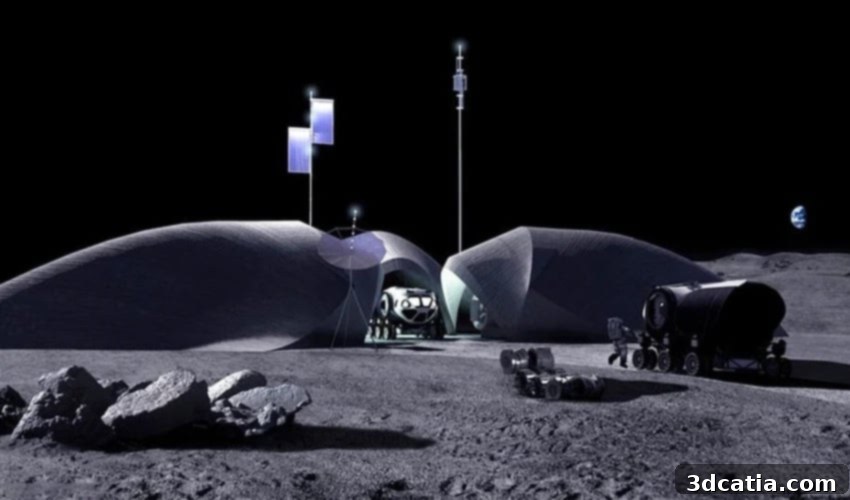
Humanity stands on the cusp of a new era in space exploration, with NASA spearheading ambitious missions to return to the Moon and establish a long-term presence. Central to this vision is the groundbreaking Artemis Mission, which aims not just for fleeting visits but for sustained lunar habitation. A crucial component of this future is LINA (Lunar Infrastructure Asset), an innovative 3D-printed base camp being developed through a strategic collaboration between NASA and AI Space Factory. This revolutionary lunar bunker is designed to serve as a robust, protective, and functional habitat where astronauts and robots can live, work, and conduct critical scientific research on the Moon’s surface. With the capacity to house astromobiles, sophisticated telecommunication devices, and essential habitation modules, LINA represents a monumental leap forward in off-world construction. Beyond providing living quarters, its primary function is to shield its occupants from the harsh lunar environment, offering unparalleled protection against intense radiation, seismic lunar quakes, extreme thermal fluctuations, and dangerous micrometeorites. Furthermore, the base will be equipped with a cutting-edge photovoltaic “tree” system, efficiently capturing and converting solar energy to power its operations, ensuring self-sufficiency and sustainability.
The ambitious timeline for NASA’s Artemis program targets a human return to the Moon by 2025, with a broader objective of establishing a sustainable lunar presence by 2028. This long-term vision extends beyond mere scientific discovery; it aims to foster technological advancements that will pave the way for a thriving lunar economy and, ultimately, facilitate human exploration of Mars. LINA plays a pivotal role in this grand strategy, providing the foundational infrastructure for such extended stays. The development of the materials used for this 3D-printed lunar bunker is a testament to rigorous scientific inquiry. Synthesized by NASA’s esteemed Granular Mechanics and Regolith Operations Laboratory, the specialized composite material has undergone extensive validation. These materials were subjected to stringent static extrusion tests within a vacuum environment, meticulously simulating the extreme conditions of the Moon to ensure their integrity, durability, and performance under extraterrestrial pressures.
LINA: Designing for Lunar Life and Long-Term Habitation
The design of LINA, or Lunar Infrastructure Asset, is the brainchild of the innovative American company AI Space Factory. Their vision is centered on enabling astronauts to sustain long-duration missions on the lunar surface, a critical step towards establishing a permanent human outpost. A significant aspect of LINA’s construction methodology is its reliance on autonomous robots. These robotic builders will be responsible for 3D printing the entire shelter on-site, minimizing the need for extensive human intervention and reducing the risks associated with manual construction in a hazardous environment. The base is conceptualized as a modular structure, comprising three distinct units, each spanning an impressive 75 square meters. These individual modules are intelligently separated by a common courtyard, covering 90 square meters, designed to foster collaboration, social interaction, and provide additional protected space for equipment or experiments.
Strategically, the LINA shelter will be situated at the lunar south pole, a location of immense scientific and strategic importance. This region is famously known as the “Peak of Eternal Light” due to the almost constant solar radiation it receives. This continuous sunlight is crucial for powering the photovoltaic tree system, ensuring a reliable and renewable energy source for the base. Beyond energy, the lunar south pole offers another invaluable resource: water ice. Within permanently shadowed craters near the proposed site, ice deposits are believed to exist in significant quantities. The ability to collect and process this ice would be a game-changer, providing not only potable water for astronauts but also a potential source of oxygen for life support and hydrogen for rocket fuel, essential for future deep-space missions and in-situ resource utilization (ISRU).
The robust design and innovative materials of the LINA bunker project a remarkable life expectancy of at least 50 years. This longevity is paramount for establishing a sustainable human presence on the Moon. A critical engineering challenge for any lunar habitat is protection against the myriad threats of the space environment. LINA addresses these challenges head-on. Its thick outer shell, primarily constructed from lunar regolith – the loose soil and dust covering the Moon’s surface – provides exceptional shielding. This regolith covering acts as a natural barrier, protecting astronauts from the harmful effects of both solar flares and cosmic radiation, which are significantly more intense on the Moon than on Earth. Additionally, the regolith layer offers superior defense against relentless bombardments of micrometeorites, tiny space debris that can inflict considerable damage. The structure is also engineered to withstand lunar quakes, seismic events unique to the Moon, and to insulate against the extreme thermal changes, which can range from a blistering 120°C (250°F) in sunlight to a freezing -170°C (-280°F) in shadow. The commitment to such comprehensive protection underscores the dedication to astronaut safety and mission success.
To thoroughly test and validate LINA’s design and materials, a prototype is currently being manufactured at NASA’s Kennedy Space Center. This facility is uniquely equipped to reproduce the harsh and unforgiving conditions expected on the lunar surface. By subjecting the prototype to temperatures ranging from an icy -170ºC to a scorching 70ºC, engineers can rigorously assess its structural integrity, thermal performance, and overall resilience. These ground-based simulations are vital for identifying and mitigating potential risks before the actual construction takes place on the Moon. This meticulous testing ensures that when LINA is finally deployed, it will meet the stringent demands of supporting human life in an extraterrestrial environment, providing a safe and reliable sanctuary for future lunar explorers.
Reflecting on the transformative potential of LINA, the design team at AI Space Factory eloquently stated, “As we expand the horizon of what is possible in the future, LINA is an architectural and technological milestone that sets a precedent for conducting explorations farther out than our moon.” This powerful statement highlights LINA’s significance not just as a lunar habitat, but as a blueprint for future deep-space colonization. A key innovation enabling this vision is the strategic inclusion and utilization of regolith. This loose lunar rock has garnered significant interest among NASA scientists working on 3D printing applications, primarily because it offers a sustainable and locally sourced building material. By leveraging regolith, future missions can drastically reduce the amount of material that needs to be transported from Earth, significantly cutting launch costs and enabling the construction of larger, more complex structures on other planets or satellites like the Moon. This approach embodies true sustainability in off-world construction, moving away from Earth-reliant logistics towards self-sufficient, in-situ resource utilization.

Structure of the LINA base, showcasing its modular design and robust construction intended for lunar habitation.
The Artemis Mission: A Phased Approach to Lunar Exploration
The Artemis Mission is a meticulously planned, multi-phased program designed to gradually and safely return humans to the Moon and establish a foundation for future exploration. It represents the culmination of decades of spaceflight knowledge and cutting-edge technology. The mission is structured into three distinct and progressively complex phases:
The inaugural phase, **Artemis I**, successfully launched in late 2022. This uncrewed test flight was crucial for demonstrating the performance of NASA’s powerful Space Launch System (SLS) rocket and the Orion spacecraft. During this phase, mannequins equipped with sensors were sent on a journey around the Moon, gathering vital data on radiation levels, acceleration forces, and other environmental factors that future human crews will experience. Artemis I paved the way for manned flights by rigorously testing the hardware, systems, and operational procedures without risking human lives, ensuring that all components could withstand the rigors of deep-space travel.
Following the success of Artemis I, the next critical phase is **Artemis II**, tentatively scheduled for May 2024. This mission will mark a historic milestone as it will be the first crewed flight to the Moon since Apollo 17 in 1972. Four astronauts will fly close to the satellite, completing a lunar flyby but without landing on its surface. This mission will serve as a crucial dress rehearsal, allowing the crew to test Orion’s systems with humans on board, practice critical maneuvers, and gain invaluable experience operating in deep space. It will provide essential data on life support systems, crew dynamics, and the overall human experience of prolonged spaceflight beyond Earth orbit, ensuring preparedness for the subsequent landing mission.
Finally, the climax of the initial Artemis program will be **Artemis III**, targeted for 2025. This last stage will be the one that finally transfers humans to the lunar surface, marking the first human lunar landing in over 50 years. This mission carries profound historical significance as it aims to achieve two unprecedented milestones: it will be the first time for both a woman and a person of color to set foot on the Moon. Beyond these groundbreaking human achievements, Artemis III will focus on specific scientific objectives, including detailed geological surveys and the collection of lunar samples from the unexplored South Pole region, where LINA is planned to be established. This mission will lay the groundwork for a sustained human presence, beginning the process of validating surface operations, setting up initial equipment, and preparing for the eventual construction of habitats like LINA. You can learn more about the intricacies of this monumental endeavor by visiting the official NASA Artemis program page HERE.
The development of LINA and the execution of the Artemis Mission signify humanity’s unwavering commitment to expanding its presence beyond Earth. By leveraging cutting-edge technologies like 3D printing and advanced robotics, and by strategically utilizing in-situ resources like lunar regolith, NASA and its partners are not just planning a return to the Moon; they are building the foundation for a sustainable, multi-planetary future. This endeavor promises not only profound scientific discoveries but also the inspiration for generations to come, fostering innovation and pushing the boundaries of what is possible. LINA stands as a beacon of this ambition, representing the next giant leap in human space exploration, paving the way for eventual voyages to Mars and beyond. It embodies the spirit of collaboration, ingenuity, and perseverance that defines our quest to understand and explore the cosmos.
What are your thoughts on LINA and its potential to revolutionize lunar exploration? Let us know in a comment below or on our LinkedIn, Facebook, and Twitter pages! Don’t forget to sign up for our free weekly Newsletter here, the latest 3D printing news straight to your inbox! You can also find all our videos on our YouTube channel.
*Cover Photo Credits: AI Space Factory