
Elevating Performance: A Comprehensive Guide to Chopped vs. Continuous Fiber 3D Printing
In the realm of additive manufacturing, when designs demand superior mechanical properties or specific functionalities that conventional plastics cannot provide, composite 3D printing emerges as a powerful solution. This advanced technique allows for the creation of parts that can surpass the strength of certain metals while offering unparalleled performance characteristics. At its core, a composite material is defined as the combination of two or more distinct materials, engineered to achieve novel or enhanced properties that neither component could offer individually. While various types of composites exist, this discussion will focus specifically on those formed by a polymer matrix reinforced with fibrous materials. Within the dynamic 3D printing industry, carbon fiber, glass fiber, and Kevlar (aramid fiber) stand out as the three most prevalent fiber types employed for reinforcing 3D printed composites, each imparting unique advantages to the final product.
This article delves into the fascinating world of 3D printing with fiber-reinforced composites, specifically differentiating between chopped fiber and continuous fiber reinforcement. These two methodologies yield distinct results and are implemented using different additive manufacturing technologies. However, for both types of fiber reinforcement, material extrusion, particularly Fused Filament Fabrication (FFF), remains the most popular and widely adopted technology, and thus will be a primary focus here. We will explore the fundamental similarities and crucial differences between these techniques, providing insights into their characteristics, processing methods, benefits, limitations, and real-world applications. Understanding these distinctions is paramount for engineers and designers seeking to select the most suitable type of reinforcement for a particular application, thereby optimizing part performance and production efficiency. Let’s embark on a detailed exploration of these cutting-edge composite 3D printing solutions.

Photo Credits: Anisoprint
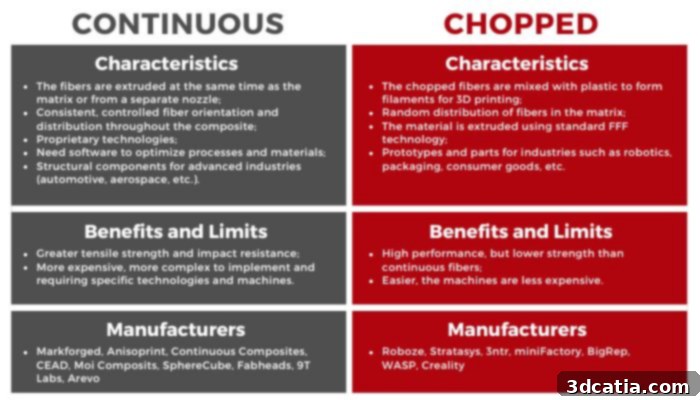
Characteristics of Chopped and Continuous Fiber Composite Materials
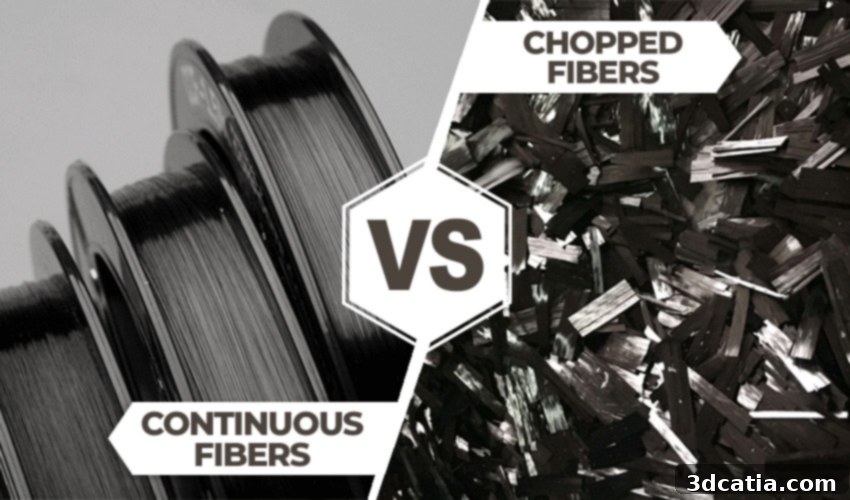
When discussing fiber reinforcement in 3D printing, the terms “chopped fibers” or “short fibers” refer to small, discrete segments of fibrous material. The length of these fibers can vary significantly, ranging from several centimeters down to mere millimeters or even sub-millimeter scales. This concept is analogous to reinforcing concrete with small pieces of rebar, where the fibers are uniformly dispersed throughout a plastic polymer matrix. In this configuration, these short fibers act as localized reinforcements, enhancing the overall mechanical integrity and properties of the material in a more isotropic fashion across the printed part.
In stark contrast, “continuous fibers” or “long fibers” consist of uninterrupted strands that span the entire length or critical sections of a composite part. These continuous filaments are strategically integrated into a plastic matrix during the 3D printing process, resulting in a composite material with highly directional, anisotropic properties. This direct integration creates a powerful synergy, combining the inherent properties of the polymer with the superior mechanical attributes of the fiber. Before delving into the intricacies of their additive manufacturing processes and the design considerations for parts made with these materials, it’s essential to understand their fundamental characteristics.
Both chopped and continuous fiber composites share a common underlying composition: a reinforcing fiber and a polymer matrix. The fiber component is primarily responsible for imparting the exceptional mechanical properties, such as tensile strength, stiffness, and impact resistance. The polymer matrix, on the other hand, acts as a binder and protective casing, ensuring that the reinforcing fibers are securely held together and properly aligned. This adhesion between the fiber and the matrix is crucial for efficient load transfer and overall material performance. The choice of matrix compounds, which commonly include thermoplastics like PLA, ABS, polypropylene (PP), HIPS, and PETG, directly influences the printability and baseline properties of the composite. Similarly, the selection of reinforcing fibers – typically glass, carbon, or aramid – dictates the specific advanced characteristics the final material will possess. Once chosen, these two elements are meticulously combined to form a single, high-performance composite material.
The manufacturing process for chopped fiber filaments typically involves an extrusion technique. In this method, the short fibers are pre-mixed with the polymer pellets. This blend is then melted and extruded through a die to form a continuous filament. During this stage, precise control over temperature and extrusion speed is critical to ensure a homogeneous dispersion of the fibers within the polymer matrix, preventing clumping and ensuring consistent material properties throughout the filament spool.
Continuous fibers, when processed into a usable filament form, often undergo a coextrusion process. Here, the continuous fiber strand is impregnated with a special resin or polymer blend, which is then cured and solidified around the fiber. This creates a pre-impregnated (pre-preg) filament that can be fed into a 3D printer. Beyond pre-manufactured filaments, some advanced production systems are capable of directly molding the matrix and reinforcement simultaneously during the layer-by-layer deposition process, essentially impregnating the fiber *in situ* as the part is being built. Regardless of the processing method, a critical factor for optimal performance in both chopped and continuous fiber composites is the cleanliness and purity of the fibers, as any contaminants can significantly impair adhesion to the polymer matrix and consequently reduce the mechanical strength of the final part.

Difference of the arrangement of chopped and continuous fibers in the matrix (photo credits: Coperion)
The resultant properties of these fiber-reinforced materials are highly dependent on both the chosen polymer matrix and the specific type of fiber reinforcement. It’s an obvious truth that if a high-performance technopolymer, such as PEEK or PEI, serves as the base plastic material, the composite will exhibit far more advanced properties compared to those derived from standard engineering plastics. For instance, a composite with polypropylene (PP) as its matrix polymer will offer a robust combination of good basic wear resistance, excellent impact-absorbing capacity, and enhanced toughness and flexibility, making it suitable for durable applications. Conversely, if a more common material like PLA is used as the matrix, the composite will be significantly easier and more affordable to print but will inherently possess lower strength and a greater tendency to break, reflecting the inherent limitations of the base polymer.
As previously highlighted, the three primary types of fibers utilized for both chopped and continuous reinforcement are carbon, glass, and aramid (Kevlar). Carbon fibers are arguably the most widely adopted in advanced manufacturing industries due to the exceptional strength, stiffness, and low weight they impart to final parts, making them ideal for high-stress applications. Glass fiber reinforcements, while generally more affordable, still offer good strength and improved stiffness, though typically not reaching the performance levels of carbon fiber. They are also known for their electrical insulation and corrosion resistance. Finally, aramid fibers, most famously known as Kevlar, are renowned for their outstanding impact and abrasion resistance, which is why they are frequently used in protective gear like bulletproof vests and other applications requiring superior toughness and energy absorption. In essence, the overarching goal of integrating either chopped or continuous reinforcing fibers into a polymer matrix is to produce parts that are not only significantly stronger and more durable but also remarkably lightweight, pushing the boundaries of what additive manufacturing can achieve.
3D Printing Processes for Chopped and Continuous Fibers
The vast majority of 3D printers designed to process composite materials, particularly those integrating fibrous reinforcements, rely on the material extrusion method. For Fused Filament Fabrication (FFF) 3D printing with chopped fibers, the process closely mirrors that of printing with unreinforced thermoplastics. In this scenario, short fibers, precisely cut into small pieces, are pre-mixed with the thermoplastic polymer and extruded together to form a composite filament. This filament is then spooled and used in standard FFF 3D printers. The process involves heating this composite filament in the extruder, melting the thermoplastic matrix, and then extruding it through a nozzle to deposit material layer by layer, building the part from the bottom up. The fibers are merely suspended within the molten thermoplastic. A critical consideration for chopped fiber FFF is the use of a hardened steel or ruby nozzle, as the abrasive nature of the fiber strands, especially carbon and glass, can quickly wear down standard brass nozzles, leading to poor print quality and frequent replacement.
In contrast, the 3D printing of continuous fiber composites is considerably more intricate and specialized. In a typical material extrusion setup for continuous fibers, a dual-nozzle system is frequently employed. One nozzle is dedicated to depositing the polymer matrix material (which can be a thermoplastic or a thermoset resin), while a second, separate nozzle or guiding mechanism feeds the continuous fiber strand into the print head. Alternatively, a single, highly specialized nozzle head might be engineered to integrate and mix the fiber with the matrix material just before deposition. The essence of this process lies in precisely arranging these continuous fibers with a specific orientation and trajectory within the polymer matrix. The matrix functions as a structural casing, encapsulating and protecting the reinforcing fibers while simultaneously ensuring their exact placement throughout the part’s geometry.
To ensure robust adhesion and load transfer between the continuous fibers and the polymer matrix, a thermosetting resin-based matrix or a specialized filler is commonly utilized. This matrix material is then subjected to an *in-situ* curing process, typically initiated by ultraviolet (UV) light or a precisely controlled heat source. This curing step chemically fuses the deposited layers and materials, resulting in a strong, monolithic composite structure. The description of this process intentionally remains somewhat generic because numerous manufacturers have developed and patented their own proprietary technologies for 3D printing continuous fiber composites. While these technologies share common principles, they often differ in subtle but significant ways regarding fiber impregnation, matrix curing, and overall machine architecture, each offering unique advantages in terms of material compatibility, speed, and part quality.
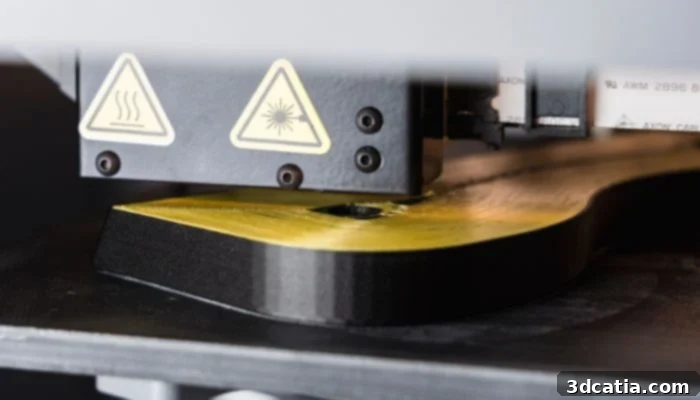
3D printing of a polymer matrix and Kevlar fiber reinforcement.(Credits: Markforged)
A critically important aspect when designing and printing parts with fibers, particularly continuous fibers, is the diligent use of Finite Element Analysis (FEA) software. FEA is a sophisticated computational method used to predict how a component will react under various external forces, loads, and environmental stimuli. For continuous fiber composites, FEA software allows engineers to meticulously analyze material characteristics and precisely define the optimal pattern and orientation according to which continuous fibers should be arranged within the polymer matrix. This enables the creation of highly anisotropic parts, where strength is maximized along specific load paths. However, this precision often necessitates certain design limitations to prioritize the correct placement and alignment of the fibers, which directly impacts the performance and structural integrity of the part. By employing a controlled process guided by FEA, specific material properties can be tailored to meet exact application requirements. While FEA can also be used for chopped fiber composites, its application differs significantly; in chopped fiber parts, it is generally not possible to precisely control the amount or exact position of individual deposited fibers. Instead, the chopped fibers are typically modeled as a single, homogenized material with the matrix, assuming a more uniform, though less optimized, reinforcement effect.
Benefits and Limitations
The adoption of 3D printing with composites brings forth a host of significant advantages. Foremost among these are the greatly increased flexibility and speed of production, enabling rapid prototyping and iteration, as well as the unparalleled ability to fabricate intricate, complex geometries that would be impossible or cost-prohibitive with traditional manufacturing methods. A particularly powerful benefit unique to continuous fiber 3D printing is the precise control it offers over the deposition process. This allows designers to strategically decide where and how to place reinforcing fibers within the part, optimizing strength and stiffness exactly where needed, thereby creating highly engineered and efficient components.
When examining the advantages of both chopped and continuous fibers as reinforcements in 3D printing, several common benefits emerge. Both types of fibers consistently deliver superior mechanical strength compared to their unreinforced plastic counterparts. Specifically, they significantly enhance the stiffness and rigidity of the base material, while also dramatically improving its fatigue resistance and ability to withstand impact loads without failure. Furthermore, fibers such as carbon fiber are exceptionally lightweight, a crucial property that contributes to substantial weight reduction in parts where mass is a critical performance factor, such as in aerospace or automotive applications.
Despite their numerous advantages, both chopped and continuous fiber 3D printing methodologies come with inherent limitations. A common hurdle is the requirement for specialized 3D printing equipment. Unlike standard FFF machines, composite printers often feature hardened components, advanced thermal management systems (like heated build chambers and high-temperature nozzles), and sometimes multi-extrusion capabilities. Additionally, processing composite materials introduces a complex set of challenges, particularly concerning the adhesion between the fiber and the plastic matrix. Achieving optimal interfacial bonding is paramount for effective load transfer and often requires careful material selection, process parameter optimization, and sometimes the use of coupling agents or surface treatments.
Nevertheless, the two types of fibers diverge in several key aspects. The primary limitation of chopped fibers, when compared to continuous fibers, is their generally less effective reinforcement capability. This is largely due to the random or semi-random orientation and distribution of chopped fibers throughout the composite. While they improve bulk properties, they cannot provide the directional strength and stiffness that continuous fibers offer, which are laid down in a highly controlled and specific manner. Consequently, the reinforcement effect with chopped fibers is less pronounced and may not suffice for demanding applications requiring extremely high strength-to-weight ratios or specific anisotropic performance. However, a significant advantage of chopped-fiber composites is their relative ease of processing and lower cost, both in terms of material and printer acquisition, making them a more accessible entry point into composite 3D printing. They also tend to be compatible with a wider variety of standard plastic materials, affording greater design flexibility for applications where ultimate strength is not the sole driving factor.
Applications
The strategic choice between continuous and short fibers, as well as the specific polymer matrix, is entirely dictated by the intended application and the precise performance requirements of the final part. Continuous fibers are unequivocally the ideal choice for applications that demand exceptional strength, high stiffness, and superior performance under extreme loads. Conversely, short fibers are far more suitable for projects prioritizing ease of processing, affordability, and applications where the highest levels of anisotropic strength are not strictly necessary.
Given their superior mechanical properties, continuous fibers are predominantly utilized for structural components in highly advanced and demanding industries. In the automotive sector, they find application in chassis reinforcements, lightweight interior components, and specialized brackets, contributing to both vehicle performance and fuel efficiency. The aerospace industry extensively employs continuous fiber composites for critical support structures, aircraft components, and tooling, where their exceptional strength-to-weight ratio is invaluable for reducing overall aircraft mass and improving operational efficiency. Beyond industrial applications, continuous fibers are also implemented in high-performance consumer products that require robust strength and durability, such as high-end bicycles, advanced sporting equipment, and lightweight drone frames.
Meanwhile, 3D printed short fiber composites serve a broad range of purposes, especially where prototyping speed and cost-effectiveness are key. They are commonly employed in the production of functional prototypes, allowing engineers to quickly test designs and iterate on product development. These composites are also frequently specified for parts within the packaging industry, robotics (for lightweight end-effectors or structural components), and various consumer products where improved stiffness and durability over unreinforced plastics are desired, but without the cost or complexity associated with continuous fibers. Their versatility makes them suitable for a myriad of components that do not necessitate extreme tensile strength or highly directional load-bearing capabilities.
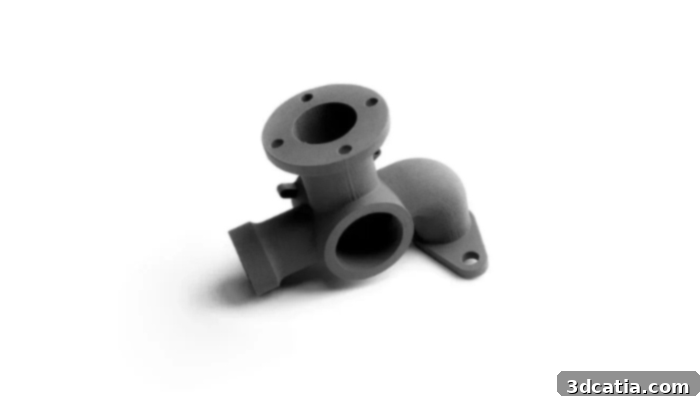
Piece made of PEEK carbon fiber (photo credits: Weerg)
Manufacturers and Prices
The market for 3D printing solutions designed for both short and continuous fiber composites, while perhaps not as expansive as that for standard polymers and metals, is remarkably diverse, offering a spectrum of options from sophisticated robotic arms and large-scale industrial printers to more accessible desktop solutions. Among the leading providers of continuous fiber 3D printing solutions, Markforged stands out with its proprietary Continuous Fiber Fabrication (CFF) technology, offering a range of both desktop and industrial-grade machines. These systems are capable of printing high-performance composites using a variety of matrix materials such as PLA, TPU, White Nylon, Onyx™ (a nylon-carbon micro-fiber blend), and ULTEM™, reinforced with continuous carbon fiber, Kevlar, or fiberglass. Similarly, Anisoprint provides advanced solutions for continuous fiber 3D printing through its unique Composite Fiber Co-extrusion (CFC) technology, allowing for strong and lightweight parts. Their desktop solutions offer wide flexibility with open systems supporting various materials, while their industrial ProM IS 500 solution is compatible with high-performance engineering plastics like PEI, PEEK, and PEKK, pushing the boundaries of material performance.
Beyond these pioneers, other innovative companies are contributing to the continuous fiber 3D printing landscape. Continuous Composites, for instance, is developing advanced processes for highly automated, freeform composite structures, while CEAD specializes in Large Format Additive Manufacturing (LFAM) solutions for continuous fiber, enabling the production of exceptionally large and robust composite parts. This segment of the industry is also a hotbed of innovation, with numerous startups actively researching and patenting new 3D printing processes for continuous fiber composites. Noteworthy emerging players include Moi Composits, SphereCube, Fabheads, 9T Labs, and Arevo, among others, each striving to refine and expand the capabilities of this transformative technology.
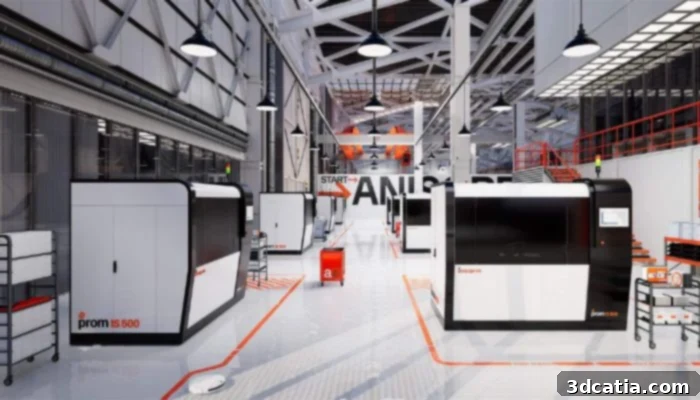
Photo Credits: Anisoprint
It is also important to note that reinforcement with continuous fibers is not exclusively limited to the primary additive manufacturing process. For example, the Spanish startup Reinforce 3D has introduced its innovative CFIP (Continuous Fiber Injection Process) technology. This unique approach allows for the reinforcement of parts with continuous fibers during the post-processing stage, offering a versatile method to add strength and durability to additively manufactured components after they have been initially printed.
Regarding manufacturers of 3D printers for chopped fiber composites, the landscape is primarily populated by producers of FFF (Fused Filament Fabrication) machines that are specifically engineered to process high-performance materials reinforced with carbon fiber or other chopped fibers. These machines often feature robust construction, upgraded extruders, and hardened nozzles to handle the abrasive nature of these materials. Prominent manufacturers in this category include industrial stalwarts like Roboze, Stratasys, 3ntr, and miniFactory, as well as large-format specialists such as BigRep, and more accessible desktop and prosumer brands like WASP and Creality. This list, while comprehensive, is by no means exhaustive, reflecting the widespread adoption of chopped fiber capabilities across various segments of the FFF market.
When it comes to pricing, the primary distinguishing factor is intrinsically linked to the type and scale of the machine utilized. For both chopped and continuous fiber 3D printing, industrial-grade solutions typically command a high price point. This is due to the inherent complexities and stringent requirements of processing these advanced materials, which often necessitate specialized printing conditions such as extremely high nozzle and chamber temperatures, precision motion control, and sophisticated material handling systems. For more accessible options, desktop machines capable of 3D printing short fiber composites can be acquired for as little as $400, offering an affordable entry into performance-enhanced 3D printing. Desktop solutions for continuous fiber 3D printing, while still significantly more expensive, generally start from around $9,000, reflecting the increased technological complexity. For industrial-scale solutions, particularly those involving continuous fibers or specialized processes, manufacturers often do not publicly disclose prices. These high-end systems can range from several tens of thousands to hundreds of thousands of dollars, depending on their capabilities, size, and level of automation. In such cases, prospective buyers typically need to request direct quotes through the manufacturers’ official websites to obtain accurate pricing information.
What are your thoughts on our detailed comparison of chopped and continuous fibers for 3D printing? We invite you to share your insights in a comment below or connect with us on our LinkedIn, Facebook, and Twitter pages! Don’t forget to sign up for our free weekly newsletter here to receive the latest 3D printing news directly in your inbox. You can also explore all our informative videos on our dedicated YouTube channel for further learning and visual insights into the world of additive manufacturing.