

Artemis II’s 3D-Printed Titanium Space Toilet: Debunking Myths and Exploring Additive Manufacturing in Deep Space
The launch of the Artemis II mission on April 1 marked a monumental step in humanity’s return to the Moon, carrying four astronauts on the first crewed journey around our celestial neighbor in over half a century. Aboard the Orion capsule, an essential piece of equipment captured significant public interest: the Universal Waste Management System (UWMS). This cutting-edge device holds the distinction of being the first functional toilet system to embark on a lunar mission, a critical component for long-duration spaceflight. Since its prominent role on Artemis II, the UWMS has frequently been characterized as a “3D-printed titanium toilet.” But how accurate is this widely circulated claim, and what role does advanced manufacturing truly play in this crucial piece of space hardware?
The UWMS itself is not a newly conceived system, but rather the culmination of years of dedicated research and development. Collins Aerospace initiated its design and engineering efforts back in 2015, operating under a substantial $30 million contract awarded by NASA. An initial, foundational version of the system was successfully delivered to the International Space Station (ISS) in 2020, where it underwent rigorous testing and validation in a microgravity environment. The particular iteration of the UWMS that flew aboard the Orion capsule during Artemis II represents a more compact, refined, and significantly optimized adaptation of that original design, specifically tailored for the unique and demanding requirements of deep space missions, where every gram and cubic centimeter counts.
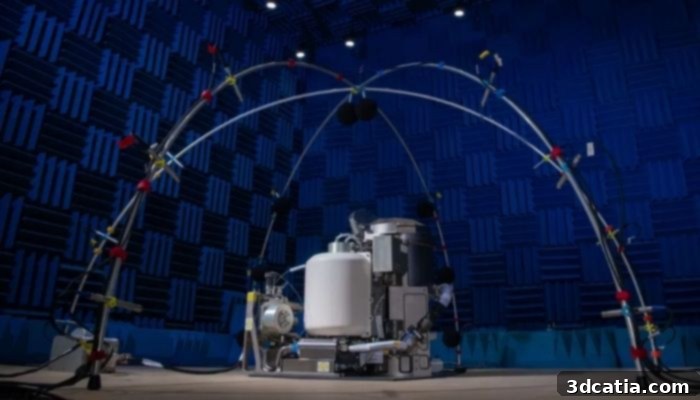
The Universal Waste Management System (UWMS) installed on the International Space Station (Photo Credits: NASA).
Where Advanced 3D Printing Technology Comes Into Play
The perception of the entire toilet being 3D-printed, while understandable given the excitement surrounding additive manufacturing in space, requires a closer look at the actual facts. In September 2020, mere days before the UWMS made its journey to the International Space Station, NASA provided a crucial clarification on its official Tumblr account. The agency explicitly stated that the system incorporated “a 3D-printed titanium cover for its dual fan separator.” This component, known as the Dual Fan Separator (DFS), is undeniably the mechanical heart of the UWMS. Its primary function is to generate the necessary airflow that, in the absence of gravity, effectively directs both solid and liquid waste towards designated collection containers. Therefore, what NASA identified as being fabricated using 3D printing was specifically the cover of this highly critical component, not the entirety of the toilet system as often misreported.
Further supporting this nuanced understanding, astronaut Andrew Morgan provided additional context during a virtual conference with the National Science Foundation around the same period. He emphasized that the UWMS “also demonstrates a lot of new technologies, including 3D-printed titanium parts,” subtly confirming that while additive manufacturing was integral, it applied to specific components rather than the entire assembly. This distinction is vital for accurately understanding the application of cutting-edge manufacturing techniques in space hardware.
Why 3D Printing Was the Ideal Choice for These Critical Parts
While the precise manufacturing details are proprietary and not publicly disclosed, the underlying design logic behind utilizing additive manufacturing for components like the DFS housing can be readily inferred from the nature of the part itself and the demands of space applications. The DFS housing features an incredibly complex geometry, incorporating distinct volutes for each impeller, meticulously engineered airflow channels with varying pressure requirements, and a dedicated housing for the centrifugal separator, complete with its integrated gear reducer. Attempting to manufacture such an intricate, multi-faceted geometry from titanium as a single, monolithic piece using conventional methods would be an exceptionally challenging, if not impossible, endeavor. This is precisely the kind of complex engineering problem where advanced additive manufacturing (AM) technologies, particularly metal 3D printing, demonstrate their unparalleled value.
The selection of titanium as the material for these critical components was a deliberate and strategic decision. Titanium is renowned for its exceptional properties, including its high strength-to-weight ratio, which is paramount for weight-sensitive space applications, and its outstanding resistance to corrosion. This latter characteristic is particularly crucial for the UWMS, as the system must effectively handle urine, which undergoes an acidic pre-treatment process to prevent microbial growth and facilitate subsequent processing. Traditional manufacturing approaches would likely necessitate the fabrication of multiple individual parts that would then need to be assembled, often involving welding, brazing, or fastening. In contrast, 3D printing enables the consolidation of what would otherwise be numerous separate components into a single, integrated part. This consolidation yields significant benefits: it dramatically reduces the overall part count, simplifies the assembly process, and, most importantly, eliminates potential failure points associated with interfaces, welds, or fasteners. Ultimately, this leads to a lighter, more robust, and more reliable system, directly contributing to the mission’s safety and success.
Despite the advanced engineering, the UWMS did encounter several operational challenges during the Artemis II mission. Approximately one hour after launch, the DFS electronic controller experienced a malfunction, ceasing to operate. Days later, mission control faced another issue when urine froze within the external vent line, necessitating a maneuver to rotate the Orion capsule and expose the frozen pipe to direct sunlight for thawing. It is important to clarify, at this current stage of investigation, that there is no indication whatsoever that the 3D-printed titanium parts contributed to these specific failures. These incidents highlight the inherent complexities and unforgiving nature of designing and operating systems in the extreme environment of deep space, where unforeseen conditions can test even the most meticulously engineered components.
Looking ahead to the ambitious Artemis III mission, which aims to land humans on the lunar surface for an extended period, the flawless operation of the UWMS will be absolutely critical. With two astronauts anticipated to spend weeks on the Moon, the system must perform without any of the issues experienced during Artemis II. Consequently, Collins Aerospace and NASA are engaged in a comprehensive post-mission assessment. This crucial evaluation will meticulously analyze the fatigue, corrosion resistance, and structural integrity of every component within the UWMS, particularly after enduring the intense vibrations of launch and prolonged exposure to the extreme thermal variations of deep space. Understanding how these materials and components, including the 3D-printed elements, perform under such strenuous conditions is vital for future long-duration missions.
Should the collected performance data explicitly include insights into the behavior and durability of the 3D-printed titanium parts, it will provide invaluable direct evidence regarding the efficacy and reliability of additive manufacturing techniques for applications far beyond low Earth orbit. This information will be instrumental in validating and advancing the use of AM for future lunar bases, Mars missions, and other deep space exploration initiatives. The ability to manufacture complex, high-performance parts on demand, potentially even using extraterrestrial resources like lunar regolith, could revolutionize how space hardware is designed, produced, and maintained in the vast reaches of space. We will be watching these developments closely, as the success of these seemingly small components could pave the way for humanity’s grandest spacefaring dreams.
What are your thoughts on the Universal Waste Management System used in the Artemis II mission and the role of 3D printing in space exploration? We encourage you to share your insights and comments below, or join the discussion on our LinkedIn or Facebook pages! Additionally, don’t miss out on the latest advancements and news in additive manufacturing by signing up for our free weekly Newsletter, delivered straight to your inbox. You can also explore our extensive library of videos on our YouTube channel for more engaging content.
*Cover Photo Credit: NASA/Bill Ingalls