

Revolutionizing Orthopedics: The World’s First 3D-Printed Toe Joint Replacement Poised for FDA Clearance
In a groundbreaking collaboration set to redefine orthopedic care, Anatomic Implants, a pioneering medical device startup based in Washington, DC, has announced its intention to seek 510(k) clearance for the world’s first 3D-printed toe joint replacement. This significant development, made possible through a strategic partnership with AddUp, represents a monumental leap forward in the medical industry. While the application of 3D-printed implants in various medical fields is well-established, this specific innovation promises to unlock new possibilities for patients suffering from debilitating foot conditions, particularly given the impressive observed success of this novel implant design.
Anatomic Implants has spearheaded the creation of what they describe as a revolutionary metatarsophalangeal (MTP) joint replacement. This state-of-the-art implant leverages advanced titanium 3D printing technology to achieve unparalleled anatomical precision. The device specifically targets the 1st MTP toe joint, located at the base of the big toe, a critical area highly susceptible to osteoarthritis. This degenerative joint disease is often the first to affect the foot, leading to excruciating pain, significant loss of balance, and a drastic reduction in the quality of life for millions worldwide. Current treatment options frequently fall short, highlighting the urgent need for more effective and durable solutions like the one proposed by Anatomic Implants.
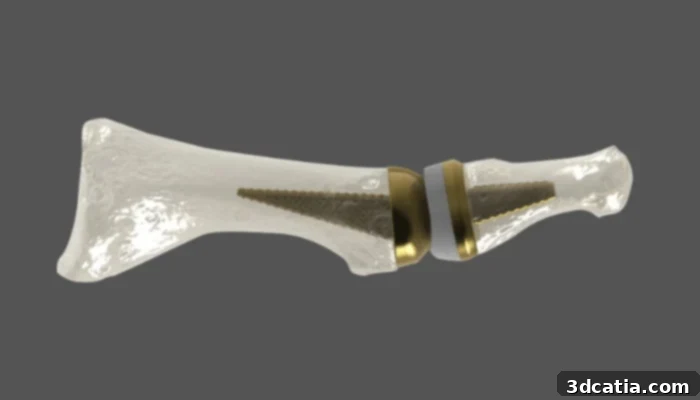
The Anatomic Great Toe Joint implant. (Photo Credits: AddUp)
Despite the global market for MTP joint reconstruction exceeding an impressive $500 million annually, patients and surgeons alike face a severe shortage of truly viable products to effectively treat osteoarthritis in this joint. A primary reason for this critical unmet need stems from the limitations of many existing designs: they are often not engineered to facilitate robust bone ingrowth, a crucial biological process where natural bone grows into and around the implant, securing it in place. Without adequate bone ingrowth, the body frequently perceives the implant as a foreign object, leading to rejection, loosening, and ultimately, surgical failure, necessitating painful and costly revision surgeries. This unfortunate reality underscores the profound challenges in current MTP joint replacement solutions and the potential for a paradigm shift.
The lack of effective and long-lasting options has rendered the MTP joint market a critically underserved domain. It is within this challenging landscape that the collaboration between Anatomic Implants and AddUp emerges as a beacon of hope. Their combined expertise is directly aimed at tackling the unique biomechanical and biological hurdles associated with MTP joint issues. By focusing on advanced manufacturing and material science, they aspire to deliver a truly promising and durable solution for individuals grappling with chronic pain and mobility limitations, potentially setting a new standard for orthopedic implants.
Unlocking Osseointegration: The Power of 3D Printing in Toe Joint Replacement
At the core of this innovative MTP joint replacement lies a sophisticated design principle: encouraging robust osseointegration. Leveraging the unparalleled capabilities of additive manufacturing, Anatomic Implants and AddUp have meticulously incorporated a porous structure into the implant’s design. This intricate, lattice-like architecture is engineered to promote the natural connection between living bone tissue and the implant material. Osseointegration is not merely a desirable feature; it is a critical factor dramatically enhancing the chances of the implant securely bonding with the patient’s bone. This biological integration minimizes the risk of implant rejection by the body, a common cause of failure in conventional implants. The result is significantly improved long-term patient outcomes, reduced post-operative complications, and an overall enhancement in patient well-being and mobility after the procedure, powerfully demonstrating the transformative benefits delivered by state-of-the-art 3D printing technologies in medical applications.
To bring this complex design to life, Anatomic Implants partnered with AddUp, specifically utilizing their cutting-edge FormUp 350 Powder Bed Fusion (PBF) printer. The FormUp 350 was chosen for its exceptional capability to produce highly complex, custom-tailored designs with unparalleled precision and consistency. This advanced additive manufacturing system allows for the creation of intricate internal structures and precise external geometries that perfectly meet the specific anatomical needs of individual patients. Such customization is nearly impossible with traditional manufacturing methods and is vital for optimal fit and function in orthopedic implants. Speaking enthusiastically on this pivotal collaboration, Anatomic Implants President David Nutter commented,
“We were excited to partner with AddUp to achieve 510(k) clearance after learning about their proprietary 3D printing technology and seeing how it could benefit the development of the Anatomic Great Toe Joint. We look forward to leveraging the AddUp team and their expertise to validate the world’s first 3D printed toe joint replacement on their FormUp 350.”
Navigating the Path to Market: 510(k) Clearance and Future Impact
The journey to widespread patient access requires a crucial step: 510(k) clearance from the U.S. Food and Drug Administration (FDA). This stringent regulatory process mandates a thorough assessment of the product’s safety and performance data, ensuring it is as safe and effective as any existing, legally marketed counterpart. The 510(k) submission will involve comprehensive testing, clinical data analysis, and detailed documentation to demonstrate the implant’s reliability, biocompatibility, and long-term efficacy. While full approval is not anticipated until the summer of this year at the earliest, the Anatomic Great Toe Joint implant will make its public debut and be showcased at the prestigious American Academy of Orthopaedic Surgeons (AAOS) Annual Conference in San Francisco, held from February 13th to 15th. This early presentation offers a unique opportunity for leading orthopedic surgeons and specialists to examine the innovative device firsthand and understand its potential to revolutionize MTP joint treatment. The successful clearance would not only validate the technology but also pave the way for a new era of personalized, effective orthopedic solutions, improving the lives of countless individuals suffering from chronic toe pain.
The potential impact of this 3D-printed toe joint replacement extends far beyond the big toe. This breakthrough signifies the increasing maturity and reliability of additive manufacturing in producing patient-specific, high-performance medical devices. The ability to precisely replicate human anatomy and integrate porous structures for superior osseointegration opens doors for similar innovations in other complex joint replacements, bone reconstruction, and personalized prosthetics. As 3D printing technology continues to advance, we can anticipate a future where implants are custom-designed not just for a specific joint, but for the unique biomechanics and pathology of each individual patient, leading to unprecedented levels of surgical success and patient satisfaction. This collaboration between Anatomic Implants and AddUp is a testament to the power of interdisciplinary innovation in addressing critical healthcare challenges and shaping the future of orthopedic surgery.
What are your thoughts on this pioneering collaboration between AddUp and Anatomic Implants and its implications for orthopedic medicine? We invite you to share your insights in a comment below or join the conversation on our LinkedIn, Facebook, and Twitter pages! Don’t miss out on the latest advancements in additive manufacturing by signing up for our free weekly Newsletter here, delivering the most relevant 3D printing news straight to your inbox! You can also find all our engaging videos and in-depth discussions on our YouTube channel.
*Cover Photo Credits: Anika Therapeutics