
AMUG 2019 Highlights: Unveiling Next-Generation Innovations in Additive Manufacturing
The Additive Manufacturing Users Group (AMUG) conference, held annually, serves as a pivotal gathering for professionals across the additive manufacturing spectrum. The 2019 edition, which took place from March 31st to April 4th in the vibrant city of Chicago, Illinois, was no exception, proving to be a landmark event for the industry. With roots tracing back to the early 1990s, when it was known as the 3D Systems North American Stereolithography Users Group and primarily focused on SLA technology, AMUG has profoundly evolved. Today, it stands as a comprehensive platform, dedicated to supporting users of all additive manufacturing technologies, encompassing rapid prototyping and advanced rapid manufacturing solutions. AMUG 2019 proudly hosted nearly 100 diverse sponsors from around the globe, featuring prominent industry leaders such as Stratasys, Carbon, Desktop Metal, HP, and GE Additive, among many others, all converging to showcase the latest advancements and foster collaborative innovation within the additive manufacturing ecosystem. This event solidified its reputation as a crucial forum for knowledge exchange, networking, and the unveiling of groundbreaking technologies that are shaping the future of industrial production.
Insightful Presentations and Keynotes at AMUG 2019
Widely acclaimed as the “largest and best AMUG” to date, the 2019 conference delivered an exceptional supporting program rich with diverse presentations, interactive workshops, and engaging competitions. These sessions provided attendees with unparalleled opportunities to gain insights from industry pioneers and experts. A highlight among the keynote speakers was Brad Keselowski, a renowned NASCAR driver and the visionary founder of Keselowski Advanced Manufacturing (KAM). Keselowski’s presentation, titled “Winning the Manufacturing Race,” resonated deeply with the audience, bridging the gap between high-performance motorsports and advanced manufacturing. He eloquently discussed how additive manufacturing technologies are critical for innovation, efficiency, and competitive advantage in modern industry, drawing parallels from his experience on the racetrack to the factory floor. His insights underscored the importance of speed, precision, and continuous improvement in both domains.
The conference continued its tradition of fostering deep dives into the personal and professional journeys of additive manufacturing leaders through the highly anticipated Innovators Showcase. This critical Wednesday presentation took the form of an insightful stage interview, offering attendees a unique perspective into the personal stories, challenges, and triumphs of leading figures in the AM sector. These candid discussions provided invaluable lessons on entrepreneurship, technological development, and market penetration, inspiring many to push the boundaries of what’s possible with 3D printing. Furthermore, Brian McLean, Director of Rapid Prototype at LAIKA, captivated the audience with his presentation, “The Art and Science behind LAIKA’s Oscar Award Winning 3D Printing Process.” McLean meticulously detailed how plastic 3D printing has revolutionized stop-motion animation, enabling the creation of intricate characters and props with unprecedented detail and consistency. His talk showcased the powerful synergy between cutting-edge additive manufacturing and creative artistic expression, highlighting 3D printing’s role in achieving award-winning visual storytelling.
BigRep Unveils the Advanced BigRep PRO Machine
At AMUG 2019, the renowned German manufacturer of large-format FDM machines, BigRep, seized the opportunity to introduce its revolutionary new 3D printer: the BigRep PRO. This innovative machine represents a significant leap forward in industrial additive manufacturing, engineered for unparalleled performance and integration. The BigRep PRO is fully automated, boasts seamless IoT integration, and is designed with 5G networking capabilities, marking it as a truly future-proof solution for demanding production environments. Its design ethos was inspired by the manufacturer’s successful predecessors, the BigRep ONE and STUDIO 3D printers, inheriting their robustness while pushing the boundaries of technology. As BigRep representatives meticulously explained at the show, the PRO is not merely an evolution; it’s a specialist machine meticulously crafted to empower companies with advanced capabilities. It is specifically engineered to print exceptionally large objects using industrial-grade materials, offering high precision, reliability, and speed. This enables businesses to tackle ambitious projects, from automotive prototypes and architectural models to functional end-use parts, with an efficiency and quality previously unattainable, thereby expanding the horizons of large-scale additive manufacturing.
Arkema Showcases High-Performance Materials for Industrial Additive Manufacturing
The French chemicals and advanced materials powerhouse, Arkema, effectively utilized AMUG 2019 as a strategic platform to highlight its extensive portfolio of high-performance materials specifically engineered for 3D printing. These cutting-edge materials are poised to unlock a plethora of new industrial applications, revolutionizing how various sectors approach design and production. Guillaume de Crevoisier, Global Business Director for 3D Printing Solutions at Arkema, emphasized the significance of the event, stating, “AMUG has always been a great venue for us to discuss new production applications and forge new partnerships.” This sentiment underscores the conference’s role in facilitating collaborations that drive material innovation and market adoption.
In the realm of polyamide powders, Arkema proudly showcased its Rilsan Polyamide 11 powders, distinguishing them as the only high-performance materials derived from a completely bio-based origin. This commitment to sustainability, coupled with exceptional mechanical properties, positions Rilsan Polyamide 11 as a leading choice for environmentally conscious industrial applications requiring strength and durability. Furthermore, the conference witnessed the introduction of eight groundbreaking products from Arkema’s N3xtDimension line of UV-curable resins. This significant launch included specialized resins tailored for specific performance characteristics: N3D-I200 for superior impact-resistance, N3D-F2110 for enhanced flexibility, and N3D-P2120 for high-quality prototyping, among others. Crucially, these new resins are designed for broad compatibility with leading additive manufacturing technologies, including SLA (Stereolithography) and DLP (Digital Light Processing), ensuring wider accessibility and application. Finally, Arkema’s strategic partner, 3DXTech, unveiled the innovative 3DXFlex TPE filament, crafted from Arkema’s high-performance Pebax elastomer. This particular elastomer is widely celebrated in sports markets for its outstanding energy return properties, promising new possibilities for applications requiring extreme elasticity and resilience in 3D printed parts.
Stratasys and Pantone Collaborate on ‘PANTONE Validated’ 3D Printers
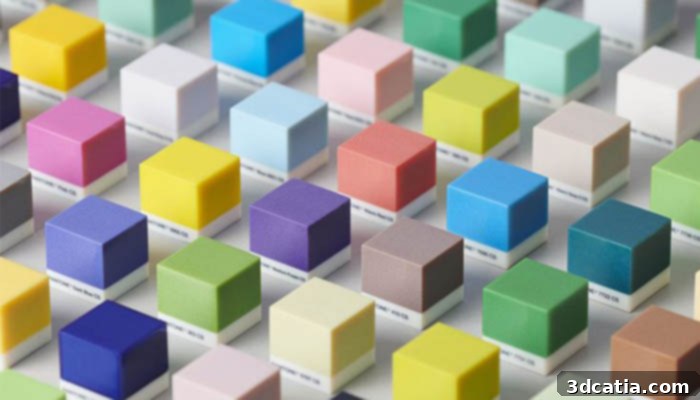
A significant announcement at the AMUG conference involved Stratasys revealing a groundbreaking agreement with Pantone, the global authority and provider of physical and digital color standards. This collaboration positions Stratasys as the pioneering 3D printing solutions provider whose technology is officially designated as “PANTONE Validated.” This endorsement signifies a monumental step forward for color accuracy and realism in additive manufacturing. Specifically, both the J750 and J735 PolyJet 3D printers from Stratasys have met Pantone’s rigorous standards for color quality and authenticity, ensuring that designers and engineers can produce prototypes with colors that precisely match their digital specifications.
The importance of Pantone’s validation cannot be overstated, as it sets a new benchmark for full design-to-production workflows where color integrity is paramount. Designers rely heavily on Pantone standards to communicate color accurately across different mediums and production stages, and now, 3D printing can seamlessly integrate into this process. A highly anticipated development from this partnership is that Stratasys customers are expected to gain direct access to Pantone functionality within the GrabCAD Print environment by July 2019. This integration will empower users to effortlessly assign and apply precise Pantone colors to their 3D printed models by simply browsing the relevant Pantone color books digitally. Hadas Schragenheim, Rapid Prototyping Manager at Stratasys, eloquently summarized the transformative potential of this alliance: “Our agreement with Pantone sets the stage for a revolution in design and prototype processes. As the industry’s first 3D printers officially ‘PANTONE Validated’, we’re allowing designers to build realistic prototypes faster than ever before – shrinking design-to-prototype and accelerating product time-to-market.” This strategic collaboration is set to significantly enhance prototyping capabilities, reduce iterative design cycles, and ultimately accelerate product development across various industries.
Stratasys Expands Portfolio with V650 Flex SLA and F120 FDM 3D Printers
The industry behemoth, Stratasys, continued to make waves at AMUG 2019 by unveiling two significant additions to its printer lineup: the V650 Flex and the F120. These launches underscore Stratasys’s commitment to broadening its technological offerings and addressing diverse market needs within additive manufacturing. The F120 industrial FDM 3D printer is a compact yet robust machine, meticulously engineered to serve the needs of engineers, designers, and educators. Its introduction aims to significantly broaden Stratasys’s FDM range, making industrial-grade FDM technology more accessible and versatile for various applications, from functional prototyping to manufacturing aids. The F120 focuses on ease of use, reliability, and consistent performance, enabling a wider audience to leverage the power of fused deposition modeling for their projects.
Perhaps even more notable was Stratasys’s strategic embarkation into a new market segment with the launch of its new SLA 3D printer, the V650 Flex. This move signifies Stratasys’s expansion beyond its traditional FDM and PolyJet strongholds, embracing stereolithography to offer customers a broader array of choices for high-precision, smooth-surface parts. The V650 Flex is designed to deliver exceptional accuracy, surface finish, and material versatility, catering to industries requiring fine details and aesthetic quality, such as automotive, medical, and consumer products. This strategic diversification positions Stratasys as an even more comprehensive provider in the additive manufacturing landscape. We provided an in-depth coverage of this pivotal launch at AMUG 2019, which can be explored further HERE for a detailed analysis of its features and implications.
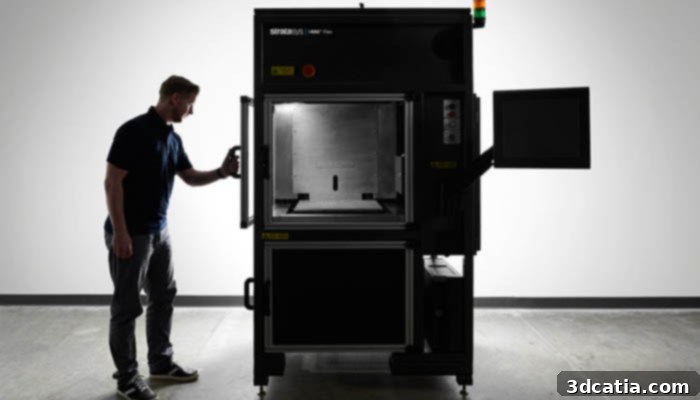
The V650 Flex 3D printer | Credits: Stratasys
Formlabs Introduces the Form 3 and Form 3L with Low Force Stereolithography
Another prominent player in the additive manufacturing arena, Formlabs, also utilized AMUG to unveil its latest innovations, further solidifying its position as a market leader. Four years prior, Formlabs had set a new industry benchmark with the launch of its Form 2 SLA machine, which quickly became a reference point for accessible, high-quality desktop stereolithography. Building upon this legacy of success and driven by relentless research and development, Formlabs introduced two groundbreaking new machines that leverage their proprietary Low Force Stereolithography (LFS) system: the Form 3 and Form 3L. These printers are built on this next-generation technology, which fundamentally re-engineers the SLA printing process. LFS technology significantly reduces the forces exerted on the part during printing, leading to dramatically improved reliability, superior print quality, and an expanded range of possible geometries. This innovation results in incredibly smooth surface finishes, sharper details, and robust support structures that are easier to remove, thus streamlining post-processing.
The Form 3 is designed as a desktop solution, catering to engineers, designers, and product developers who require precision and consistency for small to medium-sized parts. Complementing this, the Form 3L extends the benefits of LFS technology to large-scale printing jobs, offering a substantial build volume that enables the production of larger prototypes and end-use parts without compromising on quality or detail. This dual launch addresses a critical need in the market for both high-resolution desktop and large-format SLA capabilities, making advanced additive manufacturing more versatile and efficient. Formlabs’ commitment to innovation through the LFS system promises to deliver better reliability and significantly higher quality prints, whether for intricate models or expansive components, pushing the boundaries of what is achievable with resin 3D printing. Comprehensive information regarding this transformative launch can be found on our website, detailing the technical advancements and potential applications HERE.
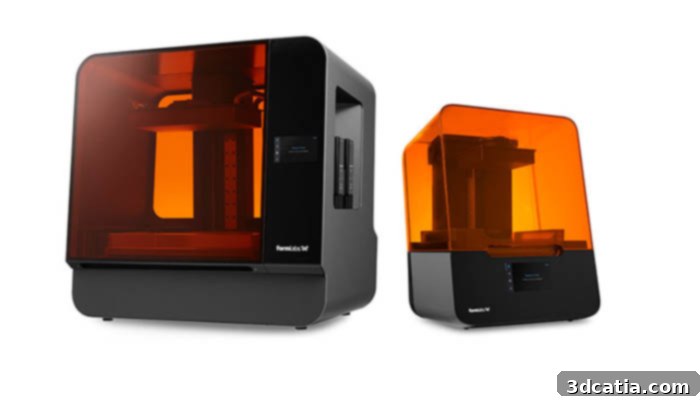
The Form 3 and 3L | Credits: Formlabs
The reveals at AMUG 2019 underscored a period of intense innovation and diversification within the additive manufacturing industry. From new materials that promise enhanced performance and sustainability to groundbreaking printer technologies designed for unparalleled precision and scale, the event showcased a vibrant future for 3D printing. Companies like BigRep, Arkema, Stratasys, and Formlabs demonstrated their unwavering commitment to pushing technological boundaries, developing solutions that cater to increasingly complex industrial demands. These advancements are not merely incremental; they represent foundational shifts that will enable faster product development, more efficient production processes, and the creation of entirely new categories of products across various sectors. The spirit of collaboration, knowledge sharing, and relentless pursuit of excellence evident at AMUG 2019 truly highlighted the transformative power of additive manufacturing.
What were your thoughts on these significant revelations and innovations showcased at AMUG 2019? We invite you to share your perspectives and let us know if this comprehensive overview proved valuable to you. Feel free to leave a comment below or connect with us on our Facebook and Twitter pages to join the discussion! For those keen on staying abreast of the latest developments and breakthroughs in the dynamic world of 3D printing, remember to sign up for our free weekly Newsletter. It delivers all the essential news and updates straight to your inbox, ensuring you never miss an important advancement in additive manufacturing!