
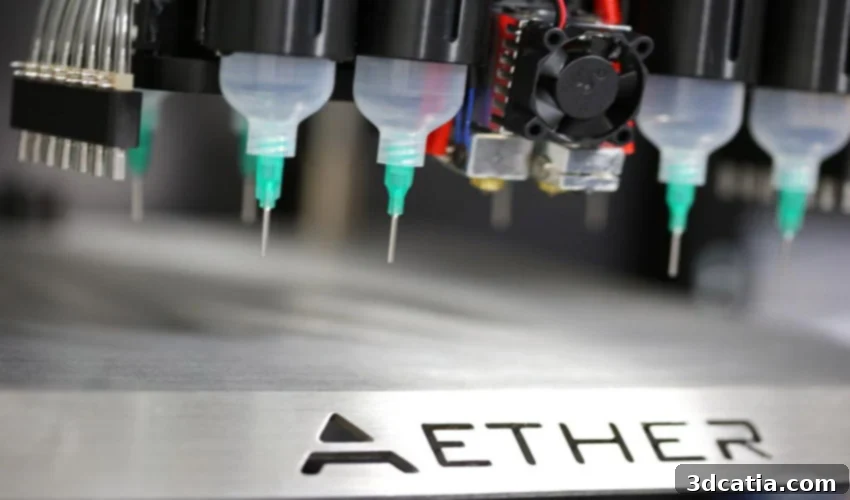
Aether and P&G Forge Alliance: Revolutionizing AI-Enhanced 3D Bioprinting and Intelligent Manufacturing
A groundbreaking collaboration is set to redefine the landscape of advanced manufacturing as Aether, the innovative San Francisco-based startup specializing in AI-enhanced 3D bioprinting, has announced a significant two-year joint development agreement with Procter & Gamble (P&G). This multinational consumer goods behemoth and the cutting-edge tech firm are pooling their expertise to accelerate the development of breakthrough 3D printing and artificial intelligence (AI) technologies. This strategic partnership signals a pivotal moment for both industries, promising to unlock unprecedented capabilities in product development, manufacturing efficiency, and personalized solutions across various sectors.
The Synergistic Vision: Merging 3D Printing and Artificial Intelligence
At the heart of this transformative collaboration lies an ambitious goal: to introduce a new, next-generation Aether 3D printer that will transcend the current limitations of additive manufacturing. Aether has already made significant strides with its flagship product, the Aether 1, a multi-material 3D bioprinter that integrates a sophisticated multi-tool hybrid manufacturing system into a single, cohesive device. What truly sets Aether 1 apart is its intelligent application of artificial intelligence to automate incredibly difficult and time-consuming tasks within the printing process. This integration of AI streamlines complex operations, enhances precision, and reduces the need for constant human intervention, thereby significantly accelerating research and development cycles.
The versatility of Aether 1 is evident in its remarkable ability to print with an extensive range of materials. From viscous pastes and gels to common filaments like ABS/PLA, as well as liquids, ceramics, and even foods, the printer’s broad material compatibility opens up a vast array of potential applications. This capability is crucial for bioprinting, where the precise deposition of diverse biomaterials is essential for creating complex tissue structures and organs. Beyond its commercial offerings, Aether has also been at the forefront of fundamental research, as evidenced by our report at the end of January, detailing Aether’s collaboration with UCL and Loughborough University on developing an ink containing nanoparticles designed to function as a nanosurgical tool. This ongoing research underscores Aether’s commitment to pushing the boundaries of what 3D printing, especially at the nanoscale, can achieve.
Photo: Business Wire
Ryan Franks, CEO and Founder of Aether, articulated the profound vision driving this partnership in a recent press release. He stated, “Aether is working with P&G to completely redefine 3D printing. It’s no longer going to be just about depositing a material or two in a specific pattern. We’re building something more like an intelligent robotic craftsman, able to perform highly complex tasks with many different tools, visually evaluate and correct its work throughout the fabrication process, and constantly learn how to improve.” This statement highlights a paradigm shift from traditional automated manufacturing to a more autonomous, intelligent system capable of intricate, adaptive production. It envisions a future where 3D printers are not just machines executing predefined commands but intelligent entities that can observe, analyze, and optimize their own processes in real-time, much like a skilled human artisan.
Technological Breakthroughs and Enhanced Capabilities in 3D Printing
The collaboration between Aether and P&G promises to introduce a suite of advanced features designed to significantly expand the capabilities of 3D printing systems. A key development announced is the integration of high-performance cameras with custom-designed hardware. This powerful combination will enable sophisticated new robotics capabilities on the 3D printer, allowing for unprecedented levels of precision, monitoring, and control during the printing process. These enhanced visual systems can provide real-time feedback, crucial for complex bioprinting applications where even minute deviations can impact the integrity and functionality of the printed object.
Further technological advancements will include the implementation of dynamic intelligent responses. This refers to the AI’s ability to make instantaneous decisions and adjustments, such as automatically modifying printing parameters or correcting errors as they occur. Imagine a printer that can detect a nozzle clog or a material inconsistency and automatically compensate for it, preventing costly failures and ensuring consistent print quality. Moreover, the project aims to enable the automatic performance of post-processing treatments directly on the printer, streamlining the entire manufacturing workflow by eliminating manual steps. Object recognition capabilities will also be integrated, allowing the printer to identify, categorize, and potentially even assemble printed components, moving closer to a fully autonomous manufacturing cell. These features collectively represent a leap towards truly “intelligent” manufacturing, where machines are not just programmed to build, but also to perceive, adapt, and refine their own output.
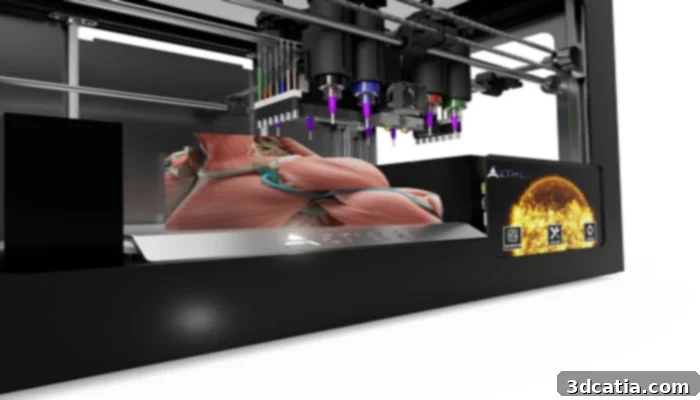
The Aether and P&G joint development project will lay the groundwork for the future of 3D bioprinting. (Photo: Business Wire)
Procter & Gamble’s Strategic Interest in Advanced Bioprinting
The involvement of a global consumer goods leader like Procter & Gamble highlights the vast potential of AI-enhanced 3D bioprinting beyond traditional medical applications. For P&G, this collaboration signifies a strategic investment in technologies that could revolutionize product development, manufacturing processes, and ultimately, consumer experiences. The ability to rapidly prototype complex product components with varied materials, or even explore novel forms of personalized consumer goods, aligns perfectly with P&G’s continuous drive for innovation. Imagine custom-tailored skincare products bioprinted on demand, or advanced material components for household items that are more sustainable and perform better. This partnership is not just about advancing technology for technology’s sake; it’s about harnessing cutting-edge science to deliver superior, more personalized, and more efficiently produced consumer solutions.
Furthermore, P&G’s interest could extend to developing advanced research tools for materials science, product testing, and even creating complex in-vitro models for toxicology or efficacy testing, reducing reliance on animal testing. The multi-material capabilities of Aether’s technology could lead to innovations in packaging, fragrances, and even specialized hygiene products that integrate multiple functional layers or textures. This synergy between Aether’s deep technological expertise in bioprinting and AI, and P&G’s immense market reach and product development needs, creates a powerful ecosystem poised to generate significant industry impact.
Accelerating Research and Development through Advanced Automation
Beyond hardware innovations, Aether is also focusing on developing additional software designed to automate image processing. This initiative aims to provide a substantial increase in speed over conventional manual processing methods, which are often laborious and prone to human error. In fields like scientific research and advanced prototyping, where rapid iteration and precise analysis of printed structures are critical, automating image processing can dramatically shorten development cycles. For instance, analyzing the quality and structural integrity of bioprinted tissues, or inspecting complex prototypes, can be achieved much faster and with greater consistency through AI-driven image recognition and analysis.
This advanced automation platform is expected to propel 3D printing into an even wider range of applications and unlock its full potential. For example, the speed and accuracy of prototyping across industries could reach unprecedented levels, allowing for faster design iterations and product launches. Similarly, scientific research, particularly in fields like regenerative medicine, pharmacology, and materials science, could benefit immensely from the ability to quickly and reliably fabricate and analyze complex experimental setups. The vision is to make 3D printing not just a manufacturing tool, but an intelligent, self-optimizing system that can accelerate discovery and innovation across the board, moving closer to the goal of personalized manufacturing at scale.
The Future Landscape of 3D Bioprinting and AI
The joint development project between Aether and P&G is more than just a collaboration; it’s a foundational effort that will lay significant groundwork for the future of 3D bioprinting and intelligent manufacturing. By combining Aether’s pioneering AI-enhanced bioprinting technology with P&G’s vast resources and market insight, this partnership is set to drive innovations that could profoundly impact healthcare, consumer products, and industrial processes. The ability to create highly complex, multi-functional objects with unparalleled precision, efficiency, and autonomy will unlock new possibilities in regenerative medicine, personalized pharmaceuticals, and sustainable product development.
As these technologies mature, we can anticipate a future where manufacturing is not only more agile and responsive to demand but also more intelligent and self-correcting. This intelligent robotic craftsmanship, as envisioned by Ryan Franks, holds the promise of manufacturing systems that continuously learn, improve, and adapt, leading to higher quality products, reduced waste, and faster innovation cycles. The implications for on-demand manufacturing, customized goods, and complex scientific experimentation are truly exciting, marking a new era where the boundaries of what’s possible with additive manufacturing are continually being pushed forward.
What are your thoughts on this groundbreaking new collaboration and its potential impact on 3D printing and AI? We invite you to share your insights and predictions in a comment below or join the conversation on our Facebook and Twitter pages! For all the latest news and developments in the world of 3D printing, don’t forget to sign up for our free weekly Newsletter, delivered straight to your inbox.