
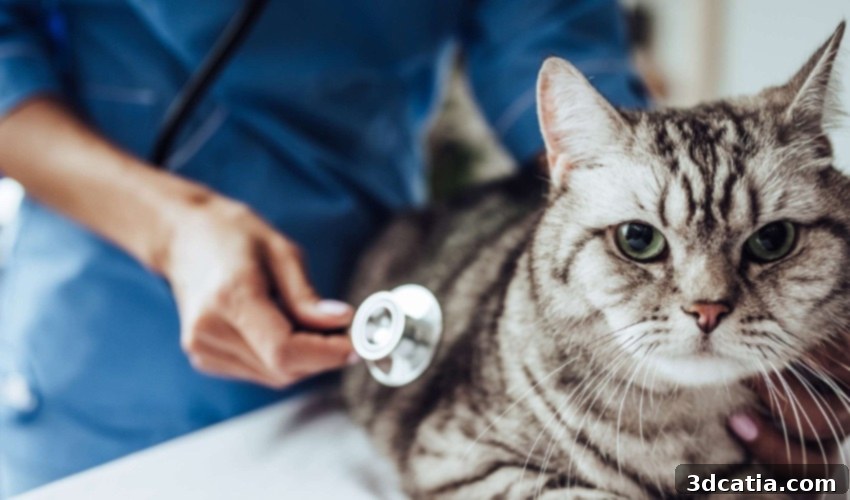
Revolutionizing Pet Care: How Additive Manufacturing is Transforming Veterinary Medicine
Our beloved animal companions, often referred to as “man’s best friend,” hold a significant place in our hearts and homes. From playful dogs and purring cats to vibrant fish and melodious birds, pets have been an integral part of human lives since ancient times. This bond has only strengthened, with pet ownership seeing a notable increase in recent years. For instance, global adoption figures for dogs rose from 76.8 million in 2016 to 83.7 million by 2020, while cat adoptions climbed from 58.4 million to 60 million during the same period. This surge was significantly influenced by the global Corona Pandemic and subsequent lockdowns, as remote work arrangements provided more individuals with the time and opportunity to welcome a pet into their lives. Beyond just the increase in pet numbers, technological advancements, particularly in additive manufacturing (3D printing), have opened up unprecedented possibilities for veterinary medicine, ensuring our animal friends receive the best possible care.
Additive manufacturing’s profound benefits are now widely recognized across numerous industries, and veterinary medicine is no exception. Considering the substantial and continually expanding economic footprint of the veterinary sector, its integration with additive manufacturing is a logical progression. In the United States alone, over 120,000 veterinarians actively practice, addressing a vast array of medical conditions in animals. As pet ownership grows, so too does the economic value of the animal health industry. A report by Grand View Research, Inc., projects the global veterinary services market to reach an impressive $114.4 billion by 2028. This growth is fueled not only by dedicated veterinarians leveraging 3D printing but also by commercial enterprises diligently developing innovative applications to enhance animal welfare. But what are the specific capabilities and constraints of 3D printing in this specialized field, and what does the typical implementation process entail?
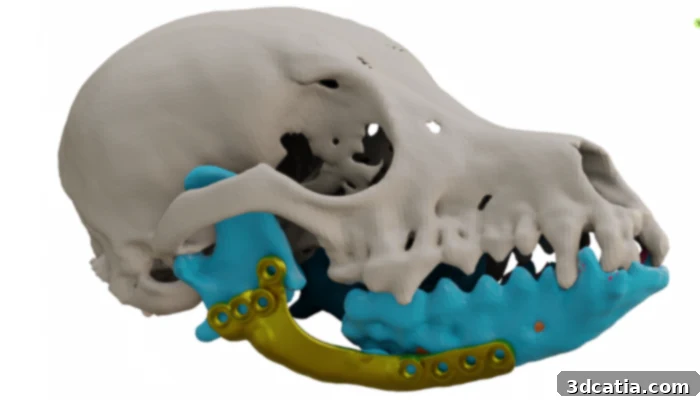
The use of additive manufacturing is becoming increasingly common in the veterinary medicine market. Here, you can see the design of a prosthetic for a dog’s lower jaw (photo credits: Dr. Johnny Uday).
Enhancing Animal Care: Additive Manufacturing in Veterinary Practice
Bringing a cherished pet to the veterinary clinic can be a source of anxiety for any owner. Beyond the concern for their animal’s health, conventional veterinary treatments often come with significant challenges such as exorbitant costs, prolonged waiting periods for essential prostheses or orthoses, and the inherent difficulty in customizing medical products for an animal’s unique needs. Fortunately, 3D printing offers groundbreaking solutions to many of these longstanding issues. Coupled with advancements in material science, additive manufacturing enables the creation of highly specialized components that meet diverse requirements within the veterinary sector. This technology translates into tangible benefits: reduced expenses, significantly shorter lead times, and an unparalleled degree of personalization for each patient. Moreover, these innovative approaches streamline the entire treatment journey for animal patients under the care of veterinarians who embrace additive manufacturing. Common materials utilized by AM-savvy veterinarians include PEEK and PEKK for their strength and biocompatibility, as well as dental plastics like nylon, PLA, and PVA for various surgical and reconstructive applications.
Concrete Applications and Processes in Veterinary Medicine
To truly appreciate the impact of additive manufacturing in veterinary medicine, it’s crucial to understand how it addresses the limitations of traditional methods. Many conventional veterinary treatments parallel those in human medicine, sometimes even in intricate details. However, despite shared biological characteristics, certain treatment options simply aren’t feasible for animals due to their varying sizes, temperaments, and unique anatomical structures. A critical first step for many procedures, such as creating prostheses or planning complex surgeries, is often a precise scan. Here, the initial hurdles often arise: many animals, especially larger or less cooperative ones, cannot fit into standard veterinary CT scanners or remain still long enough for accurate imaging. This is precisely where 3D technologies demonstrate their transformative potential.
While sedation – administering tranquilizers to calm the central nervous system – could be an option, it comes with considerable costs, risks, and time commitments. 3D scanning technology, in contrast, offers a rapid, precise, and often sedation-free alternative. Its portability allows veterinarians to scan any animal, regardless of size or disposition, in various settings. This is a stark contrast to bulky, conventional CT scanners, which would be impractical, if not impossible, for animals like an agitated alligator or aquatic species. The ability to capture highly accurate anatomical data quickly and non-invasively is a game-changer for diagnostics and treatment planning.
A compelling illustration of 3D scanning’s capabilities is the remarkable case of Mister Stubbs, an alligator. Discovered in a semi-truck in 2013, Mister Stubbs was missing his tail. Far from being a mere aesthetic issue, an alligator’s tail is vital for propulsion and steering in water, and its base serves as a crucial fat storage area, significantly impacting the animal’s overall health. To assist Mister Stubbs, Midwestern University in Glendale, Arizona, utilized an Artec 3D scanner to meticulously scan the tail of a recently deceased alligator. While subsequent adjustments were necessary to match Mister Stubbs’ precise dimensions, the 3D scan provided an incredibly detailed model of the tail’s anatomy, enabling the team to design and create a functional new tail, dramatically improving his quality of life.
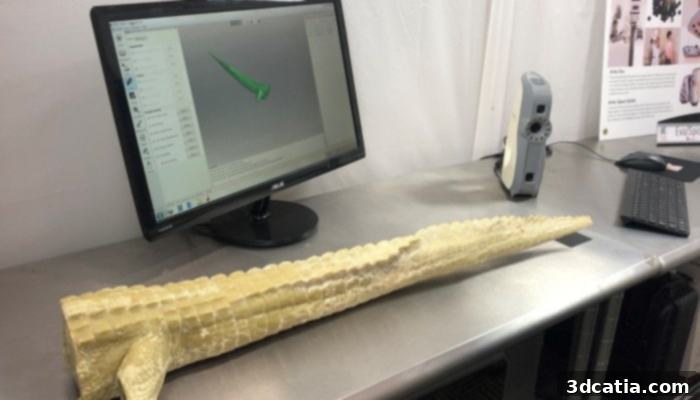
Using conventional methods, such an accurate image of the tail would probably not have been possible (photo credits: STAX3D via Artec)
Unlocking Customization: Individualized Applications Thanks to AM
Veterinarians and animal hospitals are leveraging additive manufacturing to achieve a wide spectrum of tangible benefits in animal treatment. This includes the bespoke production of prosthetics, orthotics, implants, dental components, and even custom anatomical models for pre-surgical planning. The advantages are particularly pronounced given the immense biological diversity and unique needs across different animal species. The anatomy of a dog, for example, varies tremendously from one breed to another; comparing a massive Newfoundland with a tiny Dachshund highlights the absolute necessity of individualized treatment approaches. Additive manufacturing makes this level of customization not just possible, but efficient and cost-effective.
Among the most frequently utilized applications in veterinary medicine are 3D-printed orthoses and prostheses, which can last up to five years before requiring replacement. These body-worn splints serve as orthopedic aids, providing crucial support to relieve, stabilize, or correctly position joints, bones, or muscles. A heartwarming example involves a three-month-old kitten born with a rare and potentially fatal congenital deformity of the chest wall. Doctor of Veterinary Medicine Matteo Zanfabro turned to 3D printing to address this critical condition.
Using an Ultimaker S3 3D printer and PETG material, a custom splint was created. This splint was not only precisely tailored to the kitten’s specific size and deformity but also designed to accommodate the animal’s anticipated growth. To ensure robust stabilization, the splint was secured with surgical wires and fitted with soft padding for comfort. The application of 3D printing proved immensely successful: after the additively manufactured splint was applied, the young cat experienced no further movement intolerances, demonstrating the life-changing potential of this technology.
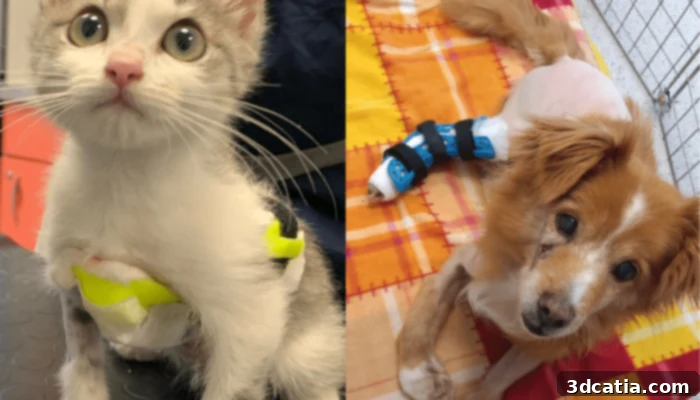
3D-printed splints, prosthetics and orthotics can not only simplify the lives of animals, but also save them (photo credits: Matteo Zanfabro via PlayVet)
The innovations don’t stop there. A team of researchers from the Slovak University of Technology in Košice explored the advantages of additive manufacturing in veterinary orthodontics. They showcased its potential using the case of a 15-month-old Labrador dog that had lost a critical tooth for food intake during play. Since the tooth would not regrow and its absence posed a risk of malnutrition, a personalized solution was imperative. The remaining healthy tooth in the dog’s jaw was meticulously scanned, and this digital model was then used to manufacture a metal 3D-printed implant. Additive manufacturing was chosen for its ability to produce an exact replica and ensure the new tooth would integrate flawlessly into the existing gap. Following a regeneration period, the Labrador’s additively manufactured tooth proved even harder and more durable than its natural counterparts, restoring full chewing function.
Dr. Johnny Uday, a veterinarian who began implementing AM five years ago, offers further insights into dental challenges in animals and how 3D printing provides solutions. He explains, “Dental problems are incredibly common and can severely damage the jaws of many pets, leading to fractures with significant bone lysis – essentially large holes. Traditional ‘standard’ plates designed for human medicine or general veterinary use can often be too large or bulky for the varied sizes of dogs, potentially causing more harm than good. This technology excels in developing personalized plates, ensuring a perfect fit and size. It even allows for pre-planning of drill holes to meticulously avoid damaging sensitive structures like tooth roots, vascular bundles, nerves, and the lymphatic system, which are crucial for normal function and proper healing.”
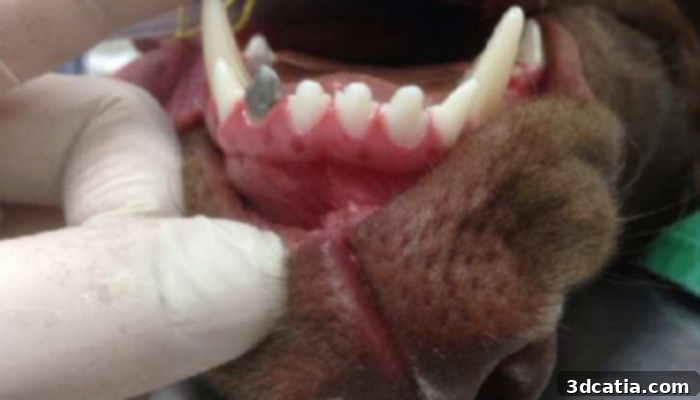
Thanks to the 3D-printed tooth, the dog can eat again (photo credits: TU Košice)
Beyond direct implants and prosthetics, additive manufacturing is exceptionally well-suited for creating surgical and anatomical models in veterinary medicine. Surgical models are particularly invaluable, allowing veterinarians to achieve superior surgical outcomes while significantly reducing operation times. These models are essentially 3D-printed templates that replicate the exact cutting planes and drilling holes for a specific animal patient. Surgeons can practice complex procedures on these templates beforehand, gaining critical experience and refining their approach. This benefit extends not only to difficult and rarely performed operations but also to common orthopedic injuries like cruciate ligament tears or even congenital limb problems. Anatomical models, which can be categorized into acupuncture, organ, skeletal, or even exercise models, also provide immense assistance to practicing veterinarians. Moreover, these highly detailed three-dimensional models are invaluable educational tools for students and aspiring veterinarians, supporting learning and research initiatives.
While additive manufacturing primarily benefits larger animals like dogs, cats, chickens, and cows, its application becomes more complex for small animals such as Chihuahuas, frogs, or hamsters. Dr. Johnny Uday explains that their minuscule anatomy makes the creation of precise incision guides and implants considerably more challenging compared to larger species. However, perhaps the most significant challenge in integrating AM into veterinary workflows lies in mastering the subject matter itself. Dr. Uday emphasizes the crucial importance of familiarity with various software platforms and understanding the specific biomaterials available for 3D printing.
Driving Innovation: Companies Leveraging Additive Manufacturing for Animal Welfare
While a growing number of forward-thinking veterinarians are embracing additive manufacturing within their practices, numerous companies have also recognized its immense potential in this specialized sector. The list of enterprises utilizing AM in veterinary applications continues to expand, featuring notable names such as Think3DDD, PlayVet, CABIOMEDE, DiveDesign, and even major players like Formlabs and Artec3D. The primary distinction between the activities of veterinarians and these commercial entities, concerning AM, largely stems from their educational backgrounds. Professionals at these companies typically hold engineering degrees, specializing in design and manufacturing, whereas veterinarians, of course, possess degrees in veterinary medicine. Consequently, their operational models differ: companies focus on manufacturing and selling these advanced products, thereby creating a dedicated market for their services. Veterinarians, on the other hand, integrate AM to enhance their efficiency, streamline workflows, and incorporate it as a powerful tool within their broader medical practice. Despite these differing educational paths and business models, their ultimate goal remains universally shared: to improve and save animal lives through the power of additive manufacturing.
Berlin-based Think3DDD, founded by Tino Jacobi, underscores the necessity of close collaboration due to the high degree of customization required. As Jacobi states, “That’s why we cooperate very closely with the treating veterinarians. So we manufacture a suitable orthosis or prosthesis with information from the vets and the vet accompanies the treatment.” Nevertheless, according to Alexander Then, owner of NordicVet3D, a considerable number of veterinarians still hesitate to adopt additive manufacturing. He ponders, “I can’t see any reason other than economic why they shouldn’t be used,” elaborating on the clear advantages: “For example, we can check whether the screws and plates we want to use are the most suitable in each individual case. This minimizes the risk of failure or the need for reoperation, which is associated with increased mortality and morbidity. It’s also been shown to reduce surgical time and therefore the actual cost of the procedure.” The economic benefits, combined with improved patient outcomes, present a compelling case for wider adoption.
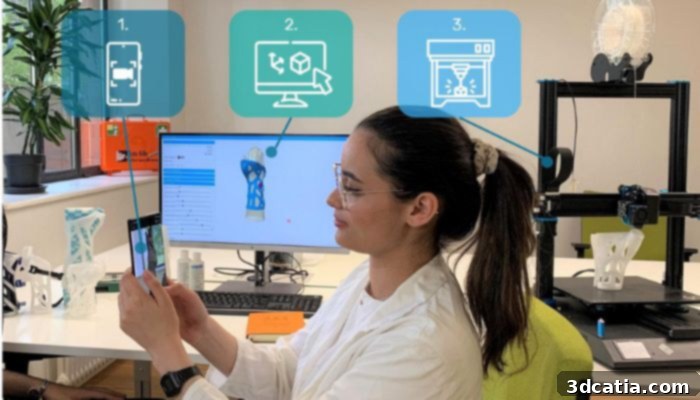
At Think3DDD, a scan is made via smartphone before a file is produced and finally 3D printed (photo credits: Think3DDD)
Addressing the Challenges: Limitations of Additive Manufacturing in Veterinary Medicine
Delving into other challenges, Matteo Zanfabro of PlayVet highlights that working with such a diverse array of materials in veterinary applications is an inherent difficulty. It’s crucial to consider that depending on the specific application, the material must possess properties ranging from extremely hard plastics to more chewable, flexible substances. This necessitates finding the optimal compromise between material quality, functionality, and production time. Zanfabro also points out an issue where “the manufacturer’s specifications for 3D printing do not match the actual result.” This discrepancy requires PlayVet to “try, test and verify every material and every manufacturer to be sure that the material is suitable for our product and our process.” This meticulous quality testing process can be both time-consuming and costly, often extending over several weeks.
So, what conclusions can be drawn about the ongoing integration of additive manufacturing into veterinary medicine? Thanks to this transformative technology, countless animal lives have already been saved, and the potential for future breakthroughs continues to grow. While both companies and veterinarians encounter a spectrum of cases – some easier, others far more complex – each challenge invariably opens new doors and presents fresh opportunities for the application of AM within the veterinary field. The continuous evolution of materials, scanning technologies, and printing methods promises an even brighter future for our animal companions.
What are your thoughts on the use of additive manufacturing in veterinary medicine? We encourage you to share your insights in a comment below or connect with us on our LinkedIn, Facebook, and Twitter pages! Don’t forget to sign up for our free weekly Newsletter here to get the latest 3D printing news delivered straight to your inbox. You can also explore all our videos on our YouTube channel for more engaging content.
*Cover photo credit: Indra Veterinary Clinic