
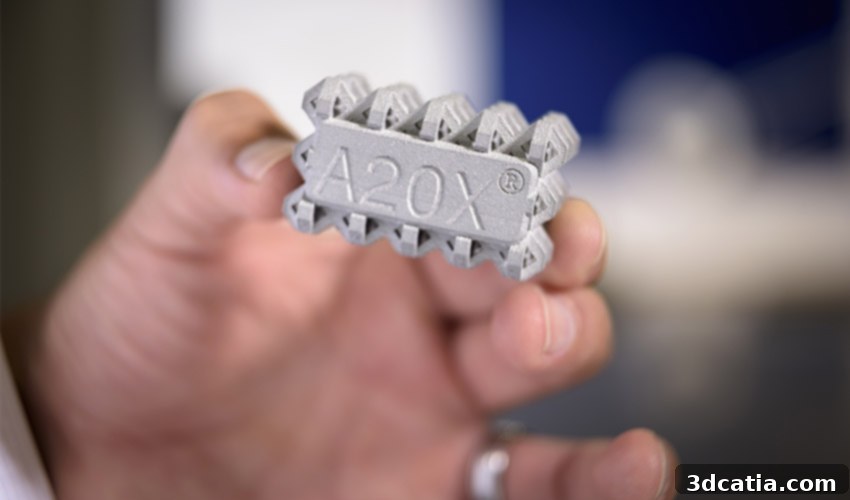
Aeromet’s A20X Alloy: Revolutionizing Additive Manufacturing with Record-Breaking Strength
Aeromet, a leader in advanced metal manufacturing, has made a significant announcement that is set to redefine the landscape of high-performance materials. Their patented A20X aluminium alloy, meticulously developed for both traditional casting and cutting-edge additive manufacturing processes, has achieved an unprecedented milestone, surpassing the 500 MPa Ultimate Tensile Strength (UTS) mark. This remarkable achievement positions A20X as potentially the strongest aluminium powder commercially available for additive manufacturing today, opening up a realm of new possibilities for industries demanding exceptional material performance.
The A20X alloy is specifically engineered to meet the stringent requirements of aerospace components, where durability, precision, and lightweighting are paramount. Its superior strength and fatigue properties, even at elevated temperatures, make it an ideal candidate for critical applications that were once limited to heavier or more complex alloys. This breakthrough underscores the ongoing evolution of materials science within additive manufacturing, highlighting how innovations in powders are pushing the boundaries of what’s achievable with 3D printing.
Setting a New Benchmark: The HighSAP Project’s Impact on A20X Performance
The record-breaking performance of A20X was validated through a comprehensive research initiative known as the HighSAP project. This collaborative endeavor brought together industry giants and experts, including Rolls-Royce, a global leader in aerospace propulsion, and Renishaw, a pioneer in additive manufacturing systems, alongside atomisation specialists PSI. The project focused on optimizing the processing parameters for A20X powder when used in additive manufacturing, aiming to unlock its full potential.
Through rigorous experimentation and refinement of heat treatment protocols, parts manufactured using A20X powder within the HighSAP project achieved an astonishing UTS of 511 MPa. This figure not only exceeds the 500 MPa benchmark but also demonstrates exceptional high-strength and fatigue properties that are sustained even under elevated temperature conditions. Such performance characteristics are critical for components operating in demanding environments, typical of aerospace and high-performance engineering applications.
Mike Bond, Director of Advanced Material Technology at Aeromet, expressed his enthusiasm regarding these results, stating, “Since bringing the A20X alloy to market for additive manufacturing five years ago, we have seen significant adoption for high-strength, design-critical applications. By working with Rolls-Royce, Renishaw, and PSI, we have optimized processing parameters that led to record-breaking results, opening up new design possibilities for aerospace and advanced engineering applications.” This statement emphasizes the power of collaboration in driving material innovation and expanding the horizons for additive manufacturing’s applicability.
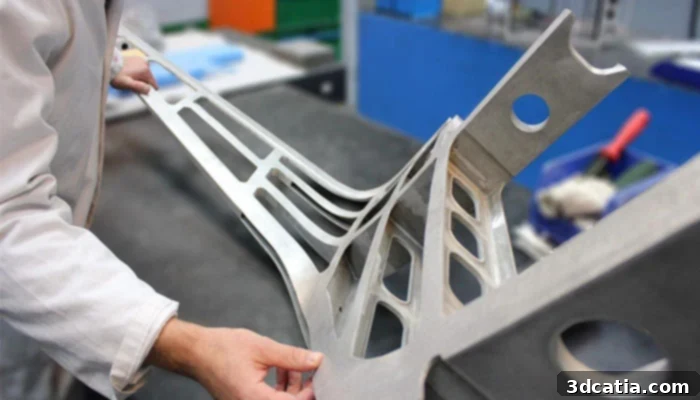
Part of a winglet manufactured by Aeromet | Credits: Aeromet
Aerospace: A Prime Beneficiary of Advanced Additive Manufacturing
The aerospace industry stands as one of the earliest and most enthusiastic adopters of 3D printing technology, with its use dating back to 1989. The inherent advantages of additive manufacturing, particularly for metal components, are profound. It offers unparalleled value across various stages, from rapid prototyping and efficient tooling applications to the direct production of complex, high-performance end-use parts. The ability to create intricate geometries, consolidate assemblies, and significantly reduce part weight has made additive manufacturing a transformative force in aircraft design and production.
In this demanding sector, there is a continuous drive for innovation, fueled by persistent research initiatives aimed at advancing the adoption and capabilities of additive manufacturing. The HighSAP project, with its focus on developing stronger and more durable materials like A20X, serves as a compelling testament to this ongoing progress. Companies are relentlessly working to engineer materials that offer increased capabilities, allowing for lighter, more fuel-efficient, and ultimately safer aircraft. A20X’s ability to achieve high strength and withstand elevated temperatures directly addresses critical needs within aerospace, promising improved performance for components exposed to extreme operational conditions.
The Collaborative Engine: NATEP and the HighSAP Project
The HighSAP project was significantly bolstered by backing from the UK’s National Aerospace Technology Exploitation Program (NATEP). NATEP plays a crucial role in fostering innovation and technological advancements within the UK aerospace supply chain. Under Aeromet’s leadership, the project strategically brought together the expertise of Rolls-Royce, providing the end-user perspective and critical performance validation, Renishaw, contributing advanced additive manufacturing system knowledge, and PSI, offering specialized insights into atomization processes crucial for producing high-quality metal powders.
The core strengths of the A20X alloy – exceptional strength, superior fatigue resistance, and enhanced temperature stability – were all meticulously optimized through this collaborative effort. For instance, parts fabricated from the A20X alloy are reported to maintain structural integrity and performance at temperatures up to 50°C higher than those achievable with conventional aluminium casting alloys. This significant thermal advantage directly translates into expanded operational envelopes for aerospace components, allowing for applications in hotter sections of aircraft engines or other high-temperature environments where traditional aluminum alloys would fail.
The synergy between material developers, equipment manufacturers, and end-users, facilitated by programs like NATEP, is proving to be a powerful catalyst for innovation. This collaborative ecosystem ensures that new materials are not only developed with cutting-edge properties but are also optimized for manufacturing processes and validated against real-world performance requirements. Such projects are essential for bridging the gap between scientific discovery and industrial application, accelerating the readiness of advanced materials for commercial deployment.
Material Innovation: The Driving Force Behind AM Industry Growth
It is becoming increasingly clear that advancements in materials science are the primary drivers of growth within the additive manufacturing (AM) industry. While early developments focused heavily on refining 3D printing technologies and machine capabilities, the industry’s evolution has shifted its spotlight towards developing a diverse array of high-performance materials. Wohler’s latest reports have consistently underscored this trend, describing a significant boom in additive manufacturing materials, particularly metals, experienced in recent years. This paradigm shift indicates a maturing industry where the focus is now on empowering technologies with materials that can meet the rigorous demands of various industrial sectors.
The availability of robust and versatile materials like Aeromet’s A20X is critical for additive manufacturing to transition from niche applications to widespread industrial adoption. As 3D printing technologies have become more sophisticated and reliable, the bottleneck has often shifted to material limitations. Therefore, prioritizing the development of materials with tailored properties – such as exceptional strength, enhanced fatigue life, and superior temperature resistance – is paramount. A20X is a prime example of how material innovation directly contributes to expanding the scope and viability of additive manufacturing, enabling the creation of components that were previously impossible or impractical to produce with conventional methods.
Beyond Aerospace: Broader Implications for Advanced Engineering
While the aerospace industry is an obvious beneficiary of A20X’s capabilities, the implications of such a high-strength aluminium alloy extend far beyond. Industries such as automotive, defense, and high-performance industrial machinery are constantly seeking materials that offer an optimal balance of strength-to-weight ratio, durability, and thermal performance. Components in these sectors often operate under extreme stress, vibration, and temperature fluctuations, making A20X an attractive solution for critical parts. For instance, in high-performance automotive applications, lightweight yet strong components can contribute to improved fuel efficiency and enhanced vehicle dynamics. In defense, the ability to rapidly produce strong, custom parts can significantly impact operational readiness and system performance.
The ease with which complex geometries can be fabricated using additive manufacturing, combined with A20X’s material properties, offers engineers unprecedented design freedom. This allows for the creation of optimized structures that reduce material waste, improve functional performance, and enable part consolidation, leading to simpler supply chains and reduced assembly times. Aeromet’s A20X alloy, therefore, represents a significant step forward in making additive manufacturing an even more compelling solution for a broader range of demanding engineering challenges across various advanced sectors.
In conclusion, Aeromet’s A20X aluminium alloy marks a pivotal moment in additive manufacturing. Its validated ultimate tensile strength exceeding 500 MPa, achieved through the collaborative HighSAP project, establishes a new benchmark for performance in commercially available aluminium powders. This breakthrough, underpinned by strategic partnerships and a commitment to innovation, is poised to unlock new design possibilities and drive further adoption of additive manufacturing, particularly in critical sectors like aerospace and advanced engineering. As the industry continues to evolve, the emphasis on developing sophisticated materials like A20X will remain central to realizing the full transformative potential of 3D printing.
You can find the original press release HERE.