
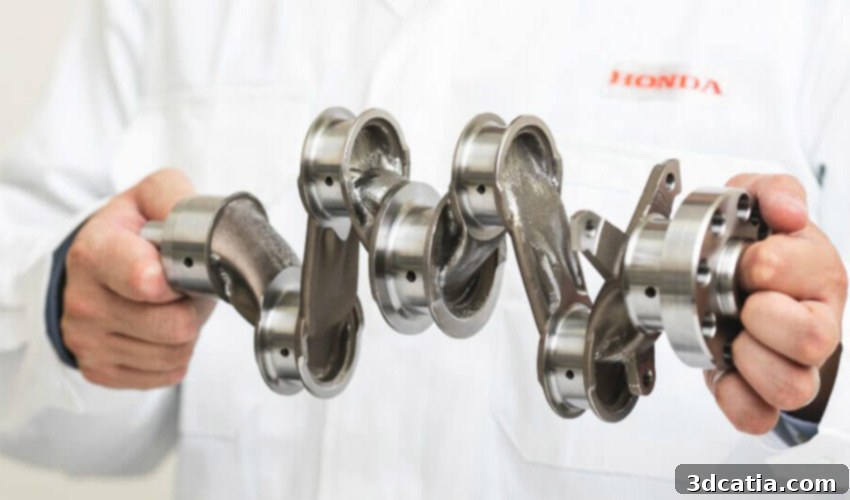
Honda and Autodesk Forge the Future of Automotive Engineering with a Revolutionary 3D Printed Lightweight Crankshaft
In a significant leap forward for automotive innovation and sustainable manufacturing, Japanese car manufacturer Honda, in collaboration with design software giant Autodesk, has unveiled a groundbreaking 3D printed metal crankshaft. This development follows Honda’s earlier foray into additive manufacturing with its Micro Commuter in 2016, a small utility vehicle partly designed using 3D printing. Four years later, the company has pushed the boundaries further, showcasing a functional prototype of an engine crankshaft that promises to redefine automotive component design.
The crankshaft, a vital component responsible for converting the linear motion of pistons into rotational motion, is traditionally a heavy, complex part, often forged from steel to withstand extreme pressures and maintain rotational balance within the engine. Its design has remained largely unchanged for decades due to stringent requirements for strength, endurance, and precision. However, this joint venture between Honda and Autodesk reimagined the component’s entire design process, leveraging advanced additive manufacturing (3D printing) and generative design principles. The primary objectives were ambitious: to drastically reduce the final weight of the part, thereby enhancing vehicle performance and significantly cutting fuel consumption. This initiative perfectly aligns with the automotive industry’s growing imperative to minimize environmental impact through lighter, more efficient vehicles. While currently presented as a working prototype, the ultimate goal for Honda is clear: to scale up this innovation for eventual mass production.
For years, engineers have grappled with the inherent constraints of traditional manufacturing methods when designing crankshafts. Meeting critical requirements such as resistance to combustion pressures and maintaining perfect rotational balance often resulted in designs that, while robust, were inherently heavy and offered limited avenues for optimization. Honda, however, has been a proactive adopter of additive manufacturing for several years, strategically using it to reduce the weight of various components across its product lines, including seat belt supports, engine control units, and even motorcycle frames. This proven track record ignited the ambition to apply the same weight-saving methodology to one of the engine’s most crucial and challenging parts: the crankshaft.
The vision was bold: to 3D print a crankshaft that could be as much as 30% lighter than existing models, without compromising performance or durability. To achieve this audacious goal, Honda turned to Autodesk, a company celebrated globally for its extensive suite of 3D modeling solutions, including industry standards like AutoCAD, Fusion 360, and Netfabb. This collaboration brought together Honda’s deep automotive engineering expertise with Autodesk’s cutting-edge design and simulation capabilities. Hirosumi Todaka, a mechanical and fluid machinery designer at Honda R&D, articulated the necessity for a radical shift in approach: “A new approach was needed that uses methods such as generative design and additive manufacturing. We had to get rid of preconceived ideas and see things in a new light. That’s why we set ourselves the ambitious goal of designing a crankshaft that is 30 percent lighter than today’s models.” This statement underscores a paradigm shift in engineering—moving away from conventional design thinking to embrace algorithmic optimization and the inherent design freedom offered by additive manufacturing.
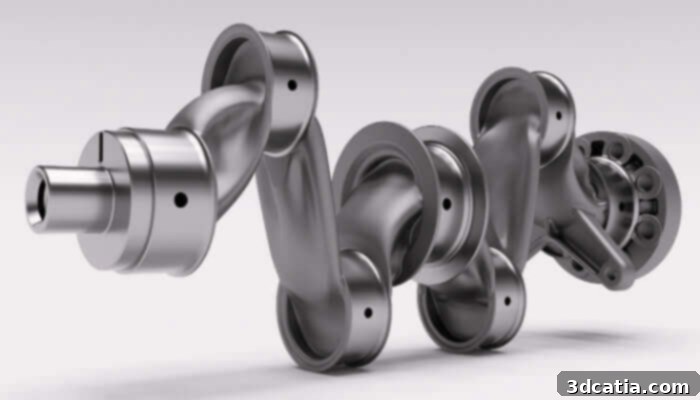
A rendering of the modeled crankshaft | Credits: Honda R&D
The core of this transformative project lay in the application of generative design solutions, primarily powered by Autodesk’s Fusion 360 and Netfabb software. Generative design represents a revolutionary approach where engineers input design goals and constraints—such as weight targets, material types, manufacturing methods, and performance requirements—into a software system. The software then uses artificial intelligence and algorithms to rapidly generate numerous design iterations that meet those criteria. What makes this particularly powerful is its ability to explore vast design spaces that human designers might overlook, often resulting in highly optimized, organic, and intricate structures reminiscent of natural forms. In this case, Autodesk was able to present Honda with several possible iterations for the crankshaft, each boasting an optimized structure inspired by the efficiency and strength found in nature’s designs.
Once Honda meticulously reviewed and selected the design that best aligned with their performance and aesthetic criteria, dedicated engineering teams were dispatched to the Autodesk Technology Centre in England. This immersive experience was crucial for deepening their understanding of the advanced capabilities of generative design and the nuances of additive manufacturing. The collaborative sessions at the center allowed for further refinement of the chosen design, leveraging real-time simulations and expert insights to propose an even more improved and optimized prototype. This iterative process, facilitated by cutting-edge software and direct collaboration, is a hallmark of how generative design accelerates innovation, allowing for rapid exploration and optimization of complex parts that would be impossible to achieve through conventional CAD and iterative physical prototyping.
The culmination of this intense collaboration and innovative design process is a remarkable 3D printed prototype that, according to the Honda teams, demonstrates an astonishing 50% weight reduction compared to a conventionally manufactured crankshaft. This significant achievement far surpasses their initial ambitious goal of a 30% reduction, underscoring the transformative power of combining generative design with additive manufacturing. Honda engineers firmly assert that such a component, with its intricate internal structures and optimized geometry, would have been utterly impossible to produce using traditional manufacturing methods like forging or machining, which are inherently limited in creating complex internal lattices or organic shapes. While the specific metal 3D printing technology employed (such as Selective Laser Melting (SLM), Direct Metal Laser Sintering (DMLS), or Electron Beam Melting (EBM)) and the exact metal alloy used (e.g., high-strength aluminum, titanium, or specialized steels) have not been disclosed, the tangible result speaks volumes: the synergy between 3D printing and generative design has successfully produced a part that is not only dramatically lighter but also inherently better-performing, with optimized load paths and improved material distribution. Naturally, a component this critical requires extensive testing and validation to ensure it meets the rigorous demands of automotive applications. At present, Autodesk continues to refine the design, ensuring the 3D printed crankshaft achieves maximum efficiency, durability, and reliability for real-world scenarios, paving the way for eventual integration into future Honda vehicles.
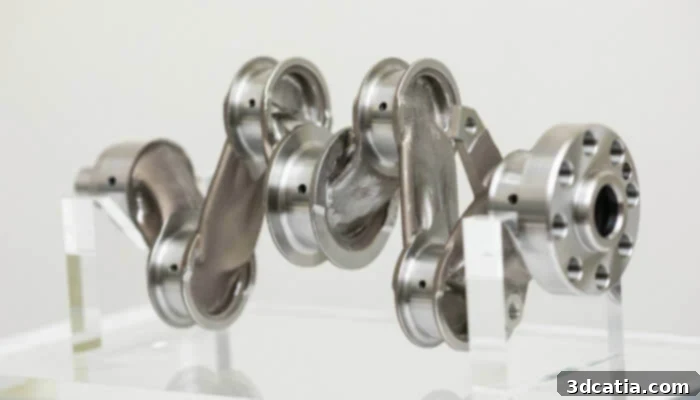
The final prototype | Credits: Autodesk / Honda
Reflecting on this pioneering project, Hirosumi Todaka concludes with an optimistic outlook: “Although some still have reservations about this new form, the attention it has given to the technology has been worthwhile. Although there is still much to be done to lighten the parts, we can now see a way forward to achieve our goals. In the future, I expect innovative products created using generative design to be the norm.” His remarks acknowledge the inherent skepticism that often accompanies disruptive technologies but emphasize the undeniable value and potential uncovered through this endeavor. The “reservations” typically revolve around concerns regarding material properties consistency in additive manufacturing, post-processing requirements, scalability for mass production, and overall cost-effectiveness compared to established methods. However, this project clearly demonstrates that these challenges are being systematically addressed, revealing a clear “way forward.” This breakthrough signifies a crucial step in the broader adoption of advanced manufacturing techniques across the automotive sector. As generative design continues to evolve and become more integrated into product development workflows, it is poised to become the standard for creating next-generation components that are not only lighter and more efficient but also stronger and more sustainable. This collaboration between Honda and Autodesk is a testament to the power of interdisciplinary innovation, pushing the boundaries of what is possible in engineering and setting a new benchmark for lightweight automotive design. You can find more information about this project HERE.
What are your thoughts on this revolutionary 3D printed crankshaft and its potential impact on the automotive industry? We invite you to share your insights in a comment below or join the conversation on our Facebook and Twitter pages! Don’t miss out on the latest advancements in additive manufacturing; sign up for our free weekly Newsletter to receive all the cutting-edge 3D printing news straight to your inbox and stay ahead of the curve!