
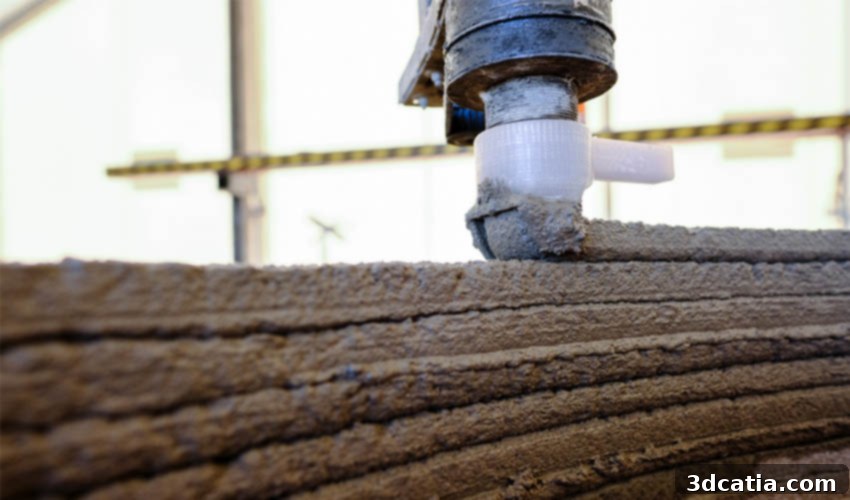
Revolutionizing Construction: COBOD and PERI Unveil Future-Ready 3D Printing at Bautec
The recent Bautec construction exhibition in Berlin served as a pivotal international gathering point, attracting over 30,000 industry professionals and innovators from more than 40 countries. This grand stage provided the perfect backdrop for groundbreaking advancements in construction technology. Among the prominent participants, COBOD, a recognized leader in the burgeoning field of concrete 3D printing, seized the opportunity to dramatically showcase the capabilities and immense productivity of their state-of-the-art BOD2 3D construction printer. In a strategic partnership with PERI, a global powerhouse in formwork and scaffolding solutions, COBOD embarked on an ambitious live demonstration: the daily 3D printing of the walls of an entire small house directly on the exhibition floor. Over the intensive four-day duration of the show, this remarkable collaboration resulted in the successful 3D printing of four distinct small houses. Each of these structures featured an impressive 64 square meters of wall area, meticulously produced by the BOD2 printer in less than 24 hours, consistently meeting demanding timelines and exceeding expectations for on-site fabrication speed and efficiency. This impactful demonstration not only drew significant attention but also provided tangible proof of the technology’s readiness for wider commercial application, setting a new benchmark for what is possible in automated construction.
COBOD’s Transparent Vision for 3D Construction Printing
COBOD has consistently maintained a strong and transparent position regarding the actual capabilities and current limitations of 3D printing within the construction sector. In an industry sometimes prone to hype, the company has actively challenged what it views as misleading claims surrounding projects that purport to have 3D printed entire houses or buildings in unprecedented, record-breaking times. COBOD’s expert analysis and hands-on experience reveal a more nuanced reality: while the technology is rapidly advancing, its current practical application primarily facilitates the precise and efficient construction of structural walls. The entire process, encompassing foundations, roofing, utilities, and finishes, is often more intricate and time-consuming than what is frequently depicted in promotional materials or early-stage demonstrations. Many initial initiatives, while valuable for R&D and proof-of-concept, have largely served as experimental showcases rather than commercially viable production models. This pragmatic perspective from COBOD underscores a critical truth: the construction industry still has significant ground to cover, encompassing material development, rigorous regulatory frameworks, and integrated building systems, before truly turnkey 3D printed houses become a widespread, mainstream reality accessible to the general public. Their commitment to realism fosters greater trust and sets achievable expectations for industry stakeholders and consumers alike.
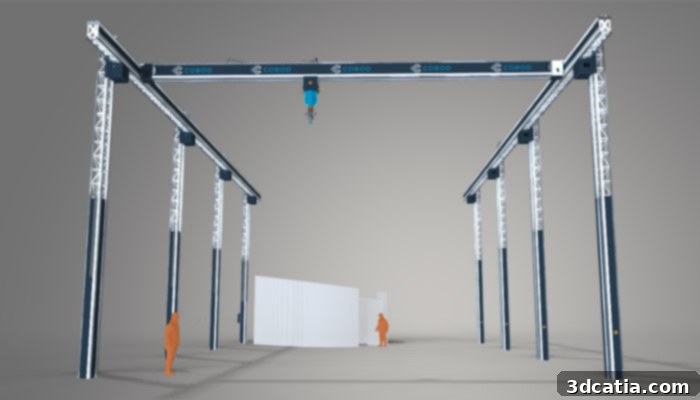
COBOD’s BOD2 modular solution
Unmatched Productivity and Market Readiness
Underscoring their commitment to transparency and real-world viability, COBOD explicitly clarifies that their BOD2 printer focuses on the precise and efficient 3D printing of building walls. This focus was vividly brought to life at the Bautec exhibition, where COBOD and PERI transported the BOD2 system to the heart of the show floor. Every day, from 9 AM until 5 PM, visitors witnessed the printer in continuous operation, meticulously laying down layers of concrete to form robust walls. This relentless, day-long production schedule was not just a display of the machine’s functionality but a powerful testament to its industrial readiness and endurance. Henrik Lund-Nielsen, CEO of COBOD, articulated the core objective of this ambitious undertaking: “With this showcase of live 3D construction printing, we wanted to unequivocally demonstrate that our BOD2 printer technology is not merely a prototype but is genuinely ready for the commercial market. It possesses the inherent quality, impressive speed, remarkable robustness, and unwavering stability required to perform consistently hour after hour, day after day, delivering truly incredible productivity under demanding exhibition conditions.” This statement powerfully encapsulates COBOD’s confidence in their technology and its immediate potential to revolutionize traditional construction workflows by offering a reliable, high-performance automated solution.
Transforming Construction: Key Benefits of 3D Printing Technology
One of the most compelling advantages heralded by 3D printing in the construction sector is its transformative impact on labor requirements. Compared to conventional building methods, which often necessitate large, specialized crews for tasks like formwork installation and bricklaying, 3D printing significantly minimizes the human resources needed for the wall-building phase. This not only translates to potential cost savings and faster project completion but also enhances safety on job sites by reducing manual labor and mitigating challenges associated with skilled labor shortages. Beyond these operational efficiencies, 3D printing unleashes an unprecedented degree of design freedom. Architects and engineers are no longer constrained by the rigid limitations of traditional rectilinear formwork and manual construction techniques. This newfound versatility allows for the creation of complex geometries, elegant curvilinear designs, and unique architectural expressions that were previously cost-prohibitive, structurally impractical, or simply impossible to achieve with conventional methods. This opens up entirely new aesthetic and functional possibilities for urban and rural landscapes.
Smart Building Design Through Additive Manufacturing
The capabilities of 3D construction printing extend far beyond just aesthetic flexibility. Dr. Fabian Meyer-Brötz, who leads 3D printing initiatives at PERI Group, emphasized the profound implications of these advanced design capabilities: “It is important to note that these freeform capabilities are not only relevant for purely aesthetic or architectural purposes but crucially allow for the seamless integration of functionality directly within the walls themselves. This enables the creation of truly smarter building designs, where conduits for electrical systems, intricate plumbing networks, specialized ventilation ducts, or even advanced insulation layers can be printed precisely as an intrinsic part of the structural element.” This innovative approach reduces the need for extensive post-construction modifications and improves the overall structural integrity and energy efficiency of the building. He further asserted the unique standing of their technology in the global market: “We are not aware of any other technology currently available which can produce such integrated and sophisticated results with this level of efficiency and precision.” This highlights the potential for buildings that are not only structurally sound and visually appealing but also inherently smarter, more adaptable, and optimized for modern living and operational demands, truly leveraging the full power of additive manufacturing in construction.
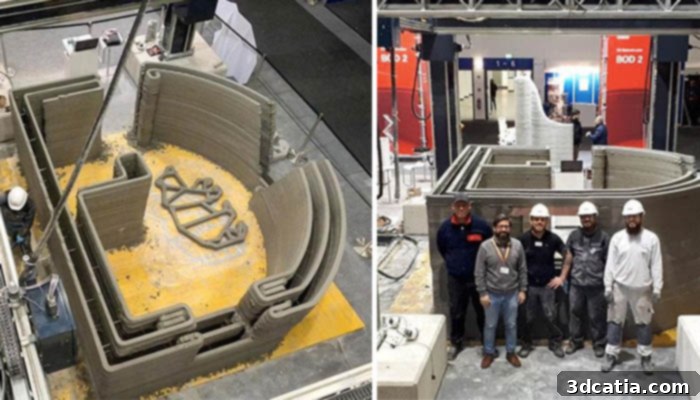
At the exhibition COBOD and PERI 3D printed a house every day during the opening hours | Credits: COBOD
Global Adoption and Future Prospects of COBOD’s Solution
During the Bautec exhibition, the Danish company consciously calibrated the BOD2’s printing speed to operate at 8 square meters per hour, a rate chosen for optimal live demonstration and to allow attendees to fully observe the intricate process. However, the company’s ambitious forward-looking goals aim to significantly enhance this productivity. With ongoing advancements in pump technology, material science, and integrated delivery systems, COBOD intends to achieve an impressive target of 20 square meters of walls per hour. This translates to an accelerated printing speed of 40 centimeters per second, a substantial leap that underscores the rapid evolution and scalability inherent in their technological roadmap. Such advancements promise to drastically reduce construction timelines and make 3D printing an even more competitive alternative to traditional methods, especially for large-scale projects.
Scaling Up: Speed and Modularity for Diverse Projects
The BOD2 itself is engineered as a highly versatile and modular solution, offering unparalleled adaptability for various construction demands. Its innovative structural design allows for seamless extension in any direction, utilizing standard 2.5-meter modules. This modularity ensures that the printer can be configured to suit a wide array of project sizes and site conditions, from small residential units to larger commercial structures. While offering immense flexibility, the system maintains practical limits to ensure structural integrity and operational efficiency, currently accommodating widths of up to 15 meters and heights of up to 10 meters. This makes the BOD2 suitable for a wide array of residential, light commercial, and even some public building applications, providing a flexible tool for modern construction. The ease of assembly and disassembly further enhances its appeal for projects in diverse geographical locations, allowing for efficient mobilization and demobilization.
Strategic Investments Driving Industry Growth
Since commencing shipments in January of the preceding year, COBOD has successfully deployed seven BOD2 3D printers to various clients globally, marking a significant milestone in the commercialization of additive construction. This robust initial adoption indicates growing market confidence in the technology’s performance and return on investment. Notably, a significant investment in COBOD’s cutting-edge solution has come from Elite for Construction & Development Co., a prominent Saudi Arabian construction firm. This strategic acquisition by a major player in a rapidly developing region further validates the BOD2’s potential to address large-scale construction needs and accelerate innovation in diverse global markets, particularly where rapid housing and infrastructure development are critical priorities. Such partnerships not only expand COBOD’s global footprint but also demonstrate the increasing readiness of the broader construction industry to embrace and integrate advanced manufacturing techniques.
Paving the Way for Mainstream 3D Printed Homes
Reflecting on the overwhelming success of their live demonstration at Bautec, Henrik Lund-Nielsen, COBOD’s CEO, offered a conclusive perspective: “Overall, we managed precisely what we set out to achieve, and the tangible results unmistakably speak for themselves: with our innovative technology, our customers are poised to become significantly more productive and efficient than those who continue to rely solely on conventional construction equipment and traditional methodologies.” This powerful statement encapsulates the paradigm shift that COBOD’s BOD2 printer represents for the global construction industry. By offering a proven, robust, and highly productive solution for 3D printing building walls, COBOD and PERI are not just showcasing a new tool; they are actively shaping the future of how structures are designed and built. The Bautec demonstration served as a vivid testament to the readiness of additive manufacturing to move beyond niche applications and into the mainstream of construction, promising a future of faster, more sustainable, and inherently smarter buildings. The implications for housing, infrastructure development, and architectural innovation are profound, pointing towards a new era of construction where efficiency, sustainability, and creative design go hand in hand.
What do you think of these latest developments in 3D construction printing? Share your thoughts and engage with our community below or on our Facebook and Twitter pages! Don’t miss out on the latest advancements and insights – sign up for our free weekly Newsletter to get all the news in 3D printing delivered straight to your inbox!