
Milo: France’s Pioneering AI Student Blends Advanced Intelligence with 3D Printed Robotics
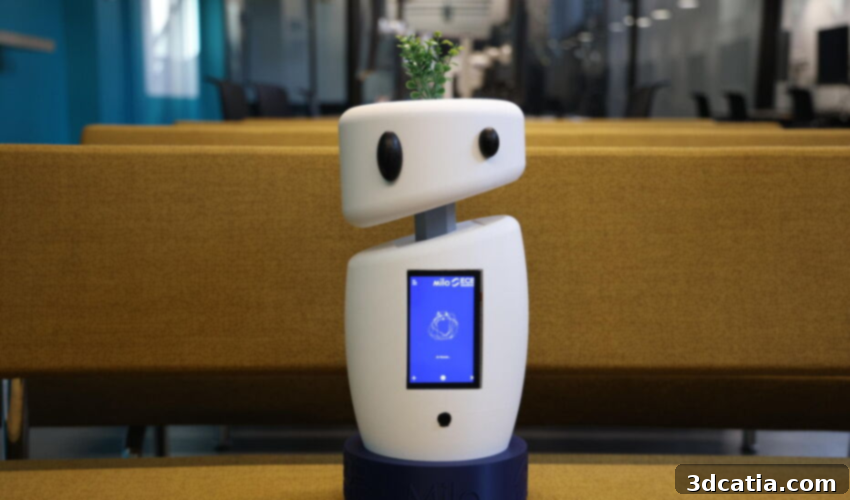
The future of education and human-machine interaction recently took a significant leap forward in France, specifically at ECE (École centrale d’électronique), a distinguished engineering school celebrated for its expertise in artificial intelligence. Here, students were introduced to an unprecedented new classmate: Milo. Far from being just another software program, Milo stands as the country’s first autonomous AI student, embodying a remarkable fusion of cutting-edge artificial intelligence and innovative 3D printing technologies. Milo showcases a suite of impressive cognitive abilities, from generating complex texts and solving intricate equations to interpreting detailed diagrams and engaging in meaningful interactions with her human peers. What truly distinguishes Milo from the burgeoning landscape of AI tools is not solely her intellectual prowess, but her tangible, physical presence – a groundbreaking achievement made possible through the rapid and versatile capabilities of additive manufacturing.
The journey to Milo’s physical embodiment began during a summer semester, when an ambitious group of students from ECE’s robotics club envisioned extending Milo beyond her software interface. Their goal was clear: to provide Milo with a body that would allow her to physically integrate into the academic environment. This innovative project leveraged a Bambu Lab X1 Carbon Combo 3D printer, a state-of-the-art machine known for its speed, precision, and multi-material capabilities. With this advanced tool, the students meticulously designed and fabricated a lightweight yet robust chassis. This custom-made body now ingeniously houses Milo’s screen interface, a sophisticated array of sensors that enable her perception of the environment, and even features a charming small plant perched atop her head, adding a touch of personality. In a remarkably short span of just under three months, Milo transitioned from an abstract concept to a fully embodied AI student, a testament to the unparalleled speed and inherent flexibility offered by additive manufacturing. This project serves as a compelling demonstration of how 3D printing can revolutionize robotics development, acting as an indispensable rapid prototyping tool that dramatically compresses development timelines while simultaneously empowering in-house production and fostering student innovation.
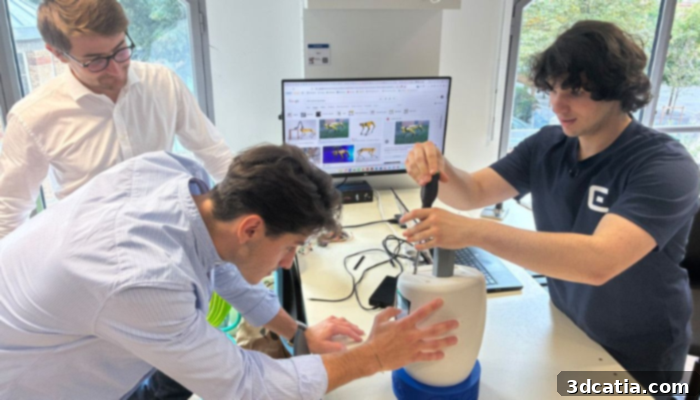
Students were able to design a lightweight body for Milo in their robotics studio. (Photo Credit: Les Echos)
François Stephan, the esteemed Director of ECE Paris, highlighted Milo’s pivotal role, emphasizing that she is envisioned as a crucial bridge facilitating enhanced interaction and understanding between students and faculty. As he eloquently explained, “Milo will be a kind of mediator to increase pedagogy and the student experience.” This innovative approach signifies a move towards personalized and integrated learning environments. Beyond her physical presence in lectures, where she actively participates and observes, Milo’s accessibility is further extended through a dedicated mobile application. This digital interface allows students to interact with her remotely, seeking advice and guidance on a wide array of academic and campus-life matters. Milo is designed to offer personalized support for coursework, help navigate internship opportunities, and assist with overall integration into the vibrant campus community. Her multifaceted role at ECE Paris powerfully illustrates the escalating overlap of advanced AI systems and their physical manifestations, a convergence that is increasingly enabled and propelled by the transformative capabilities of additive technologies. This synergy not only enhances the learning experience but also pushes the boundaries of what is possible in educational robotics.
For the global 3D printing community, Milo represents far more than just a fleeting novelty; she symbolizes a tangible vision of the future. Her existence points towards an imminent era where sophisticated AI-powered systems and intricately printed components no longer merely coexist but evolve in a synergistic partnership. Additive manufacturing, with its inherent structural freedom, empowers designers to create remarkably lightweight, highly customized, and even organically aesthetic robot forms, which are crucial for enhanced mobility and natural interaction. This freedom allows for complex geometries that traditional manufacturing methods simply cannot achieve, fostering innovation in robotic design. Concurrently, AI plays a pivotal role in accelerating design optimization, enabling generative design processes that explore countless permutations to find the most efficient and effective structures. Furthermore, AI significantly enhances user interaction, making robots like Milo more intuitive and responsive. This powerful combination establishes a dynamic feedback loop where each technology propels the other forward: AI generates innovative designs, 3D printing rapidly brings them to physical reality, and the data gathered from these physical prototypes then refines and improves the AI algorithms. In Milo’s unique case, this intricate dance involves a sovereign and ethically developed AI, meticulously crafted in-house by ECE students and faculty, seamlessly integrated with a physical body that was precisely shaped, layer by layer, within the university’s own lab, demonstrating a profound commitment to ethical AI development and practical application.
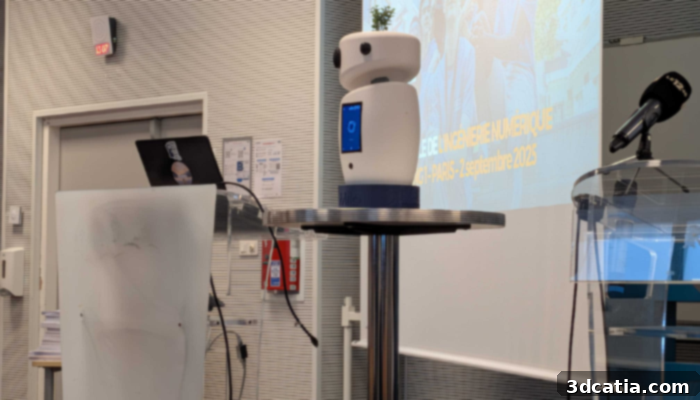
Milo currently attends lectures with students and learns alongside them in the classroom. (Photo Credit: BFMTV)
It is important to acknowledge that Milo, like all pioneering technologies, remains under active development. She occasionally exhibits slower response times and experiences intermittent glitches, which are common and expected in the iterative process of cutting-edge research and development. However, these minor imperfections do not detract from the immense significance of this project at ECE Paris. Instead, they underscore a critical and transformative direction for the future of engineering and technological innovation. Artificial intelligence is unequivocally poised to revolutionize a vast array of industries, from the precision-driven manufacturing sector to the life-saving field of medicine, and extending into areas like logistics, automotive design, aerospace engineering, and even personalized consumer goods. In this sweeping transformation, 3D printing will undoubtedly serve as one of the most vital enabling tools, facilitating the rapid prototyping, customization, and localized production necessary for these advancements to take tangible form. For the dedicated students at ECE Paris, Milo is not merely a novel classmate; she is a dynamic, living embodiment of the future – a tangible glimpse into the very technologies and possibilities they are actively striving to master and shape. Her presence in the classroom fosters an immersive learning environment, preparing them for a world where AI and advanced manufacturing are inextricably linked.
Milo embodies the spirit of innovation and collaborative learning at ECE Paris, pushing the boundaries of what is achievable when AI and advanced manufacturing converge. Her journey from concept to physical presence highlights the incredible potential of 3D printing in making futuristic AI applications a tangible reality within educational and research settings. What are your thoughts on Milo’s groundbreaking role in redefining the student experience and the future of robotics? We invite you to share your insights in a comment below or connect with us on our LinkedIn or Facebook pages! Furthermore, don’t miss out on the latest advancements in additive manufacturing by signing up for our free weekly Newsletter, delivered straight to your inbox. You can also explore all our insightful videos and compelling content on our dedicated YouTube channel.
*Cover Photo Credit: Le Parisien