
Hyundai Motor Group first began using industrial 3D printing in 1996. Nearly three decades later, Hyundai Motor and Kia have established a dedicated facility focused on additive manufacturing research and production: the Additive Manufacturing Solution Center (AMSC) at the Namyang R&D Center in South Korea. This center concentrates the Group’s growing capabilities in additive manufacturing, enabling faster development cycles and greater flexibility in parts design and production.
The AMSC is one of four advanced facilities at Namyang highlighted by Hyundai in a series about its digital R&D infrastructure. It sits inside the Advanced Mobility Solutions building and integrates both polymer and metal additive manufacturing processes under one roof. By combining equipment, design expertise and quality control in a single location, the center shortens the path from concept to finished hardware and supports production-ready AM applications.
“We are rapidly internalizing additive manufacturing technologies through a growing range of applications across the Group. Beyond vehicle components, we are expanding their use in high-value applications such as equipment consumables and manufacturing tools.” – Hanwoo On, Senior Manager of the Additive Manufacturing Solutions Team, Hyundai Motor and Kia
Two Material Streams, Complementary Capabilities
The AMSC operates two principal material streams: polymers and metals. For polymer parts, the center uses vat photopolymerization methods—digital light processing (DLP) and stereolithography (SLA)—alongside polymer powder bed fusion (polymer PBF). DLP and SLA are deployed when fine detail and tight dimensional accuracy are required, such as for design validation and high-fidelity prototypes. Polymer PBF is chosen for larger, more durable components where structural performance and repeatability are priorities.
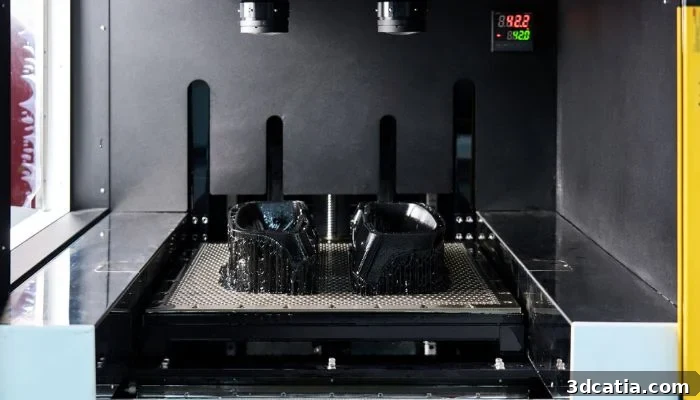
Vat photopolymerization cures liquid resin layer by layer using light.
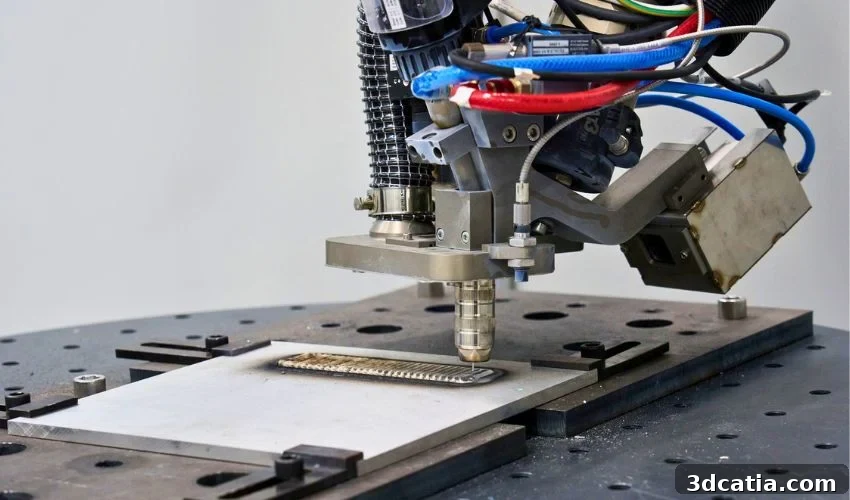
On the metal side, the AMSC works with laser powder bed fusion (LPBF) and directed energy deposition (DED). The DED line includes wire arc additive manufacturing (WAAM) capabilities that support steel, stainless steel, aluminum and titanium. These large-format metal processes enable rapid near-net-shape production of structural components that can then be finished by machining to achieve final tolerances and surface quality.
When illustrating the workflow, Hyundai showed the same motor housing printed using WAAM and then again after CNC machining. The example highlights a common hybrid approach: additive techniques produce the basic geometry more quickly and with greater material efficiency, and subtractive machining brings the part to precise specifications.
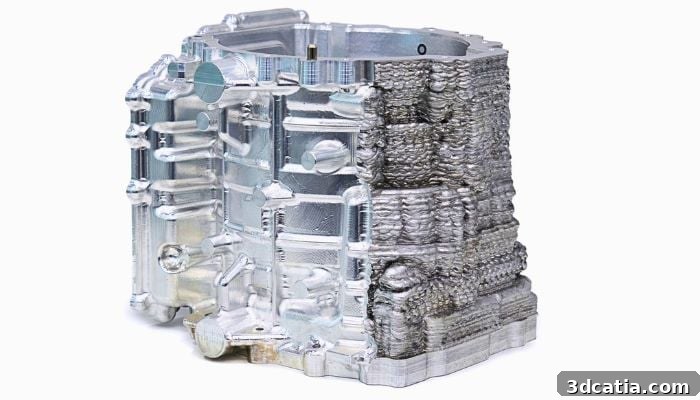
A sample metal component after partial CNC machining, demonstrating post-processing of an additively manufactured part.
Design Freedom and Quality Control
A core focus of the AMSC is developing design for additive manufacturing (DfAM) skills. Engineers work on part consolidation, lattice and topology-optimized structures, and lightweight geometries that are not achievable with traditional tooling. Optimizing parts for additive manufacturing unlocks benefits in reduced weight, improved performance and simplified assemblies, delivering value across production, aftermarket and motorsport applications.
Quality assurance is tightly integrated into the center’s workflow. Every fabricated component is inspected in the Quality Inspection Cell, where dimensional and mechanical testing ensure parts meet production-equivalent standards. Material verification, metallurgical analysis and in-house testing confirm process consistency and part reliability before components are released for use in vehicles, tooling or service applications.
Practical Applications and Business Benefits
Beyond rapid prototyping, the AMSC already produces jigs and fixtures used in manufacturing, service parts for discontinued models where traditional tooling is uneconomical, and performance components for motorsport, including anti-roll bar blades, damper brackets and brake duct rails. The center also supports heritage restoration by using 3D scanning and reverse engineering to recreate obsolete components—Hyundai reproduced a side-sill for the Pony, the company’s first production car, as an example of preserving automotive history through modern manufacturing.
Having design, production, post-processing and quality inspection co-located shortens lead times and reduces the iteration cycle between digital design and finished hardware. This vertical integration also gives engineers greater freedom to explore complex geometries and material combinations without being constrained by conventional manufacturing tooling.
As additive manufacturing matures within major automakers, in-house centers like the AMSC can drive strategic advantages: faster development, lower-cost low-volume parts, localized production for service and heritage projects, and tailored manufacturing tools. The AMSC demonstrates how a modern R&D hub can turn additive manufacturing from a prototyping technology into a production-capable discipline supporting both product innovation and operational efficiency.
*All Photo Credits: Hyundai Motor Group