
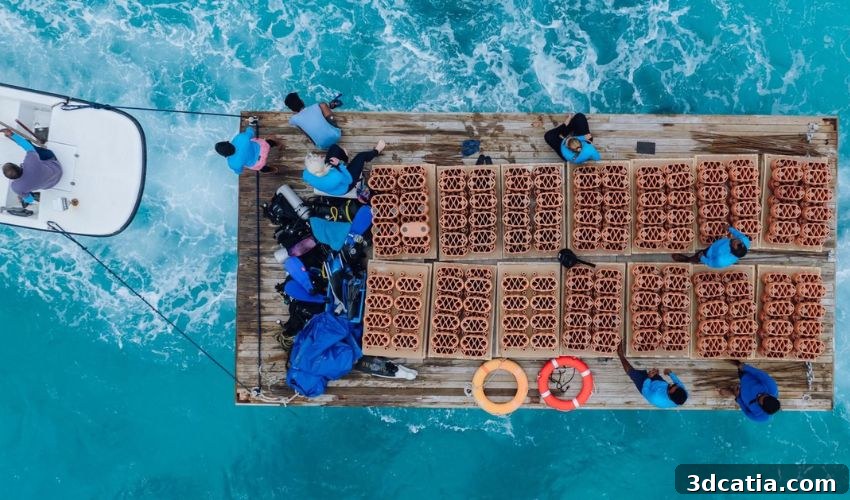
The Anantara Dhigu resort in the Maldives has installed thirteen 3D-printed clay structures in its lagoon to help revive an ecosystem long threatened by coral bleaching. Named Theyra Maa, which means “13 flowers” in Dhivehi, the installation was created in collaboration with rrreefs, a Swiss company that focuses on reef restoration using large-scale additive manufacturing. The initiative aims to provide stable, biologically attractive substrates for coral larvae and to accelerate natural regrowth in a part of the ocean facing mounting environmental stress.
3D-printed clay is increasingly used in marine conservation projects worldwide. By producing bespoke geometries and controlled surface properties, additive manufacturing enables designers and marine biologists to create structures that encourage coral attachment and growth. Since its founding in 2020, rrreefs has worked on multiple restoration projects and reports having helped add thousands of corals to reefs where its modules have been deployed. The Theyra Maa installation builds on that experience, applying proven design principles in a new location with hotel-resort partnership and local support.
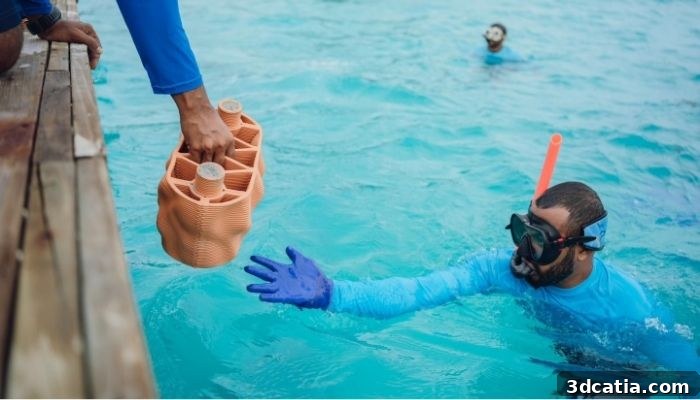
Installation of “Theyra Maa” in the Maldives (photo credit: rrreefs).
Microcavities Designed for Coral
Mauro Bischoff, Head of Production at rrreefs, explains that the layer-by-layer 3D printing process naturally produces tiny microcavities between printed layers. These small pockets offer shelter to coral larvae, reducing their exposure to predators and increasing the chance they will attach and begin the process of calcification. The design also allows precise control over overall porosity, which encourages the formation of beneficial biofilms — thin microbial layers that create favorable chemical and biological conditions for coral settlement. By tuning surface texture, pore size, and internal cavities, the printed modules function as both refuge and foundation for early-stage coral development.
Beyond immediate settlement benefits, the material choice of clay supports long-term integration with the surrounding seafloor. Clay-based structures can encourage colonization by a variety of marine organisms, forming a more complex habitat that supports juvenile fish and invertebrates as coral communities recover. The project’s focus on material science and ecological engineering reflects a growing trend in reef restoration: combining design, manufacturing, and biology to produce scalable solutions that work with natural processes rather than against them.
Thirteen Underwater Flowers
The thirteen modules installed in the lagoon take the shape of flowers. This aesthetic choice is functional: the petal-like forms create small eddies and sheltered zones around each unit, slowing local currents so that coral larvae are more likely to settle rather than be swept away. Divers from rrreefs assembled and anchored the structures directly on the seafloor in South Malé Atoll, securing them to withstand wave action and ensure long-term stability. Anchoring and proper placement are critical in any restoration effort, as modules must remain in position through storms, tides, and routine seabed movement.
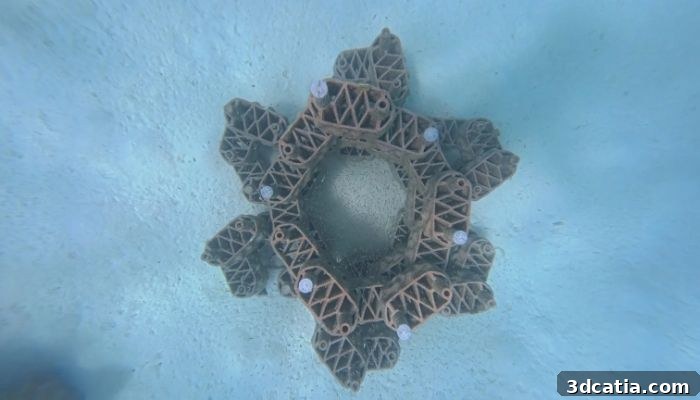
One of the thirteen floral installations from “Theyra Maa” (photo credit: Minor Hotels).
The installation was supported by partners within the Lufthansa Group as part of responsible tourism and environmental stewardship initiatives. This collaboration between an international resort, a specialized restoration company, and corporate stakeholders illustrates how diverse actors can contribute resources and logistics to local restoration efforts. Notably, this project represents rrreefs’ first direct partnership with a hotel resort, expanding the model for how tourism operators can actively support the ecosystems they depend on.
Restoration projects like Theyra Maa are not a substitute for broader actions to address climate change and local stressors such as pollution and overfishing; rather, they are one component of a multi-faceted strategy to increase reef resilience. Monitoring and adaptive management will be essential in the coming months and years to assess coral recruitment, growth rates, and broader ecological responses around the modules. Success will depend on careful scientific observation and ongoing maintenance where necessary.
Photographs and early observations will help inform future deployments and refinements to module geometry, porosity, and placement strategy. As more projects use additive manufacturing for reef work, shared learning between companies, resorts, researchers, and local communities will speed improvements and clarify which designs perform best under different environmental conditions.
*Photo credits: rrreefs