
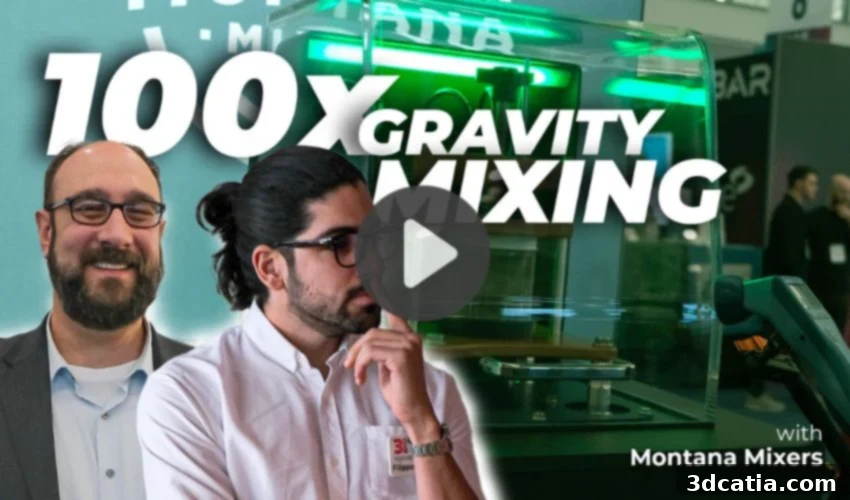
Revolutionizing Additive Manufacturing: Montana Mixers and VROM Technology Unveiled at RAPID + TCT 2026
In the rapidly evolving landscape of additive manufacturing, significant attention is often directed towards printer hardware, new materials, and post-processing techniques. However, a crucial foundational step that underpins the quality and reliability of 3D printed parts – material preparation – frequently remains an overlooked hero. At RAPID + TCT 2026, Montana Mixers is boldly bringing this critical phase into the spotlight with its groundbreaking VROM technology. This innovative Vertical Resonant Oscillatory Mixing system promises to redefine how powders, liquids, and pastes are processed before they ever reach the printer, ensuring unprecedented levels of material homogeneity and consistency.
The VROM technology operates on a principle distinct from traditional mixing methods. Instead of relying on blades or tumbling mechanisms, it harnesses the power of pressure waves. Oscillating at a precise 60Hz and capable of generating forces up to 100g, VROM achieves bladeless, high-frequency mixing. This unique approach allows for the creation of exceptionally consistent material blends throughout the entire volume, mitigating common issues such as particle segregation and agglomeration that plague conventional methods. By ensuring every particle, regardless of its size or density, is uniformly distributed, Montana Mixers is laying the groundwork for superior print quality and more reliable final products.
The Underrated Challenge: Material Preparation in Additive Manufacturing
The quality of the raw material directly dictates the quality and performance of the final 3D printed component. In additive manufacturing, where layer-by-layer deposition relies on precise material characteristics, even minor inconsistencies can lead to significant defects. Traditional mixing techniques, while suitable for many industries, often fall short for the stringent demands of AM:
- Particle Segregation: Particularly problematic with multi-component powders or blends with varying particle sizes and densities. Gravity can cause heavier particles to settle or lighter ones to rise, leading to non-uniform distribution within a batch.
- Agglomeration: Fine powders, especially those used in metal AM, can clump together due to electrostatic forces or moisture, making them difficult to flow and spread evenly during printing.
- Air Entrapment: Bladed mixers can introduce air bubbles into liquid or paste formulations, leading to voids and defects in printed parts.
- Shear Damage: Aggressive bladed mixing can damage delicate particles or alter the rheological properties of shear-sensitive materials, impacting their printability and the final part’s mechanical properties.
- Batch Inconsistency: Achieving identical material properties from one batch to the next is a persistent challenge, hindering repeatability and scalability in production environments.
These issues not only compromise the mechanical strength, surface finish, and dimensional accuracy of printed parts but also contribute to increased material waste, longer development cycles, and higher production costs. Montana Mixers recognizes these bottlenecks and offers a targeted solution designed specifically for the unique demands of advanced manufacturing.
VROM Technology: A Deep Dive into Resonant Oscillatory Mixing
The core of Montana Mixers’ innovation lies in its Vertical Resonant Oscillatory Mixing (VROM) technology. This bladeless mixing method represents a significant departure from conventional approaches, offering a cleaner, more efficient, and fundamentally superior way to prepare materials for additive manufacturing. Dr. Peter Lucon, CIO and Founding Partner of Montana Mixers, explained the science behind VROM during our visit to their booth:
- Bladeless Operation: By eliminating physical mixing elements like blades, VROM prevents shear-induced damage to delicate particles and eliminates the introduction of contaminants from wear and tear of moving parts. This is particularly crucial for sensitive materials like ceramic slurries or advanced polymer blends.
- High-Frequency Oscillation: The system oscillates at 60Hz, generating rapid, controlled movements that induce pressure waves within the material. These pressure waves are the primary mechanism for mixing, creating micro-eddies and turbulent flow patterns that ensure thorough and uniform distribution of components.
- High G-Forces: Reaching up to 100g, the VROM system subjects materials to intense accelerations. This force effectively de-agglomerates particles and forces them to move and interact with surrounding material, breaking down clumps and ensuring intimate mixing at a microscopic level. The high g-forces also contribute to rapid processing times.
- Uniform Energy Distribution: Unlike bladed mixers where energy input is localized around the blades, VROM’s pressure waves distribute energy uniformly throughout the entire material volume. This results in consistent mixing from the center to the edges of the container, eliminating dead zones and ensuring comprehensive homogeneity.
- Scalability and Versatility: The VROM principle is inherently scalable, allowing for efficient mixing across various batch sizes, from small R&D volumes to large industrial production quantities. Its adaptability makes it suitable for a wide array of material types, including highly viscous pastes, low-viscosity liquids, and challenging powder mixtures.
This advanced mixing methodology ensures that material properties – such as particle size distribution, viscosity, and chemical composition – are uniform throughout the batch, a prerequisite for repeatable and high-quality 3D printing.
Broadening the Horizons: VROM’s Applications Across Additive Manufacturing
The versatility of Montana Mixers’ VROM technology extends across a wide spectrum of additive manufacturing processes and materials, addressing specific challenges in each domain:
Enhancing Metal Powder Quality for Laser Powder Bed Fusion (LPBF)
For metal AM processes like Laser Powder Bed Fusion (LPBF), the quality and consistency of metal powders are paramount. VROM technology ensures uniform particle size distribution within a batch of metal powder, which is critical for consistent layer spreading, proper laser absorption, and defect-free melting. By effectively de-agglomerating fine metal particles and preventing segregation, VROM helps achieve optimal powder bed density and flowability, leading to parts with superior mechanical properties, reduced porosity, and excellent surface finish. This is vital for demanding applications in aerospace, medical, and automotive sectors where part reliability is non-negotiable.
Optimizing Polymer Blends and Printable Inks
In polymer-based additive manufacturing, creating homogeneous blends of polymers, additives, and colorants is essential for functional and aesthetic properties. VROM efficiently mixes polymer powders for processes like Selective Laser Sintering (SLS) or prepares composite filaments for Fused Deposition Modeling (FDM) by ensuring even distribution of reinforcing fibers or functional fillers. For inkjet 3D printing and material jetting, the preparation of printable inks requires precise control over viscosity, particle suspension, and pigment dispersion. VROM’s bladeless, high-frequency action prevents sedimentation of solid particles in liquid inks, ensuring stable suspensions and consistent jetting performance, which translates into accurate color reproduction and reliable material deposition.
Revolutionizing Slurry and Paste Preparation
Many advanced AM techniques, such as ceramic 3D printing, stereolithography (SLA) with highly filled resins, and binder jetting with specialized binders, rely on precisely formulated slurries and pastes. These materials often present significant mixing challenges due to high viscosity and the tendency for solid particles to settle. VROM excels in this area, creating perfectly homogeneous slurry suspensions and pastes. The strong g-forces and pressure waves break down agglomerates and uniformly disperse solids within the liquid matrix, leading to stable, highly consistent printing materials. This capability is instrumental in producing dense, high-performance ceramic parts with complex geometries and in developing novel composite materials for various industrial applications.
Scaling Innovation with MixOS™ Software
Beyond the hardware, Montana Mixers addresses the critical need for process control and scalability through its sophisticated MixOS™ software platform. This intelligent operating system empowers users to transition seamlessly from research and development to full-scale production. MixOS™ provides a comprehensive suite of tools for:
- Process Parameter Control: Users can precisely define and control mixing parameters, including oscillation frequency, duration, and intensity, allowing for optimization based on material type and desired outcome.
- Data Logging and Analysis: The software records all critical mixing data, enabling engineers and researchers to analyze process variables, identify trends, and ensure batch-to-batch consistency. This data-driven approach is invaluable for quality assurance and process improvement.
- Repeatability and Traceability: MixOS™ facilitates the creation and execution of standardized mixing protocols, ensuring that every batch meets specific quality metrics. This level of repeatability is crucial for regulated industries and for scaling production efficiently.
- Integration and Automation: Designed for modern manufacturing environments, MixOS™ can integrate with existing production lines and AM workflows, paving the way for automated, closed-loop material preparation systems.
Together, the VROM hardware and MixOS™ software platform highlight Montana Mixers’ holistic approach to material preparation, positioning it as an indispensable step for achieving the full potential of additive manufacturing.
The Impact on Additive Manufacturing: Quality, Efficiency, Innovation
Montana Mixers’ VROM technology is poised to have a transformative impact on the additive manufacturing industry by addressing fundamental challenges that hinder widespread adoption and performance. By elevating the standard of material preparation, VROM enables:
- Enhanced Part Quality and Performance: Homogeneous materials lead to parts with improved mechanical properties, reduced internal defects, better surface finish, and more predictable performance, which is crucial for safety-critical applications.
- Increased Material Efficiency and Reduced Waste: Consistent materials minimize print failures and rejected parts, leading to more efficient use of expensive specialty powders, liquids, and pastes. This translates directly into cost savings and reduced environmental impact.
- Faster R&D Cycles and Innovation: Researchers and material scientists can more rapidly develop and validate new material formulations knowing that mixing inconsistencies will not skew their results. VROM accelerates the exploration of novel composite materials and multi-material applications.
- Greater Scalability and Repeatability: The ability to consistently prepare materials from lab scale to production volume with identical properties removes a major bottleneck for industrializing additive manufacturing. This ensures that a prototype’s success can be reliably replicated in mass production.
- Broader Material Compatibility: VROM’s gentle yet effective mixing action opens up possibilities for processing materials that are difficult or impossible to mix with traditional methods, including highly sensitive, high-viscosity, or multi-component systems.
In essence, Montana Mixers is not just offering a new mixer; it’s providing a foundational technology that unlocks new levels of precision, reliability, and innovation in additive manufacturing, moving the industry closer to its promise of truly transformative manufacturing capabilities.
Experience VROM at RAPID + TCT 2026
For those attending RAPID + TCT 2026, the opportunity to witness this revolutionary technology firsthand is not to be missed. Montana Mixers will be showcasing its VROM system in the AeroDef section at booth #2416. This dedicated area often features technologies critical to aerospace and defense, industries where material quality and part reliability are paramount. Seeing the VROM technology in action provides invaluable insight into how material preparation can be optimized to meet the most stringent manufacturing requirements. Our full conversation with Dr. Peter Lucon, offering deeper insights into the vision and technical prowess behind VROM, is available in the video below.
Join the Conversation: The Future of Material Processing in Additive Manufacturing
The role of material processing in additive manufacturing is undeniably critical for the industry’s continued advancement. As 3D printing moves beyond prototyping to become a mainstream production technology, the demand for consistent, high-quality, and cost-effective materials will only intensify. Innovations like Montana Mixers’ VROM technology are essential for meeting these demands and unlocking the full potential of AM. We encourage you to reflect on the significant impact that advanced material preparation can have on the quality, reliability, and scalability of 3D printed parts.
What are your thoughts on the evolving role of material processing in additive manufacturing? Do you believe technologies like VROM will become standard in the industry? Share your insights and perspectives in a comment below or join the discussion on our LinkedIn or Facebook pages! Plus, to stay informed about the latest breakthroughs and news in the world of 3D printing, don’t forget to sign up for our free weekly Newsletter to receive updates directly in your inbox. You can also explore all our videos and interviews, including this one, on our YouTube channel.