
Navigating the Future of 3D Printing Post-Processing: Trends, Challenges, and Solutions for 2026
The additive manufacturing landscape is rapidly evolving, and with it, the crucial stage of post-processing. PostProcess Technologies has recently released its highly anticipated 5th edition study, a comprehensive analysis of the latest trends and challenges in post-processing. Building on the insights from the 2022 release, this report underscores a growing emphasis on sustainability, safety, and health within the industry. As 3D printing production volumes continue to surge, so do the concerns surrounding the efficiency, consistency, and safety of post-processing operations. This article delves into the key findings of the report, exploring the horizon of post-processing in 2026 and beyond.
While the additive manufacturing industry continues to innovate, several fundamental post-processing needs have remained constant over time. Since 2019, support removal and surface finishing have consistently been the two most prevalent methods employed by 3D printing users. The survey reveals that approximately 59% of respondents utilize support removal techniques, while 48% rely on surface finishing to achieve desired part characteristics.
The selection of post-processing techniques is inherently linked to the chosen additive manufacturing process. The study reaffirms that material extrusion, including Fused Deposition Modeling (FDM), maintains its dominance as the most widely used 3D printing method. Resin-based processes, such as stereolithography (SLA) and digital light processing (DLP), occupy the second position, followed by powder-based methods like selective laser sintering (SLS) and selective laser melting (SLM). These rankings have largely remained consistent with previous years. However, the post-processing sector is undergoing significant changes to keep pace with the evolving demands of the industry in 2026 and beyond. What are the specific challenges and opportunities shaping the future of post-processing?
Key Challenges in 3D Printing Post-Processing for 2026
The PostProcess Technologies report identifies a shift in the primary challenges associated with post-processing. For the first time, achieving consistent part quality across multiple batches has emerged as the leading concern, cited by 54% of survey participants. This highlights the critical need for robust and reliable post-processing solutions that can deliver repeatable results regardless of batch size or material variations.
Closely following consistency is the time required for post-processing operations, a significant obstacle for 53% of respondents. This underscores the fact that many post-processing tasks remain excessively time-consuming, creating bottlenecks in the overall additive manufacturing workflow. The time-intensive nature of these operations also directly impacts workforce allocation, as companies increasingly recognize the value of redeploying skilled labor to tasks that offer higher added value. Consequently, there is a growing demand for automated post-processing solutions that minimize human intervention or, at the very least, streamline manual processes to enhance efficiency.
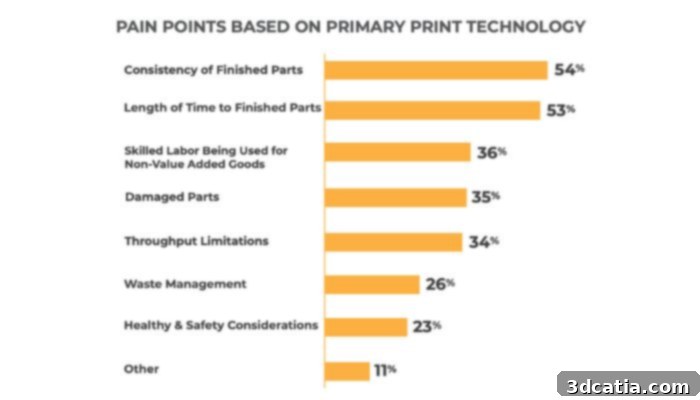
The main challenges associated with post-processing (credit: PostProcess)
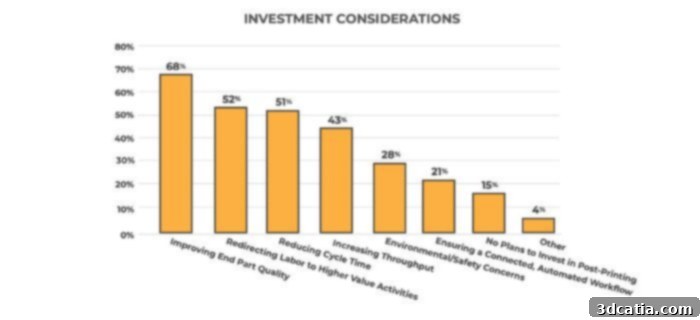
The desire to optimize workforce allocation is further emphasized by the fact that 52% of respondents identify redirecting labor to other operations as a top priority when considering investments in post-processing equipment and technologies. However, it’s important to note that improving the quality of finished parts remains the paramount concern, cited by 68% of participants. This reinforces the understanding that while automation and efficiency are crucial, they cannot come at the expense of part quality and performance.
The Imperative of Scaling Up Post-Processing
One of the most compelling insights from the 2026 PostProcess Technologies report is the emphasis on scaling up post-processing capabilities to accommodate the growing production volumes in additive manufacturing. As 3D printing increasingly transitions from prototyping to the production of end-use parts, often in varying batch sizes, post-processing methods must keep pace in terms of scalability and throughput.
This raises fundamental questions about the future of post-processing: How can post-processing operations keep up with the rapid advancements in 3D printing technology and production speeds? What strategies can be employed to further automate certain post-processing processes and minimize manual labor? What is the optimal balance between machine automation and the expertise of skilled workers in achieving the desired outcomes?
A significant 70% of survey respondents expressed doubts about the ability of their current post-processing methods to meet future demands. This indicates a widespread recognition that the industry is at a critical juncture, requiring a significant leap forward in post-processing technology and strategies to unlock the full potential of additive manufacturing. This requires a multi-faceted approach encompassing technological advancements, process optimization, and workforce training.
The budgets allocated to post-processing provide valuable insight into the industry’s priorities. For the majority of companies surveyed, post-processing expenses account for less than 25% of their total additive manufacturing budget. While this may not necessarily indicate a lack of investment, it suggests that post-processing has not historically been viewed as a top priority, at least from a budgetary perspective. However, as the challenges and opportunities outlined in the report become increasingly apparent, it is likely that companies will re-evaluate their investment strategies and allocate more resources to improving their post-processing capabilities.
One thing is certain: the landscape of post-processing is evolving rapidly as we approach 2026. While the changes may not be revolutionary, they are indicative of a clear shift in focus. The industry recognizes that post-processing must adapt to the prevailing trends in additive manufacturing, which are increasingly geared towards full-scale production. This requires a commitment to innovation, efficiency, and sustainability to unlock the full potential of 3D printing. You can access the complete study HERE to gain a deeper understanding of the specific trends and challenges shaping the future of post-processing.
*Cover Photo Credits: KingStarMold