
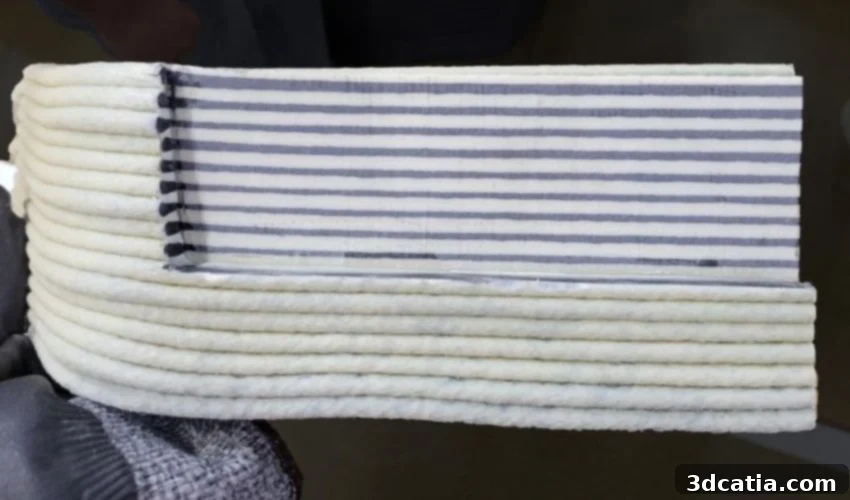
Revolutionary Multi-Material 3D Printing System Unveiled by Oak Ridge National Laboratory
The world of 3D printing is constantly evolving, and multi-material printing stands at the forefront of this innovation. We’ve recently explored the advancements in multi-material 3D printing technology and highlighted the compelling reasons why it’s considered the next frontier. From user-friendly desktop systems developed by companies like Bambu Lab and Prusa to more experimental approaches, the progress is undeniable. Now, researchers at the Oak Ridge National Laboratory (ORNL) have introduced a groundbreaking multi-material 3D printing system that promises to redefine the capabilities of additive manufacturing.
This innovative system integrates multiple extruders into a single, high-output stream using a specialized nozzle. According to ORNL, this design achieves the speed of larger extruders while offering enhanced flexibility and precision. This development addresses key challenges associated with traditional large extruder systems, paving the way for more efficient and versatile 3D printing processes.
The impetus for this project stemmed from the need to overcome limitations in the performance of large extruders. A primary concern is the significant weight of these extruders, which necessitates the use of robust and expensive gantries or robots to support them. Furthermore, as output increases, the precision of large extruders tends to decrease, leading to inconsistencies in material flow. This poses significant problems when printing small, intricate parts or large, tapered designs. To mitigate these issues, printing speed often has to be reduced, which can result in heat buildup and subsequent warping of the printed object.
ORNL’s innovative solution presents a more efficient and effective approach. It enables users to selectively add or deactivate smaller extruders without sacrificing print quality. Critically, the system facilitates the simultaneous printing of multiple materials within a single bead, eliminating the need for equipment swaps. This capability opens up a wide range of possibilities for creating parts with complex material compositions and tailored properties.
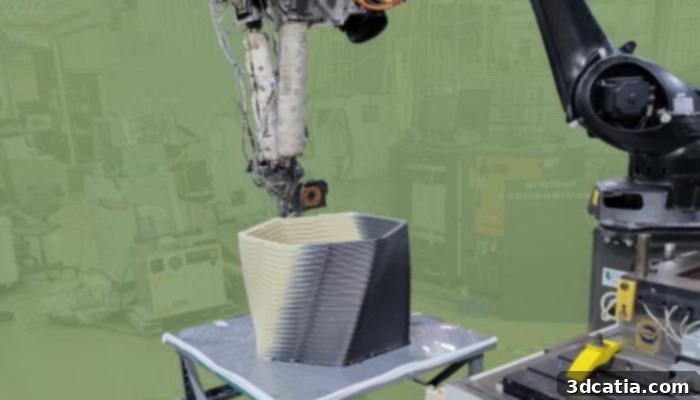
The ORNL system allows for the deposition of multiple materials in a single bead, enabling complex material combinations.
How the Multi-Material 3D Printing System Works
The core of ORNL’s design lies in its patent-pending nozzle blocks. These blocks are constructed from aluminum bronze, chosen for its strength and thermal conductivity. The internal design of these blocks is engineered to merge two molten polymer streams originating from parallel extruders. This innovative design allows the system to process a broad range of large-scale pellet feedstocks across various configurations. Importantly, ORNL reports consistent doubling of flow rates, with the potential for tripling, quadrupling, and beyond. The multiplexing system effectively streamlines the extrusion process and significantly minimizes center porosity through the implementation of a Y-shaped nozzle. This innovative nozzle design is crucial for achieving consistent and high-quality multi-material prints.
The elimination of center porosity is particularly important for ensuring the structural integrity and performance of the final printed part. By minimizing voids within the material, the Y-shaped nozzle contributes to increased strength and durability.
“By enabling smaller-scale extruders to match the output of larger systems without the burden of extra weight — and by achieving unprecedented multi-material extrusion within the bead — this system is poised to redefine extrusion-based additive manufacturing,” stated Halil Tekinalp, the ORNL researcher who led the project. “These advancements will help strengthen U.S. manufacturing competitiveness and expand access to cutting-edge production technologies, allowing companies to create innovative products with enhanced performance characteristics.”
Beyond the Y-shaped nozzle, the researchers also developed a proprietary nozzle capable of generating core-and-sheath beads, where one material encases another. This development enables the precise combination of two materials, resulting in distinct mechanical and/or functional properties within a single bead. Manufacturers can leverage this capability to incorporate composite cores with enhanced interlayer adhesion, effectively addressing the issue of delamination, or layer separation, which has been a persistent challenge in polymer additive manufacturing.
Delamination occurs when the layers of a 3D printed part fail to adhere properly, leading to weakness and potential failure. The core-and-sheath bead approach offers a solution to this problem by creating a stronger bond between layers, resulting in more durable and reliable printed parts.
Potential Applications of Multi-Material 3D Printing
This innovative technology holds immense potential across a wide spectrum of applications. In the aerospace industry, it could be used to fabricate crash-safe panels or radar-absorbing parts. For defense applications, it could enable the creation of strong, lightweight shelters or protective panels. The energy sector could benefit from flame-resistant enclosures or lightweight modular housing and support structures for battery racks or thermal energy systems. Even civil projects could leverage this technology for applications such as reinforced bridge decks, car bumpers, and boat hulls.
The ability to combine different materials with tailored properties opens up exciting possibilities for optimizing the performance of these applications. For example, a crash-safe panel could be designed with a combination of impact-resistant and energy-absorbing materials, while a radar-absorbing part could incorporate materials with specific electromagnetic properties.
“This innovation opens up new manufacturing horizons, making it possible to achieve complex, efficient, and creative designs with dynamic material switching, all while preventing cross-contamination — meaning the distinct materials remain pure and do not mix unintentionally,” explained Vipin Kumar, another technical lead on the project. The prevention of cross-contamination is crucial for maintaining the desired properties of each material and ensuring the overall performance of the printed part.
To delve deeper into this groundbreaking research, you can read the official article from ORNL here. This article provides further details on the system’s design, capabilities, and potential impact on the future of additive manufacturing. This new method has the potential to significantly streamline the manufacturing process.
The development of this multi-material 3D printing system represents a significant step forward in the field of additive manufacturing. By overcoming the limitations of traditional large extruder systems and enabling the creation of complex material combinations, this technology is poised to revolutionize a wide range of industries.
The implications of this advancement extend beyond specific applications. It also has the potential to transform the way products are designed and manufactured, leading to more efficient, sustainable, and innovative solutions. The ability to tailor material properties at a microstructural level opens up a new realm of possibilities for engineers and designers.
The team at Oak Ridge National Laboratory has demonstrated a commitment to pushing the boundaries of additive manufacturing, and their multi-material 3D printing system is a testament to their ingenuity and expertise. This technology has the potential to reshape the future of manufacturing and unlock new possibilities for innovation across various industries. The impact of this system will likely be felt for many years to come, as it empowers manufacturers to create products with unprecedented levels of customization and performance.
What are your thoughts on this innovative multi-material 3D printing method? Share your opinions in the comments below or connect with us on our LinkedIn or Facebook pages! Don’t forget to subscribe to our free weekly Newsletter to stay up-to-date on the latest 3D printing news. You can also find all our videos on our YouTube channel.
*All Photo Credits: Halil Tekinalp/ORNL, U.S. Dept. of Energy