
Revolutionary 3D Printed Blood Vessels Offer New Hope for Stroke Prediction and Personalized Treatment
Imagine a future where medical professionals can seamlessly leverage advanced technology to enhance patient care. In this not-so-distant future, a patient’s CT scan is instantly transformed into a meticulously crafted 3D printed model of their blood vessels. This physical replica allows doctors to analyze the patient’s blood response with unparalleled precision, and harnessing the power of artificial intelligence (AI), accurately predict their risk of stroke years in advance. This vision is rapidly becoming a reality thanks to pioneering research being conducted at the University of Sydney, where a team of dedicated scientists has developed an innovative technology for 3D printing blood vessels.
Published in the prestigious journal Advanced Materials, this groundbreaking research details an approach that allows for the creation of blood vessels that not only closely mimic real anatomical structures but also accurately replicate the intricate fluid dynamics of blood flow. This innovative technology has the potential to revolutionize the way strokes are studied and treated, providing a powerful tool for understanding the underlying causes of this debilitating condition and paving the way for the development and testing of personalized treatments tailored to each patient’s unique needs.
According to Professor Arnold Ju, the lab head and senior author of the study, the team has successfully created a “physical twin” of patient blood vessels – an exact miniaturized replica that behaves just like the real thing. This remarkable achievement opens up a world of possibilities for understanding and treating stroke.
Looking ahead, Professor Ju and his team are focusing on integrating artificial intelligence into their biofabrication platform. Helen Zhao, the postdoctoral digital scientist and operation manager of the MBL Ju lab, explains, “Our next frontier is integrating artificial intelligence with our biofabrication platform to create true ‘digital twins’ that can predict stroke events before they happen, moving from reactive treatment to proactive prevention.” This ambitious goal could transform stroke care, shifting the focus from treating the condition after it occurs to proactively preventing it in the first place.
Envisioning the future impact of this technology, Helen Zhao adds, “Imagine a future where we can take a patient’s CT scan, rapidly print their blood vessel model, test their blood response, and use AI to predict their stroke risk years in advance.” This scenario highlights the potential of this research to revolutionize personalized medicine and improve the lives of millions at risk of stroke.
Professor Ju emphasizes that this achievement is the result of exceptional collaborative efforts across various departments within the University of Sydney, including the School of Biomedical Engineering, the Charles Perkins Centre, and the Heart Research Institute. This multidisciplinary approach has been crucial to the success of the project.
Acknowledging the vital role of funding and support, Professor Ju states, “We’re deeply grateful for the visionary support of the Snow Medical Research Foundation and the Snow Family through the Snow Fellowship and the National Heart Foundation Future Leader Fellowship, which has been instrumental in advancing this transformative research.” These fellowships have provided the resources and freedom necessary to pursue this innovative research.
Professor Ju also praises the dedication and ingenuity of his team: “My Snow Lab members have shown remarkable innovation in developing this technology, and working with our clinical partners at Royal Prince Alfred Hospital and Prince of Wales Hospital ensures our research directly addresses real patient needs. This exemplifies how engineering innovation can transform healthcare delivery, particularly aligned with future Sydney Biomedical Accelerator (SBA) goal.” This collaboration between researchers and clinicians ensures that the technology is relevant and beneficial to patients.
Ultimately, Professor Ju expresses his hope for the future: “We’re not just printing blood vessels – we’re printing hope for millions at risk of stroke worldwide. With continued support and collaboration, we aim to make personalised vascular medicine accessible to every patient who needs it.” This statement encapsulates the profound impact this research could have on global healthcare.
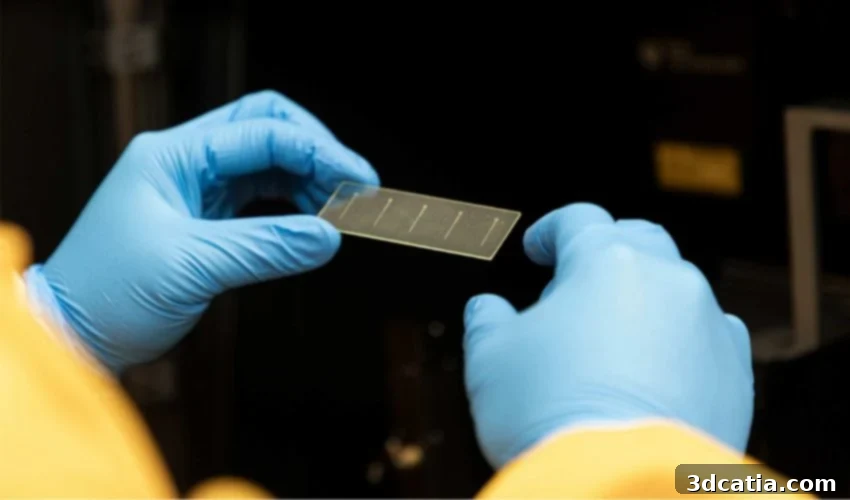
While 3D printing blood vessels is not entirely new, the speed and precision of this particular project set it apart. By utilizing CT scans of stroke patients, the researchers were able to create miniature models of the carotid artery, reducing the original size to an incredibly small scale of 200 to 300 micrometers, compared to the full-sized artery which measures 5 to 7 mm. These models were then printed on glass slides, resulting in accurate replicas of both healthy and diseased areas of the blood vessels, including common features found in stroke patients, such as dents and divots on the damaged lining of the vessel wall.
The miniature size of the models also contributed to a significant reduction in printing time. The researchers were able to print these vessels in just two hours, a remarkable feat compared to the ten hours it would typically take to print larger models. This accelerated printing process makes the technology more practical and efficient for clinical applications.
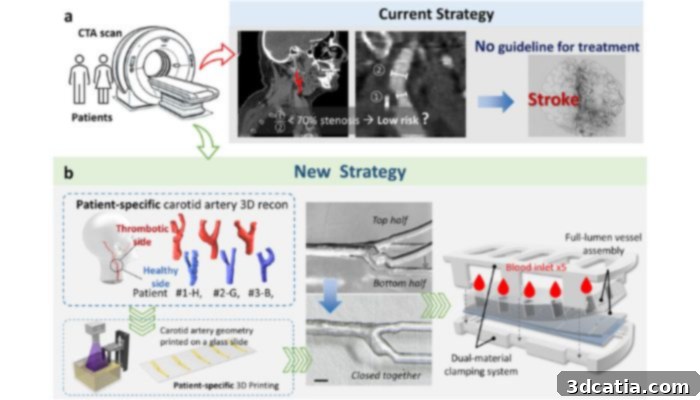
A visualization of the current strategy used for assessing stroke risk, versus the new one proposed. (Image credit: Charles Zhao et al.)
Unlocking the Secrets of Stroke Through Blood Vessel Models
These meticulously crafted 3D printed blood vessels, resembling fine engravings on glass, serve as powerful tools for researchers. Inside these delicate structures, they can observe accurate blood flow simulations that mimic the fluid dynamics and movement of natural blood flow. According to the research team, accurately recreating and visualizing these fluid dynamics was one of the most significant challenges in the field, making this achievement a major breakthrough.
By observing these models in real-time under a microscope, the researchers were able to study blood clot formation and the behavior of platelets, which play a crucial role in blood clotting and can ultimately lead to stroke. The technology revealed that the friction and force generated by blood flow against the lining of the blood vessels significantly influenced platelet movement, which regulates clotting. This phenomenon is particularly relevant in conditions such as high blood pressure and atherosclerosis, where the arteries become diseased. The researchers discovered a staggering 7 to 10 times more platelet movement in areas where the blood vessels experienced high levels of stress.
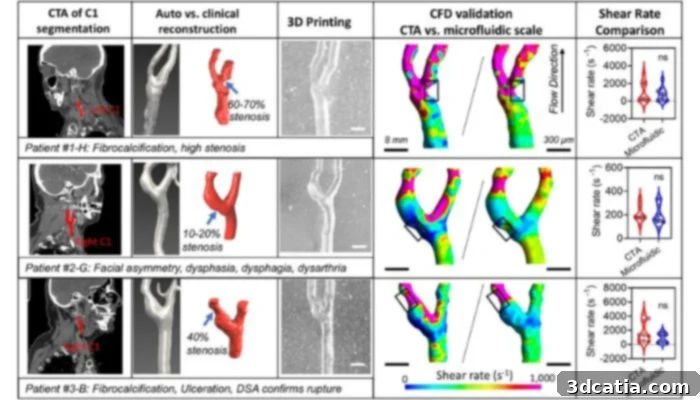
A detailed 3D reconstruction and fabrication of patient-specific carotid artery vessel geometries. (Image credit: Charles Zhao et al.)
The creation of this “physical twin” of a patient’s blood vessels paves the way for personalized vascular medicine. According to Helen Zhao, the goal is to integrate AI with their biofabrication platform to create “digital twins” that can predict stroke events before they happen. This proactive approach would allow for earlier intervention and potentially prevent strokes from occurring altogether. This biomanufacturing approach represents a significant leap forward in patient-specific organ-on-a-chip technology, offering a promising new avenue for drug discovery and personalized treatment strategies.
PhD candidate Charles Zhao from the School of Biomedical Engineering, Faculty of Engineering, emphasized the critical importance of speed and accuracy in stroke diagnosis: “When it comes to heart attack and stroke diagnosis, speed and accuracy is key. Clinicians typically have an approximately 12-hour decision-making window after symptom onset.” The rapid prototyping capabilities of this technology could significantly improve the efficiency of stroke diagnosis and treatment.
The Sydney researchers employed digital light processing (DLP) 3D printing onto a glass substrate to fabricate these vessels, which they dubbed “patient-specific carotid artery-on-a-chip devices.” By using treated glass slides as printing substrates and custom-designed mechanical clamping, they achieved an impressive success rate of approximately 100%. This high success rate underscores the reliability and robustness of the technology.
This innovative research holds immense promise for the future of stroke prediction, prevention, and treatment. By combining the power of 3D printing, artificial intelligence, and patient-specific data, researchers are paving the way for a new era of personalized vascular medicine. As the technology continues to evolve, it has the potential to significantly reduce the burden of stroke worldwide and improve the lives of millions at risk.