
Revolutionizing Metal Additive Manufacturing: NIST & KTH Breakthrough Unlocks Predictive Material Control
Metal additive manufacturing (AM), commonly known as metal 3D printing, holds immense promise for industries ranging from aerospace and automotive to medical and energy. Its ability to create complex geometries, reduce material waste, and accelerate product development cycles is transformative. However, one of the most significant barriers to its widespread industrial adoption has been a persistent knowledge gap: a lack of comprehensive understanding regarding the intricate material transformations that occur during the printing process. Specifically, there have been limited tools capable of revealing what precisely happens to the internal microstructure of various metals as they are rapidly melted and then solidified during fabrication. This uncertainty often leads to inconsistencies in part quality and hinders reliable qualification.
Fortunately, this long-standing issue may soon become a challenge of the past. A groundbreaking collaboration between the National Institute of Standards and Technology (NIST), the KTH Royal Institute of Technology in Sweden, and other esteemed institutions has recently unveiled a major breakthrough. This discovery significantly enhances our ability to predict and, crucially, control the fundamental characteristics of metal 3D printed parts. This advancement holds the potential to dramatically improve the consistency, reliability, and predictability of the technology, making it far more feasible for large-scale, critical manufacturing applications where stringent quality control is paramount. By demystifying the internal processes, this research paves the way for a new era of confidence in metal AM.
NIST’s engagement with metal 3D printing is not a new endeavor; it reflects a strategic national interest in advancing manufacturing capabilities. Just last year, following the launch of the Biden Administration’s “AM Forward Initiative” – a program designed to bolster U.S. supply chains and accelerate the adoption of additive manufacturing among small and medium-sized manufacturers – NIST demonstrated its commitment through substantial investment. The institution awarded approximately $3.7 million in grants specifically aimed at addressing both current and anticipated future barriers to the widespread adoption of metal additive manufacturing. These crucial projects focused on a variety of essential topics.
Key areas of research funded included determining critical material properties for robust quality control in AM processes, as well as establishing data-driven frameworks for the nondestructive qualification of AM materials and finished parts. The latter is particularly vital, gaining considerable attention as additive manufacturing increasingly finds its way into security-critical applications across diverse sectors such as defense, aerospace, and medical implants, where component failure is simply not an option. This latest breakthrough, which promises unparalleled insight into material behavior, aligns perfectly with NIST’s overarching mission to foster innovation and ensure the reliability and integrity of advanced manufacturing technologies, directly supporting the goals of the AM Forward Initiative and national security concerns.
Harnessing Historical Insights to Propel Future Metal AM Innovations
This pivotal announcement from NIST arrives on the heels of other significant developments within the additive manufacturing landscape. Notably, NASA recently declared its plans to intensify investigations into methods for improving the certification and qualification processes for metal 3D printed components, particularly those destined for space exploration. This convergence of interest from leading national institutions underscores a long-standing and growing trend: the urgent need to establish rigorous standards and reliable methodologies for AM. While 3D printing continues to gain immense popularity due to its inherent advantages – including significant reductions in manufacturing costs, minimized material waste, and unprecedented design freedom – lingering issues surrounding part qualification and the consistent replication of material properties have posed considerable hurdles to its broader industrial integration.
NIST’s latest discovery is poised to be a game-changer in this regard. The researchers believe it will grant an unprecedented level of mastery over the metal 3D printing process, moving beyond trial-and-error approaches to a more predictive science. Intriguingly, to achieve this futuristic control, the scientific team actually looked to the past, drawing inspiration and methodologies from established principles of metallurgy and materials science. This innovative approach, combining cutting-edge observation techniques with foundational knowledge, highlights a powerful strategy for unlocking the full potential of additive manufacturing.
The core challenge for the scientists was guaranteeing consistent material properties in metal AM parts. To achieve this, they recognized the paramount importance of gaining a deeper, more precise understanding of the physical phenomena occurring during the rapid melting and subsequent cooling stages of metal within the printing process. Specifically, their focus was on unraveling how the incredibly fast cooling rates characteristic of AM processes directly influence the formation of the metal’s internal crystal structure. This has historically been an exceptionally difficult area to study, primarily because the solidification process in AM occurs almost instantaneously, making it nearly impossible to observe with traditional methods.
To circumvent this observational limitation, the researchers employed an ingenious and sophisticated experimental approach. They utilized two distinct, state-of-the-art particle accelerator facilities – highly specialized research instruments designed to probe the deepest secrets of matter. These facilities generated incredibly powerful, high-energy X-rays, which were then directed at steel samples as they underwent the precise melting and solidification cycles akin to those experienced during 3D printing. The facilities used were Argonne National Laboratory’s Advanced Photon Source and the Paul Scherrer Institute’s Swiss Light Source, both world-renowned for their advanced X-ray capabilities.
The generated X-rays were powerful enough and the detection systems fast enough to capture real-time, high-resolution images of these fleeting and rapid processes. This allowed the team to directly observe the atomic rearrangements and crystal formation within the steel at cooling rates ranging from tens of thousands to over a million kelvins per second – a range that accurately mimics the extreme thermal gradients present in laser-powder bed fusion and other metal AM techniques. This unprecedented observational capacity provided the critical empirical data needed to validate theoretical predictions and unlock new insights into microstructural control.
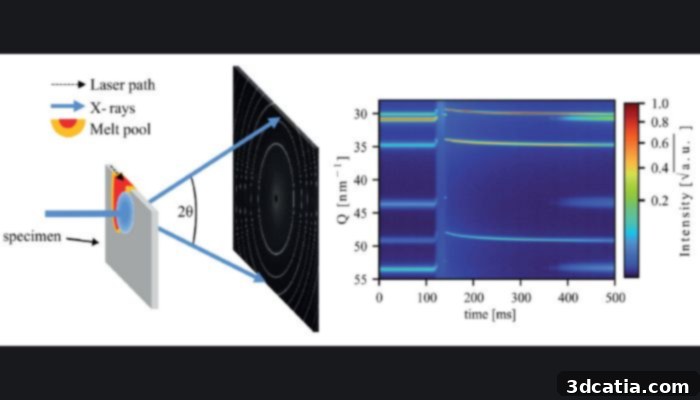
Researchers used high-speed X-ray diffraction to identify the crystal structures that form within steel as it is 3D printed (photo credits: H. König et al. via Creative Commons, adapted by N. Hanacek/NIST)
The meticulously gathered experimental results from the particle accelerators were then compared against predictions generated by a computational model. This particular model, originally developed in the 1980s, describes the solidification behavior of alloys. The decision to reference this decades-old model was not arbitrary; it is a well-established and highly trusted tool for predicting the mechanical and material properties of metals in traditional manufacturing processes, such as casting and forging. However, until this groundbreaking study, it remained uncertain whether such a model, designed for slower cooling rates, could accurately predict phenomena occurring within the extremely rapid temperature shifts inherent to metal additive manufacturing.
Remarkably, the researchers discovered an astounding correlation: what they observed in the real-time X-ray experiments was accurately predicted by the venerable 1980s computational model. This incredible validation bridges a significant gap, effectively extending the applicability of a proven scientific tool to the cutting-edge realm of 3D printing. This means a model that has long been a reliable cornerstone for materials design in conventional manufacturing can now serve as an invaluable support for metal 3D printing. The implications are profound: the press release highlights that this model can now be used to inform scientists and engineers about the precise and necessary cooling rates required during the critical early solidification steps of the printing process. This capability will ensure that the optimal crystal structure, which dictates the final properties and performance of the part, will consistently appear within their desired material, thereby making metal 3D printing far more reliable, predictable, and robust for industrial use.
NIST physicist Fan Zhang, a co-author of the seminal study, underscored the profound impact of their findings, stating, “Basically, if we can control the microstructure during the initial steps of the printing process, then we can obtain the desired crystals and, ultimately, determine the performance of additively manufactured parts. The agreement between the model and the experimental data is remarkably strong. When we saw these results, we were truly excited. Having this kind of empirical data allows us to rigorously validate and refine our theoretical models. That’s precisely how we accelerate the widespread adoption of additive manufacturing for critical industrial applications.” This validation provides the fundamental scientific understanding needed to move metal AM from an art to a precise science. Further details of this pioneering research can be found in the comprehensive paper published in Acta Materialia, accessible HERE.
This breakthrough represents a monumental step forward for metal additive manufacturing, providing a foundational understanding that will reduce uncertainty, lower qualification costs, and significantly increase confidence in 3D printed components. Industries that rely heavily on stringent material performance, such as aerospace, defense, and medical devices, stand to benefit immensely from the enhanced predictability and control offered by this research. By transforming metal AM from a largely empirical process into a scientifically controlled one, NIST and its partners are not just improving a technology; they are setting the stage for a new generation of high-performance, reliably manufactured parts that will drive innovation across countless sectors and unlock the full potential of this transformative manufacturing method.
What are your thoughts on this groundbreaking research from NIST? Do you believe that this level of predictive control will finally enable metal AM to achieve even further widespread industrial adoption and revolutionize manufacturing as we know it? Share your insights and opinions in a comment below or connect with us on our LinkedIn, Facebook, and Twitter pages! Don’t forget to sign up for our free weekly Newsletter here to receive the latest 3D printing news directly in your inbox! You can also find all our compelling videos on our YouTube channel.
*Cover Photo Credits: CCDC Army Research Laboratory