
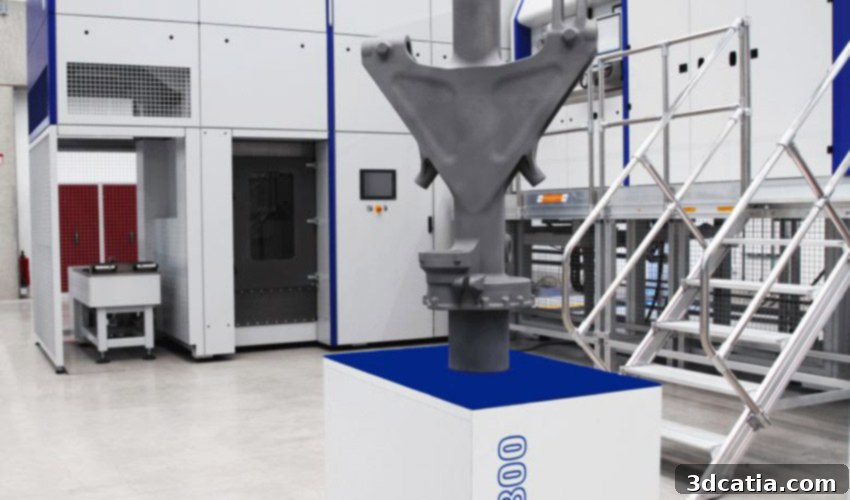
Revolutionizing Aerospace Manufacturing: Safran and SLM Solutions Achieve a World First with 3D Printed Titanium Landing Gear Component
In a monumental stride for the aerospace industry, the renowned French industrial group Safran, through its Safran Landing Systems branch, has successfully leveraged SLM Solutions’ cutting-edge Selective Laser Melting (SLM) technology. This groundbreaking collaboration has resulted in the production of a critical component for a business jet’s nose landing gear using advanced metal additive manufacturing. More specifically, the teams have pioneered the 3D printing of a vital part responsible for transferring loads from the aircraft’s wheels to its structural airframe, which elegantly retracts after takeoff. This achievement is particularly notable given the component’s substantial dimensions of 455 x 295 x 805 mm – an impressive volume for metal AM, especially for a primary structural element. This innovative approach has allowed Safran to reduce the total weight of the part by an impressive 15% without compromising its crucial mechanical properties. Fabricated from titanium, a material known for its exceptional strength and durability, this component operates under immense stress. Historically, the demanding load conditions meant this specific part had never before been created using additive manufacturing. This successful deployment unequivocally demonstrates the transformative potential of 3D technologies within the highly regulated and demanding aeronautical sector, setting a new benchmark for structural integrity and performance.
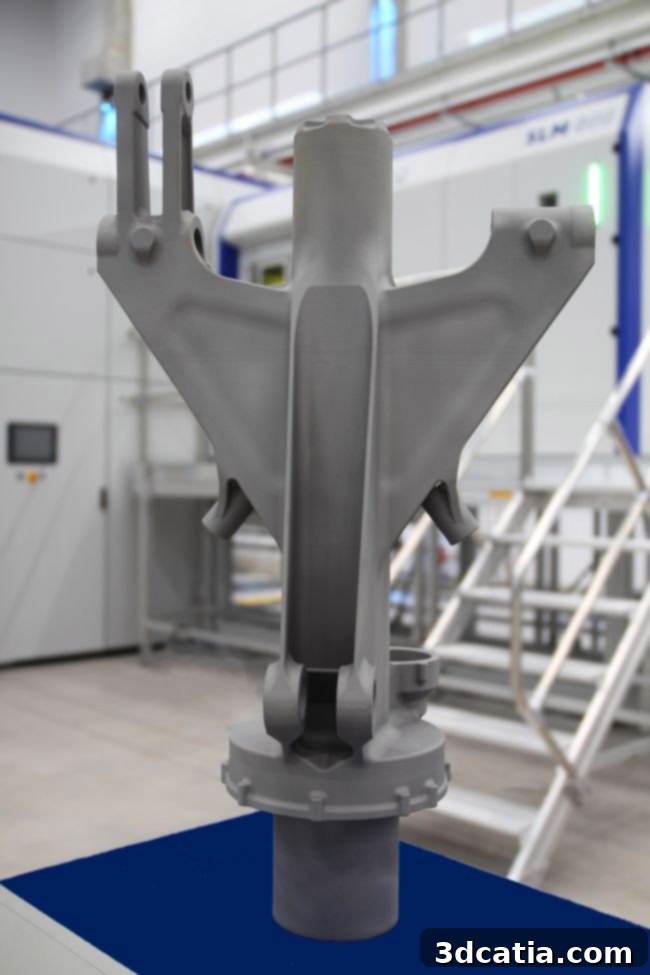
The 3D printed part (photo credits: SLM Solutions)
The landing gear system of an aircraft is unequivocally one of its most critical assemblies, performing essential functions during takeoff, landing, and braking. These complex structures are subjected to extraordinary forces, absorbing the impact of landing and effectively transferring dynamic loads during taxiing, takeoff, and retraction. Safran Landing Systems focused specifically on producing a part that must not only withstand the immense stresses transmitted by the aircraft’s wheels but also facilitate the smooth retraction of the gear. Nicolas Nguyen, head of the R&T platform for this pioneering project at Safran Landing Systems, emphasized the profound challenge: “This is a structural element that is subject to a lot of stresses: it must be able to pivot to allow the landing gear to retract under the aircraft, and it must absorb the mechanical stresses from the aircraft’s wheels. The use of additive manufacturing for a part of this nature and size is a world first.” This statement underscores the unprecedented nature of this achievement, pushing the boundaries of what is considered feasible with metal 3D printing for safety-critical aerospace components.
The Strategic Collaboration: Safran Landing Systems and SLM Solutions
The ambition to revolutionize this critical component necessitated a robust partnership and advanced technological capabilities. Safran Landing Systems meticulously selected SLM Solutions as their key partner, recognizing their profound expertise in metal additive manufacturing and their high-performance machinery. The component, measuring 455 x 295 x 805 mm, was expertly printed on an SLM Solutions metal machine, specifically the SLM®800. This industrial-grade machine is celebrated for its multi-laser technology, typically featuring four powerful lasers, and its proven reliability in producing large-format metal parts with exceptional precision. Traditionally, manufacturing such a complex component would involve producing three separate parts using a conventional 5-axis machining process, followed by an intricate and often costly assembly stage. However, by embracing additive manufacturing, the joint teams were able to produce the entire part in a single, continuous build, thereby eliminating the time-consuming and expensive assembly process entirely. Thierry Berenger, Additive Manufacturing project manager at Safran Landing Systems, elaborated on the choice: “We chose SLM Solutions as our partner as experts in this type of project, particularly because of their particularly high-performance additive manufacturing machine, the SLM®800, which meets our requirements for print size, quality and reliability in every respect.” This strategic decision, combined with a fundamental rethinking of the part’s design to fully exploit the advantages of additive manufacturing, enabled Safran Landing Systems to achieve two significant objectives: a substantial 15% reduction in total mass and a streamlined production timeline, marking a pivotal success for the French industrial group.
Titanium’s Advantage: Engineering for Extreme Conditions
The selection of titanium as the primary material for this crucial landing gear component was a carefully considered decision, driven by its unparalleled properties ideal for aerospace applications. Titanium is celebrated for its exceptional robustness, an outstanding strength-to-weight ratio, and its remarkable resistance to corrosion. These characteristics make it a superior choice for components that must endure both high mechanical stresses and environmental challenges over an aircraft’s operational lifespan. Traditionally, a part of this nature might be manufactured from aluminum through a forging process. However, given the innovative design chosen for 3D printing, aluminum proved unsuitable for achieving the desired performance and design complexity. Additive manufacturing, particularly SLM, allows for the creation of intricate geometries and optimized internal structures that would be impossible to achieve with conventional forging or machining of aluminum. Nicolas Nguyen further elucidated the efficiency gains: “70% of the part’s surface is not mechanically reworked. Only the functional surfaces are machined.” This statement highlights a significant advantage of AM: near-net-shape production. By minimizing the amount of post-processing machining required, material waste is dramatically reduced, and manufacturing costs and lead times are lowered. Furthermore, the inherent properties of titanium, combined with the optimized geometry enabled by 3D printing, are expected to significantly increase the overall longevity and fatigue life of the component, contributing to enhanced safety and reduced maintenance over the aircraft’s operational lifecycle.
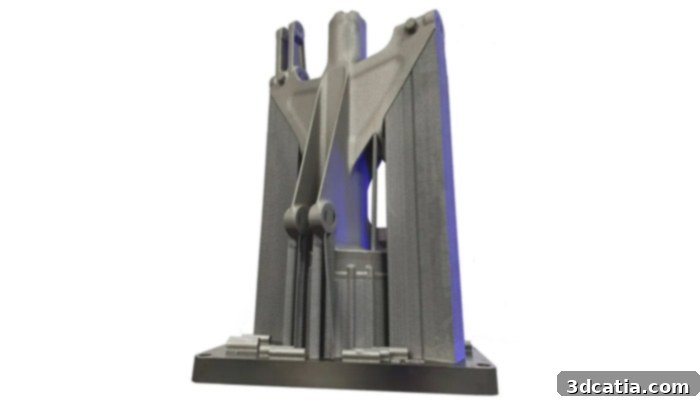
The part was 3D printed with titanium (photo credits: SLM Solutions)
Design for Additive Manufacturing (DfAM): A Paradigm Shift in Aerospace Engineering
The success of Safran Landing Systems’ project is not solely attributable to the advanced SLM technology or the material choice, but fundamentally to the application of Design for Additive Manufacturing (DfAM) principles. DfAM represents a paradigm shift from traditional engineering design, where designers are no longer constrained by the limitations of conventional manufacturing processes. Instead, they can envision complex geometries, internal lattice structures, and topology-optimized forms that are precisely tailored to the stress profiles of the part. For this landing gear component, DfAM allowed engineers to redistribute material intelligently, placing it only where structurally necessary and removing it where it served no critical function. This sophisticated approach directly led to the remarkable 15% weight reduction without compromising the component’s structural integrity or performance under extreme loads. Beyond lightweighting, DfAM enabled significant part consolidation. What was once three separate components requiring intricate assembly—each with its own potential failure points—is now a single, monolithic structure. This consolidation inherently simplifies the supply chain, reduces assembly time and costs, and enhances the overall reliability of the system by eliminating fasteners, welds, and other connections that could otherwise be sources of weakness. The freedom afforded by DfAM also allowed for the integration of features and functionalities that would be impossible to achieve with traditional subtractive manufacturing or forging, pushing the boundaries of performance and efficiency for aerospace components.
Towards Flight: Qualification and Future Prospects
The journey for this pioneering 3D-printed landing gear component is far from complete, with rigorous qualification steps ahead. Safran Landing Systems has outlined plans to commence comprehensive testing of the 3D-printed part in 2022. This phase is an absolutely critical step in the aerospace certification and qualification process, involving extensive mechanical, fatigue, and environmental tests to ensure the component meets the stringent safety and performance standards demanded by the aviation industry. If these demanding tests are successfully passed and all qualification hurdles are cleared, the outlook is highly optimistic for its eventual integration into an aircraft, potentially taking flight within the next few years. This achievement, therefore, signifies more than just a successful prototype; it represents a significant validation of additive manufacturing’s capability to produce primary structural components for aircraft. The implications for the wider aerospace sector are profound, suggesting a future where AM is increasingly used for critical, load-bearing parts, leading to lighter aircraft, improved fuel efficiency, reduced emissions, and streamlined manufacturing processes. This project serves as a compelling blueprint for how collaborative innovation and advanced manufacturing techniques can drive the aerospace industry towards a more sustainable and technologically advanced future. For those interested in delving deeper into the technical specifics and details of this impressive 3D-printed casing, additional information can be found in the official press release HERE.
The successful 3D printing of a critical titanium landing gear component by Safran Landing Systems and SLM Solutions marks a pivotal moment in aerospace manufacturing. This collaboration underscores the immense potential of metal additive manufacturing to deliver lighter, more efficient, and structurally optimized parts, pushing the boundaries of aircraft design and performance. By achieving a 15% weight reduction and streamlining production through part consolidation, this project demonstrates a clear path towards innovation for safety-critical aerospace applications. We invite you to share your thoughts on this latest 3D-printed marvel. Let us know in a comment below or join the conversation on our Linkedin, Facebook, and Twitter pages! Don’t miss out on the latest advancements in 3D printing; sign up for our free weekly Newsletter here, delivering news straight to your inbox! You can also find all our compelling videos on our YouTube channel.
*Thumbnail photo credits: SLM Solutions