
Revolutionizing Off-Road: Pantheon Design’s 3D Printed Electric Dirt Bike Redefines Performance and Rapid Prototyping
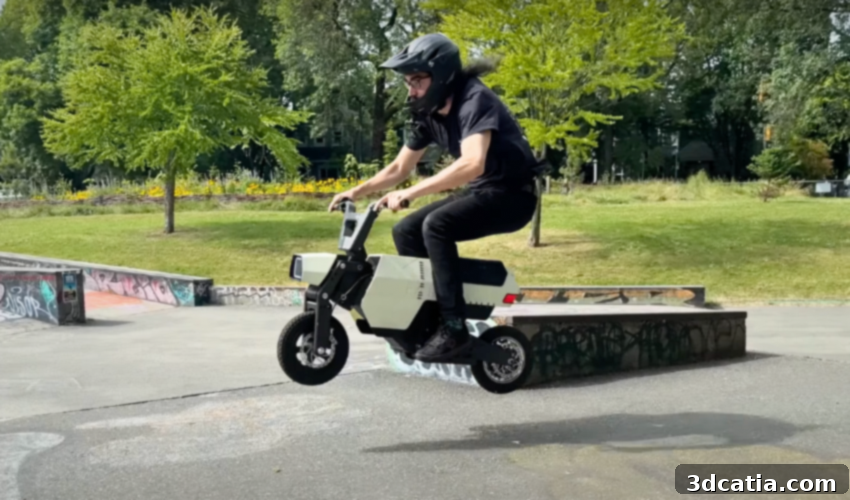
Pantheon Design, a company widely recognized for its high-speed industrial 3D printing solutions, has recently unveiled a groundbreaking innovation: an entirely 3D-printed electric dirt bike. This ambitious project, built using their advanced HS-Pro system, emerged from an unconventional spark – CEO Bob Cao’s playful disdain for the utilitarian Honda Motocompacto. What began as a simple concept for a compact, urban electric motorcycle quickly evolved into a robust, high-performance machine capable of tackling challenging trail rides and impressive jumps, showcasing the transformative power of additive manufacturing in personal transportation.
The initial vision was straightforward: to create a modern electric counterpart to the iconic Honda Motocompo. However, as Pantheon Design commenced testing prototypes, it became evident that the capabilities of a 3D-printed frame extended far beyond urban commuting. The inherent strength and design flexibility offered by their additive manufacturing process allowed the team to push the boundaries of the original concept. This evolution transformed a basic city bike into a significantly tougher, more capable off-road vehicle. The culmination of this iterative process is the Enduro Compo, a formidable electric dirt bike engineered for aggressive off-road riding, with nearly every structural component meticulously crafted through advanced 3D printing techniques.

Engineering Excellence: Leveraging Pantheon’s Heritage and HS-Pro Capabilities
The roots of Pantheon Design, stemming from CEO Bob Cao and CTO Alex Wiecke’s background in motorcycle repair and parts, are deeply embedded in the practical engineering and robust design of the Enduro Compo. This hands-on experience in understanding the stresses and demands placed on motorcycle components proved invaluable throughout the development process. Utilizing their proprietary HS-Pro 3D printer, Pantheon was able to fabricate critical structural parts such as brake levers, footpegs, and even elements of the frame, all requiring exceptional strength and durability. The team proudly asserts that certain 3D-printed components achieve strength levels comparable to traditional aluminum parts. This claim is particularly significant for dirt bike applications, where components are subjected to continuous vibrations, high-impact forces, and extreme stress, underscoring the potential for additive manufacturing to replace conventionally manufactured metal parts in demanding environments.
The Power of Iteration: Learning from On-Trail Testing and Rapid Fixes
Recent video releases from Pantheon Design vividly showcase the Enduro Compo undergoing rigorous real-world testing across diverse terrains, including challenging mountain trails, daring ramps, and professional stunt parks. While not every test run concluded flawlessly, the Pantheon team views these instances not as failures, but as invaluable learning opportunities that drive continuous improvement. During these demanding trials, the bike experienced a broken footpeg and a crack in the steering head. It’s important to note that the cracked frame component, though pushed to its limits, was not originally designed for such intense live testing but demonstrated remarkable resilience before eventually failing. For Pantheon Design, these incidents highlight one of the most compelling advantages of industrial 3D printing: the ability to implement incredibly quick fixes and rapid design iterations. Instead of enduring lengthy delays for traditional manufacturing or waiting days for replacement parts to be delivered, Pantheon can design, print, and replace a broken component within a matter of hours, drastically accelerating their development cycle and minimizing downtime. This agility is a game-changer for prototyping and product development in high-performance sectors.
Beyond the Bike: Pantheon’s Vision for Additive Manufacturing
The creation of the Enduro Compo is far more than just an exercise in building a captivating electric dirt bike; it represents Pantheon Design’s deep commitment to exploring and demonstrating the full spectrum of possibilities offered by industrial 3D printing. This ambitious project serves as a compelling proof-of-concept, pushing the boundaries of what’s achievable with additive manufacturing in extreme applications. One of Pantheon’s most audacious goals is to enter a fully 3D-printed motorcycle into the legendary Dakar Rally. Such an endeavor would not only captivate the world but, more importantly, would unequivocally validate the durability, reliability, and performance capabilities of 3D printing technology in the most demanding, real-world conditions imaginable. A successful entry would showcase how additive manufacturing can withstand punishing environments, paving the way for its broader adoption in critical applications across numerous industries.
Advancing Technology and Future Accessibility
Currently, the dedicated team at Pantheon is diligently refining various aspects of the Enduro Compo, including material properties, intricate design geometries, and overall ride dynamics to optimize its performance and user experience. While industrial-grade additive manufacturing systems like the HS-Pro are not yet commonplace in every workshop, the landscape of large-format 3D printing is rapidly evolving. We are witnessing a significant trend towards increased accessibility and affordability of these advanced technologies. Projects such as the Enduro Compo are not just engineering marvels; they are powerful harbingers of how this cutting-edge technology could fundamentally transform the future of personal transportation. Imagine a world where custom-designed vehicles are rapidly produced on demand, where repairs are executed with unprecedented speed, and where innovation in design is limited only by imagination. The ability to rapidly prototype, iterate, and produce highly complex, strong, and lightweight components opens up new paradigms for manufacturing efficiency, sustainability, and bespoke product creation.
The Broader Impact of 3D Printed Mobility
The success and ongoing development of the Pantheon Enduro Compo highlight the immense potential of additive manufacturing far beyond the realm of extreme sports. This project serves as a critical case study demonstrating how 3D printing can disrupt traditional manufacturing processes, offering unparalleled benefits in terms of design freedom, material optimization, and production agility. Industries ranging from automotive and aerospace to consumer goods are closely observing such developments, recognizing the implications for rapid product development, customization at scale, and the potential for more sustainable manufacturing practices. The ability to create parts with complex internal structures, optimized for strength-to-weight ratios, can lead to lighter, more fuel-efficient, and higher-performing vehicles. Furthermore, localized production through 3D printing can reduce supply chain complexities and associated environmental impacts. As the technology continues to mature and become more cost-effective, we can anticipate a future where highly personalized, efficient, and innovative transportation solutions are commonplace, directly influenced by the pioneering work of companies like Pantheon Design.
Would you ever consider taking to the trails on a fully 3D-printed electric dirt bike? Share your thoughts with us in a comment below or connect with our community on our LinkedIn and Facebook pages! Don’t miss out on the latest advancements in additive manufacturing – be sure to sign up for our free weekly Newsletter here, delivering the most important 3D printing news directly to your inbox. You can also explore all our insightful videos and project showcases on our YouTube channel. For more in-depth coverage and news from the automotive and transportation sector within 3D printing, visit our dedicated page HERE.
*All Photo Credits: Pantheon Design