
Unveiling the Future: Your Weekly Dose of 3D Printing Innovations and Insights
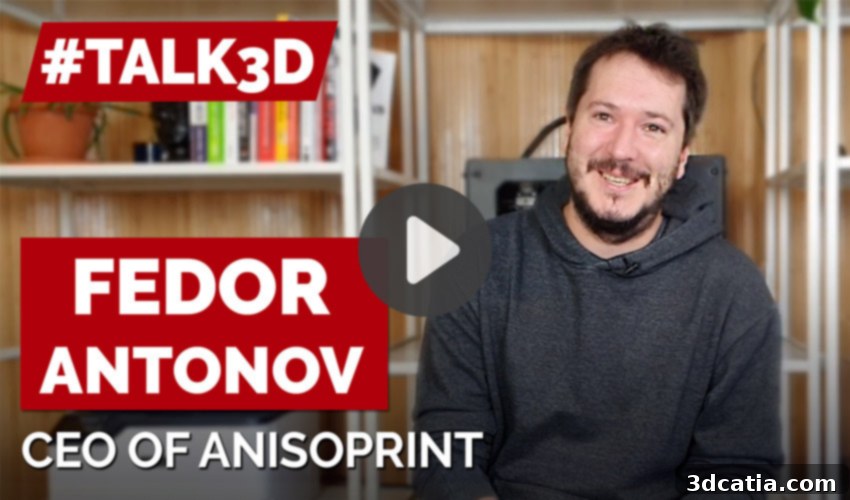
Welcome back to our highly anticipated weekly roundup, where we dive deep into the fascinating world of 3D printing and highlight the most groundbreaking advancements shaping the industry. Every Friday, we bring you the top five videos that showcase remarkable innovations, visionary leaders, and life-changing applications of additive manufacturing. This week, we’re thrilled to present an exclusive interview with Fedor Antonov, the visionary co-founder and CEO of Anisoprint, a pioneering company at the forefront of continuous fiber composite 3D printing. He shares invaluable insights into Anisoprint’s journey, its rapid development, and its ambitious plans for the future of high-performance materials. Following this, we explore GROB’s cutting-edge liquid metal 3D printer, a significant leap in industrial metal additive manufacturing. Prepare to be moved as we reveal how 3D printing is literally saving lives, focusing on an inspiring story involving a beloved canine companion. Then, we take a closer look at Titomic, an Australian innovator revolutionizing metal parts production for the demanding aerospace sector with their unique cold spray technology. Finally, we immerse ourselves in the captivating world of design, showcasing Karim Rashid’s extraordinary creations brought to life with direct-to-textile 3D printing at Milan Design Week. As always, we encourage you to engage with us; tell us which innovation captured your imagination the most. Get ready for an inspiring read and an amazing weekend!
Top 1: Pioneering Continuous Fiber Composite 3D Printing with Anisoprint CEO Fedor Antonov
The landscape of additive manufacturing has been dramatically reshaped by the exponential growth of composite 3D printing. This innovative technology now empowers engineers and designers to create parts that are not only exceptionally lightweight but also boast strength comparable to, and often surpassing, traditional metal components. These high-performance composites are unlocking new possibilities across numerous industries, from aerospace to automotive, and even in custom consumer goods. We had the distinct privilege of sitting down with one of the most influential figures in this burgeoning sector: Fedor Antonov, the brilliant co-founder and CEO of Anisoprint. Anisoprint stands out as a leading manufacturer of advanced composite 3D printers, specializing in machines that enable the production of parts with continuous fibers. This continuous fiber reinforcement is the key to achieving unparalleled strength-to-weight ratios and superior structural integrity. During our insightful conversation, Mr. Antonov generously shared the genesis of Anisoprint, detailing its evolution from a nascent startup to a global leader. He elaborated on the company’s core technological breakthroughs, its strategic vision for market expansion, and its unwavering commitment to pushing the boundaries of material science. Learn more about how Anisoprint is democratizing access to high-performance composite manufacturing and their ambitious plans for the future in the compelling video below.
Top 2: Revolutionizing Metal Additive Manufacturing with GROB’s Liquid Metal 3D Printer
In the realm of metal additive manufacturing, the pursuit of safer, more efficient, and versatile production methods is relentless. This week, we turn our attention to GROB, a renowned name in machine tool manufacturing, as they unveil their groundbreaking latest 3D printer, poised to redefine industrial metal fabrication. What makes this machine truly innovative is its capability to process high-performance aluminum alloys. Unlike conventional powder-bed fusion methods that involve fine, often hazardous metal powders, GROB’s system utilizes a wire-form material feed. This significant departure from powder-based systems brings multiple advantages. Firstly, it drastically reduces the potential risks associated with powder handling, improving workplace safety and simplifying material management. The use of a wire feed also allows for a cleaner, more controlled deposition process. The machine leverages sophisticated 3-axis kinematics, ensuring precision and accuracy in every layer deposited. This robust motion control system enables the creation of complex geometries and intricate designs that would be challenging, if not impossible, with traditional manufacturing techniques. Furthermore, GROB has integrated a comprehensive suite of advanced sensors for real-time process and system monitoring. These sensors meticulously track critical parameters such as droplet formation, nozzle integrity, and component height throughout the build process. This continuous monitoring ensures optimal print quality, minimizes errors, and allows for immediate adjustments, guaranteeing high reliability and reproducibility. By eliminating powder handling and incorporating such advanced monitoring capabilities, GROB’s new 3D printer not only enhances safety but also streamlines the entire additive manufacturing workflow, making it an attractive solution for industries requiring high-quality, dependable metal parts with reduced operational complexities. This represents a pivotal step towards wider adoption of wire-arc additive manufacturing (WAAM) for critical applications.
Top 3: The Life-Changing Impact of 3D Printing: From Canine Companions to Concrete Homes
For those familiar with the transformative power of additive manufacturing, it’s widely understood that its benefits extend far beyond human applications, profoundly impacting the animal kingdom as well. 3D printing technology offers incredible opportunities to enhance the lives of animals by enabling the custom design and rapid production of a wide array of medical devices. These include bespoke orthotics to support injured limbs, custom-fit prosthetics to restore mobility, and intricate implants tailored to an animal’s unique anatomy, all aimed at correcting congenital defects, alleviating chronic pain, or aiding recovery from severe injuries. In the emotional first segment of our featured video, we witness the heartwarming story of Murphy, a resilient dog whose life was dramatically improved, and perhaps even saved, thanks to the ingenious application of 3D printing technologies. This segment beautifully illustrates how personalized medical solutions, made possible by additive manufacturing, can provide animals with a new lease on life, restoring their ability to play, run, and live comfortably. Beyond individual animal welfare, the video then transitions to an entirely different, yet equally impactful, application of 3D printing: the construction industry. We are introduced to Twente Additive Manufacturing, a forward-thinking company that is revolutionizing home building through advanced 3D concrete printing. This innovative approach allows for the rapid construction of sustainable, cost-effective, and architecturally complex structures. 3D concrete printing offers unparalleled design freedom, reduces material waste, and significantly accelerates construction timelines compared to traditional methods. It has the potential to address housing shortages globally and enable the creation of unique, durable homes with unprecedented efficiency. This dual showcase truly underscores the versatile and benevolent nature of 3D printing, demonstrating its capacity to bring about positive change across diverse fields, from veterinary medicine to sustainable architecture.
Top 4: Titomic’s Cold Spray Technology: Advancing Aerospace and Defense 3D Printing
The aerospace sector is renowned for its stringent demands on material performance, precision, and reliability. This week, we highlight an Australian manufacturing powerhouse, Titomic, which has carved out a niche by developing sophisticated additive manufacturing solutions built upon its proprietary cold spray technology. Cold spray, a solid-state deposition process, is rapidly gaining traction for its ability to produce metal parts with superior material properties and complex geometries, making it exceptionally well-suited for high-stakes industries like aerospace and defense. Unlike traditional thermal spray processes or even some forms of metal 3D printing, cold spraying does not involve melting the metal powder. Instead, fine metallic particles are accelerated to supersonic speeds and impacted onto a substrate, where they deform plastically and bond mechanically to form a dense, high-performance coating or structure. One of the most compelling advantages of Titomic’s cold spray technology is its unparalleled ability to combine multiple metal powders within a single component. This capability allows for the creation of functionally graded materials or multi-material structures, precisely tailoring material properties to specific areas of a part – an invaluable asset in applications where varying strength, stiffness, or corrosion resistance is required. The video below provides a deep dive into Titomic’s strategic partnership with BAE Systems, a globally recognized British defense, security, and aerospace company. This collaboration is a testament to the robust capabilities and reliability of Titomic’s technology. Together, they are exploring and implementing advanced manufacturing techniques to produce critical components for aircraft, spacecraft, and defense systems. This partnership not only validates the effectiveness of cold spray for demanding applications but also signifies a major step forward in creating lighter, stronger, and more durable parts for the next generation of aerospace and defense platforms, promising enhanced performance and operational longevity in critical operational environments.
Top 5: Fashion Forward: Additive Manufacturing Transforms Milan Design Week with Karim Rashid
The intersection of technology and art continually pushes the boundaries of human creativity, and this was brilliantly showcased at the Milan Design Week 2022. Our final feature this week brings us into the vibrant world of high design and fashion, where additive manufacturing is making a stunning impact. We invite you to take a closer look at the truly incredible, avant-garde designs created by the renowned industrial designer Karim Rashid. Rashid, celebrated for his signature “sensual minimalism” and blobject aesthetic, consistently seeks innovative ways to materialize his futuristic visions. At Milan Design Week, his latest creations were a testament to the power of direct-to-textile 3D printing. This revolutionary technology, powered by Stratasys’ J850 TechStyle 3D printer and its innovative 3DFashion technology, allows for the direct deposition of intricate, multi-color, and multi-material designs onto various textile surfaces. This eliminates the need for traditional embellishment methods, offering unparalleled design freedom, speed, and customization. Imagine garments, accessories, and interior fabrics adorned with complex geometric patterns, tactile textures, and vibrant color gradients, all produced in a single, streamlined process. The J850 TechStyle printer, specifically engineered for the fashion and textile industry, opens up a world of possibilities for designers like Rashid to experiment with new forms, structures, and sensory experiences. This technology not only enables the creation of breathtaking visual effects but also offers functional advantages, such as customizable breathability, flexibility, and durability. Discover how this pioneering approach to additive manufacturing is revolutionizing fashion and textile design, enabling designers to transform their wildest concepts into tangible, wearable art, as detailed in the captivating video below. It’s a paradigm shift for bespoke fashion and interior decor.
We hope this week’s exploration into the multifaceted world of 3D printing has been as enlightening and inspiring for you as it was for us. The innovative spirit driving companies like Anisoprint, GROB, Titomic, and Twente Additive Manufacturing, alongside the artistic vision of designers like Karim Rashid, truly exemplifies the boundless potential of additive manufacturing. Whether it’s enabling lighter, stronger components for aerospace, offering critical medical solutions for animals, or transforming the fashion industry, 3D printing continues to prove itself as a cornerstone of modern innovation. What are your thoughts on Anisoprint’s continuous fiber technology? Which of these groundbreaking applications resonated most with you? We’d love to hear your insights and engage in a discussion about these remarkable advancements. Please share your comments below or connect with us on our LinkedIn, Facebook, and Twitter pages! To stay at the forefront of the additive manufacturing revolution and receive the very latest 3D printing news directly in your inbox every week, don’t forget to sign up for our free weekly Newsletter here. You can also explore a comprehensive library of all our featured videos and more incredible content on our YouTube channel. Thank you for joining us on this journey of discovery!