
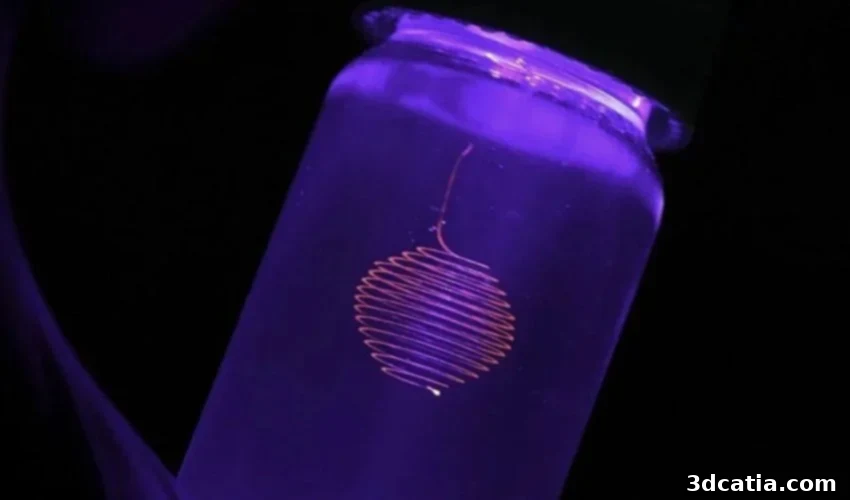
3DPX 3D Printing: Revolutionizing Ultra-Fine Fiber Creation with Nature’s Wisdom
Nature, with its boundless complexity and efficiency, consistently serves as an unparalleled source of inspiration for technological advancement. This profound influence is particularly evident within the additive manufacturing sector, where researchers are increasingly turning to biological blueprints to overcome conventional engineering limitations. A groundbreaking study recently published by the University of Illinois Urbana-Champaign exemplifies this trend, introducing an innovative 3D printing methodology known as 3DPX. This cutting-edge process is distinguished by its ability to fabricate ultra-fine fibers with an astonishingly small diameter, measuring merely 1.5 microns. Such precision opens up unprecedented possibilities for designing intricate structures, mirroring the delicate yet robust architecture found in the natural world.
The success of the 3DPX method hinges on a sophisticated approach that leverages a viscoplastic fluid rheology support gel. This specialized gel acts as a dynamic printing medium, within which the 3D printer’s nozzle operates. By submerging the printing process in this gel, the inherent gravitational constraints that typically hinder the fabrication of extremely fine, delicate fibers are effectively neutralized. This ingenious solution allows for the creation of highly complex fibrous structures that would otherwise collapse under their own weight or surface tension. The visionary team behind this novel 3D printing technique harbors ambitious hopes for its future impact, envisioning transformative applications across a diverse range of critical sectors, including robotics, medicine, and advanced materials engineering, thereby pushing the boundaries of what is achievable with micro-scale additive manufacturing.
The Enduring Fascination with Nature’s Engineering: Biomimicry in 3D Printing
Who among us hasn’t marvelled at the incredible resilience of a spider’s web, designed to withstand significant forces while remaining virtually invisible? Or pondered the protective strength of an eggshell, perfectly encapsulating life within a fragile yet remarkably robust structure? Similarly, the strength and versatility of the silk produced by various insects, used for everything from capturing prey to constructing intricate nests, continue to captivate scientists and engineers alike. Upon closer examination, these natural constructs are not only aesthetically impressive but also serve as an inexhaustible reservoir of design principles and material science lessons, offering blueprints for superior functionality, efficiency, and durability.
It is precisely this deep appreciation for nature’s engineering prowess that frequently leads to the harmonious integration of additive manufacturing and biomimicry. This powerful synergy aims to unlock novel applications and push the boundaries of what is technologically feasible by learning from millions of years of natural selection. In the specific context of the 3DPX method, the primary objective was to devise a solution capable of accurately reproducing these incredibly fine, intricate natural fibers at a scalable and functional level. Historically, replicating the precise properties and complex network architectures of such delicate structures in a three-dimensional, additive manufacturing environment has presented an exceptionally formidable challenge, largely due to limitations in resolution, material handling, and structural integrity at micro-scales. The breakthrough with 3DPX offers a pathway to bridge this gap, enabling the creation of materials and devices with unprecedented bio-inspired functionalities.
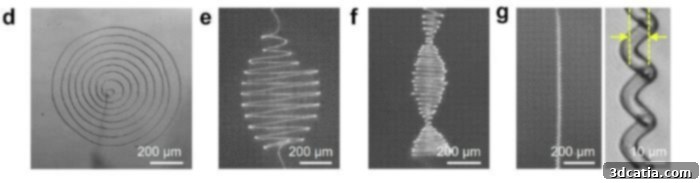
Different shapes 3D printed using the 3DPX method showcase its versatility and precision.
Unveiling the “Embedded 3D Printing by Solvent Exchange” (3DPX) Method
The researchers at the University of Illinois Urbana-Champaign have ingeniously developed a method they christened “embedded 3D printing by solvent exchange,” or 3DPX for short. A fundamental hurdle in printing materials as delicate and thin as these fibers lies in their inherent lack of sufficient flexural rigidity. This deficiency means they simply cannot support their own weight once extruded into a freestanding form, leading to immediate collapse or deformation due to gravitational forces and surface tension. To circumvent this critical limitation, the research team innovated by opting to print directly within a vat of specialized gel, which effectively functions as a supportive printing medium. This gel cradles the nascent fibers, providing the necessary buoyancy and structural support during the printing and initial solidification phases, ensuring the fidelity of the intricate designs.
The Science Behind the Gel and Fiber Formation
The technical sophistication of 3DPX is truly remarkable, stemming from a deep understanding of rheology and material chemistry. The researchers meticulously explain their approach: “To obtain filaments with a diameter of less than 1.5 µm, we modified the yield point rheology of the supporting gel and the compositions of the polymer, solvent, and non-solvent, all of which play an essential role in the process.” This statement underscores the intricate interplay of material science and fluid dynamics at the heart of 3DPX. The “yield point rheology” refers to the gel’s unique property of behaving like a solid until a certain threshold of stress is applied (in this case, by the moving printer nozzle). This allows the nozzle to create a path, after which the gel immediately reforms, holding the extruded material precisely in place. Simultaneously, the “solvent exchange” aspect is crucial. As the polymer solution is extruded from the nozzle into the support gel, a rapid chemical process occurs: the solvent carrying the polymer is exchanged with a non-solvent present within the gel. This rapid exchange causes the polymer to precipitate and instantly solidify into a robust, ultra-fine fiber. By precisely tuning the properties of the gel – specifically its yield point – and carefully controlling the chemical compositions of the polymer, the solvent carrying it, and the non-solvent in the gel, the team achieved unparalleled control over the final fiber diameter, structural integrity, and mechanical properties. This level of control is what enables the creation of structures previously deemed impossible with conventional additive manufacturing techniques.
Rigorous testing was conducted to fully validate the potential and capabilities of this innovative technique. These comprehensive experiments unequivocally demonstrated the feasibility of producing fibers as fine as 1.5 microns, even when employing a relatively larger 5-micron nozzle. This impressive resolution highlights the effectiveness of the embedded printing and solvent exchange mechanism in overcoming the physical limitations typically associated with nozzle diameter and material extrusion. A diverse array of materials was successfully utilized in these tests, including various elastomers known for their flexibility and stretchability, PVC for its durability and chemical resistance, and polystyrene for its structural integrity and ease of processing. The versatility in material compatibility further broadens the scope of potential applications, making 3DPX adaptable to different functional requirements. The researchers are particularly optimistic about the method’s transformative potential within the medical sector, foreseeing groundbreaking applications in highly localized drug delivery systems, the intricate design of ultra-precise microfluidic devices for advanced diagnostics and lab-on-a-chip technologies, and the fabrication of sophisticated scaffolds for advanced tissue engineering. Beyond medicine, they anticipate significant impact in the electronics sector, enabling the fabrication of miniaturized components and flexible circuits, and in the development of highly sensitive and compact sensor designs for myriad applications ranging from environmental monitoring to advanced robotics.
Transformative Applications Across Industries with 3DPX Technology
The advent of 3DPX technology heralds a new era for micro-scale additive manufacturing, promising to unlock unprecedented capabilities across several high-impact industries. The ability to create structures with such fine resolution and intricate geometries paves the way for innovations that were previously confined to theoretical discussions or highly specialized, labor-intensive fabrication methods. This paradigm shift will accelerate development in fields requiring extreme precision and miniaturization.
Medical and Biomedical Advancements
In the medical and biomedical fields, the implications of 3DPX are particularly profound and exciting. Ultra-fine fibers can revolutionize drug delivery systems, allowing for the creation of miniature, implantable devices that release therapeutics with unparalleled precision and controlled kinetics. This could mean highly targeted drug delivery directly to specific tumor sites, minimizing systemic side effects and improving efficacy, or sustained release over extended periods for chronic conditions. Furthermore, the design of sophisticated microfluidic devices, essential for advanced diagnostics and lab-on-a-chip technologies, stands to benefit immensely. These devices, which manipulate minute fluid volumes to perform complex analyses, can be manufactured with intricate internal channels, filters, and porous structures, dramatically enhancing their efficiency, sensitivity, and analytical capabilities. Beyond diagnostics, 3DPX could be pivotal in tissue engineering and regenerative medicine, enabling the fabrication of highly porous, biomimetic scaffolds that perfectly mimic the extracellular matrix. These meticulously structured scaffolds can guide cell growth, differentiation, and tissue regeneration with unprecedented accuracy, paving the way for new treatments for organ repair and replacement.
Robotics and Advanced Sensor Technology
The robotics sector is another area poised for significant disruption and innovation through 3DPX. The capacity to print exceptionally fine and flexible structures means that miniature, delicate grippers, often inspired by the nimble appendages of insects or the soft mechanics of biological systems, can be developed for ultra-precise micro-manipulation tasks. These could be crucial for handling sensitive components in electronics manufacturing, assembling micro-devices, or for performing highly intricate, minimally invasive surgical procedures. Similarly, the design and performance of advanced sensors could be dramatically transformed. By integrating ultra-fine conductive, piezoelectric, or active fibers into sensor architectures, researchers can create highly sensitive sensors with an increased surface area-to-volume ratio, leading to enhanced detection capabilities for everything from minute environmental pollutants and chemical agents to complex biomedical markers. Flexible electronics, another rapidly growing field, could also see significant advancements through the integration of 3DPX-printed components, leading to more adaptable, durable, and seamlessly integrated wearable devices and smart textiles.
Advanced Materials and Engineering
From a materials science and general engineering perspective, 3DPX offers the potential to engineer novel composites and functional materials with previously unattainable properties. The ability to precisely embed fine fibers within a matrix opens doors to creating lightweight yet incredibly strong materials, echoing the exceptional strength-to-weight ratios observed in natural biological structures like bone or wood. Such advanced materials could find transformative applications in aerospace, automotive, and defense industries, where performance at reduced weight and enhanced durability are paramount. Moreover, the precise control over fiber architecture and composition allows for tailoring mechanical, thermal, electrical, and optical properties at a micro-structural level. This capability can lead to the development of smart materials that respond dynamically to their environment, exhibiting self-healing properties, adaptive camouflage, or advanced energy harvesting functionalities, pushing the boundaries of material design and performance.
Future Prospects and Remaining Challenges for 3DPX
While the initial results of the 3DPX method are exceptionally encouraging and vividly demonstrate the potential of additive manufacturing to achieve unprecedented levels of finesse at the micro-scale, there are still several critical hurdles that need to be addressed before this innovative technique can achieve widespread adoption and commercial viability. One significant challenge lies in achieving greater stability of the printed structures, both during and after the printing process. This involves ensuring consistent structural integrity, dimensional accuracy, and long-term durability of the ultra-fine fibers, especially when considering their deployment in demanding applications where they may be subjected to various stresses or environmental factors. Developing methods to cure or stabilize these delicate structures efficiently and robustly post-printing will be key.
Another crucial area for refinement is perfecting the material formulation. The complex interplay of polymer, solvent, and non-solvent, alongside the precise rheological properties of the support gel, requires meticulous optimization for each specific application and desired material characteristic. For instance, in biomedical applications, ensuring not only structural integrity but also precise biocompatibility, controlled degradation rates within the body, and specific mechanical properties matching natural tissues will be paramount. Similarly, for electronic applications, precise control over conductivity, insulation properties, and dielectric constants will be essential. Further research is needed to develop a broader library of printable materials compatible with the 3DPX process, expanding its utility across a wider spectrum of industries. Addressing these challenges will undoubtedly involve continued interdisciplinary research, combining expertise in materials science, chemistry, fluid dynamics, mechanical engineering, and computational modeling.
Despite these remaining developmental stages, the foundational work of the University of Illinois Urbana-Champaign team represents a monumental leap forward in the field of additive manufacturing. It unequivocally showcases the profound capacity of 3D printing to reach extraordinarily small scales, pushing the boundaries of what is possible in precision fabrication and micro-engineering. This innovation brings us significantly closer to replicating nature’s intricate designs and harnessing them for human benefit, promising a future where micro-scale engineering is not only feasible but also highly accessible and transformative across a myriad of scientific and industrial domains. Delve deeper into the scientific intricacies and discoveries by accessing the full study HERE.
Engage with 3DPX Innovation
What are your thoughts on the groundbreaking 3DPX 3D printing method and its potential to revolutionize micro-scale fabrication and biomimicry in additive manufacturing? We invite you to share your insights and comments below, or engage with our community on our LinkedIn, Facebook, and Twitter pages! For the very latest updates, news, and breakthroughs in the dynamic world of 3D printing, don’t forget to sign up for our free weekly Newsletter here, delivered straight to your inbox. You can also explore our comprehensive video content, interviews, and demonstrations on our YouTube channel, where we continually bring you the forefront of additive manufacturing innovation.
*Cover Photo Credits: Tanver Hossain