

Additive Manufacturing Drives Automotive Innovation: 3DPRINTUK Powers Team Bath Racing’s Formula Student Car
The automotive industry is in constant pursuit of innovation, and in this relentless drive, 3D printing has emerged as an indispensable technology. Leading global manufacturers, including giants like Nissan and Audi, have seamlessly integrated additive manufacturing into their production workflows. This strategic adoption is largely due to the remarkable time savings, substantial cost reductions, and unprecedented design freedom that 3D printing offers, streamlining everything from rapid prototyping to the creation of end-use components. The benefits extend beyond mere efficiency; additive manufacturing enables the creation of complex geometries and lightweight parts that are often impossible or prohibitively expensive to produce with traditional methods. Recognizing this transformative potential, companies such as BMW and Ford have gone a step further, establishing dedicated in-house 3D printing centers. These facilities are instrumental in accelerating the development and production of critical automotive parts, solidifying the technology’s crucial role in modern vehicle engineering.
The collaborative landscape between 3D printing specialists and automotive entities is continuously expanding, fostering groundbreaking advancements across the sector. A recent and notable development highlights this synergy: 3DPRINTUK, a prominent London-based 3D printing service, has announced an exciting partnership with Team Bath Racing (TBR). TBR is an esteemed team of dedicated student engineers from the University of Bath, renowned for their participation and competitive spirit in the prestigious Formula Student car race held in the UK. This collaboration exemplifies how cutting-edge additive manufacturing services are directly contributing to the next generation of engineering talent and pushing the boundaries of automotive design and performance.
While 3DPRINTUK extends its advanced additive manufacturing capabilities to a diverse array of industries, the company has consistently demonstrated a profound specialization and commitment to the automotive field. Their expertise in 3D technologies empowers customers and partners to fundamentally transform their manufacturing processes, moving away from conventional constraints towards more agile, efficient, and innovative solutions. Conor Smith, an undergraduate student specializing in mechanical and automotive engineering and a key member of Team Bath Racing, eloquently articulates the profound impact of this technology. He states, “3D Printing really is the most cost- and time-effective way of manufacturing complex parts. Other processes cost an order of magnitude more, and there are some parts on our car that we just wouldn’t be able to manufacture any other way (they are designed specifically for 3D printing). Also, for certain applications — particularly for prototyping — the speed of 3D printing means that we can turn things around in a few days, which really speeds up our design process.” Smith’s insight underscores the dual advantage of 3D printing: its unparalleled ability to produce intricate, performance-critical components economically and quickly, and its invaluable role in rapid design iteration during the crucial development phases of a race car. Beyond merely fabricating parts for TBR, 3DPRINTUK has deepened its commitment by also becoming one of the team’s official sponsors, providing not just technical support but also financial backing, further solidifying a symbiotic relationship geared towards engineering excellence.
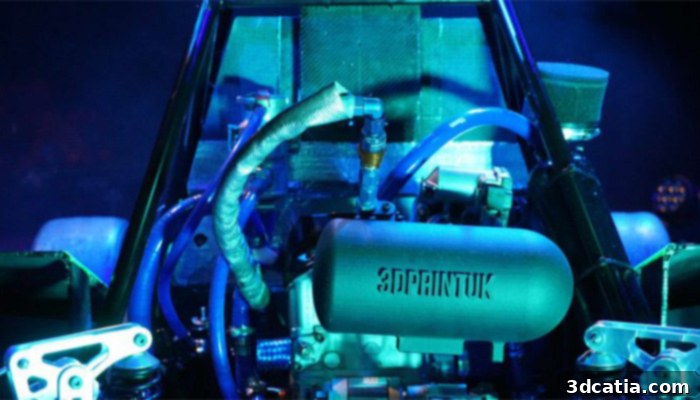
3D printed part by 3DPRINTUK (photo credits: 3DPRINTUK)
Precision Engineering Through Advanced Additive Manufacturing: 3DPRINTUK’s Contributions to Team Bath Racing
To manufacture various critical components for Team Bath Racing’s high-performance vehicle, 3DPRINTUK strategically employed two leading additive manufacturing technologies: HP Multi Jet Fusion (MJF) and Selective Laser Sintering (SLS). These powder bed fusion processes are renowned for their ability to produce highly functional, durable, and geometrically complex parts, making them ideal for the demanding environment of competitive motorsport. Each technology was selected based on the specific requirements of the parts in question, optimizing for factors such as material properties, surface finish, structural integrity, and production speed.
HP’s Multi Jet Fusion technology was instrumental in producing the car’s plenum. The plenum is a vital large-volume container meticulously positioned between the turbocharger and the engine’s air intake. Its primary function is to efficiently deliver a uniform and consistent flow of air to all engine cylinders, thereby maximizing combustion efficiency and overall engine performance. Given its critical role, the plenum demands exceptional precision and robust material characteristics. Printed from Nylon 12, a thermoplastic known for its excellent mechanical properties, chemical resistance, and thermal stability, the part boasts a highly complex internal geometry crucial for optimal airflow dynamics. With impressive dimensions of 250 mm x 150 mm, the MJF process allowed for the creation of this intricate component in a single, seamless build, demonstrating the technology’s capability to handle large, functional parts with sophisticated designs that would be incredibly challenging or impossible to produce with conventional machining.
In addition to the plenum, 3DPRINTUK utilized the Selective Laser Sintering (SLS) process to fabricate an array of components for the car’s front wing. The front wing assembly is pivotal for generating aerodynamic downforce, which enhances grip and stability, particularly at high speeds and during cornering. Precision in these parts directly translates to improved handling and competitive advantage. Like the plenum, these components were also printed from Nylon 12, leveraging its high strength-to-weight ratio, impact resistance, and flexibility, which are all critical for parts exposed to high aerodynamic loads and potential impacts. The efficiency of the SLS process was particularly evident in this application; it took merely one day to produce these essential front wing parts. This rapid production capability is a game-changer in the fast-paced world of motorsport development, allowing TBR to iterate designs quickly and adapt to testing feedback without significant delays.
Conor Smith elaborates on the stark contrast with traditional manufacturing methods for these specific components. He notes that if the parts had been manufactured using conventional techniques, the team would have been compelled to use carbon fiber composites, a material that, while strong, typically involves labor-intensive fabrication processes requiring significant tooling and manual layup. This would have resulted in a minimum production time of five days, a considerable increase compared to the single-day turnaround achieved with additive manufacturing. The cost associated with carbon fiber production, including material costs, specialized labor, and equipment, would also have been significantly higher. This comparison vividly illustrates the profound advantages of 3D printing: not only does it offer superior speed and cost-effectiveness for complex geometries, but it also provides greater design freedom and material efficiency, allowing engineers to optimize parts for performance without being constrained by manufacturing limitations.
The results of this collaboration have been highly encouraging. According to Team Bath Racing, the 3DPRINTUK printed parts exhibit mechanical characteristics remarkably similar to, or in some cases even surpassing, those produced through traditional manufacturing methods, particularly in terms of crucial properties like strength and stiffness. These attributes are paramount for components operating under the extreme stresses of a competitive race environment. Furthermore, the 3D printed parts have consistently delivered excellent performance during rigorous test phases, validating their suitability and reliability for high-stakes automotive applications. This successful implementation provides compelling evidence that the partnership between the automotive industry and additive manufacturing is not only beneficial but also increasingly essential for pushing the boundaries of engineering. It’s a testament to the fact that 3D printing allows for rapid iteration and optimization, translating directly into enhanced vehicle performance and a competitive edge.

The Team Bath Racing car (photo credits: 3DPRINTUK)
This particular partnership between 3DPRINTUK and Team Bath Racing is far from an isolated incident; it represents a growing trend of successful collaborations between additive manufacturing specialists and the automotive sector. Each new partnership, much like this one, invariably demonstrates the immense value and tangible payoffs that 3D printing brings. From rapid prototyping and concept validation to the production of lightweight, durable, and geometrically optimized end-use parts, additive manufacturing is consistently proving its worth. The ability to quickly design, test, and refine components gives teams like TBR a significant advantage, allowing them to innovate faster and respond to performance demands with unprecedented agility. Looking ahead, it is abundantly clear that 3D printing and the automotive industry are poised for a future filled with continued innovation, efficiency gains, and groundbreaking developments. This dynamic synergy will undoubtedly continue to shape the next generation of vehicles, from high-performance race cars to everyday automobiles, driving progress in design, functionality, and sustainability. For those interested in delving deeper into Team Bath Racing’s journey and this remarkable collaboration, comprehensive details can be found on their official website HERE.
What are your thoughts on the groundbreaking collaboration between 3DPRINTUK and Team Bath Racing? Do you foresee even greater integration of additive manufacturing in competitive motorsports and the broader automotive industry? We invite you to share your insights and comments below, or join the conversation on our Facebook and Twitter pages. To stay abreast of all the latest news, innovations, and partnerships in the world of 3D printing, don’t forget to sign up for our free weekly newsletter, delivered straight to your inbox!
*Thumbnail Photo Credits: 3DPRINTUK