
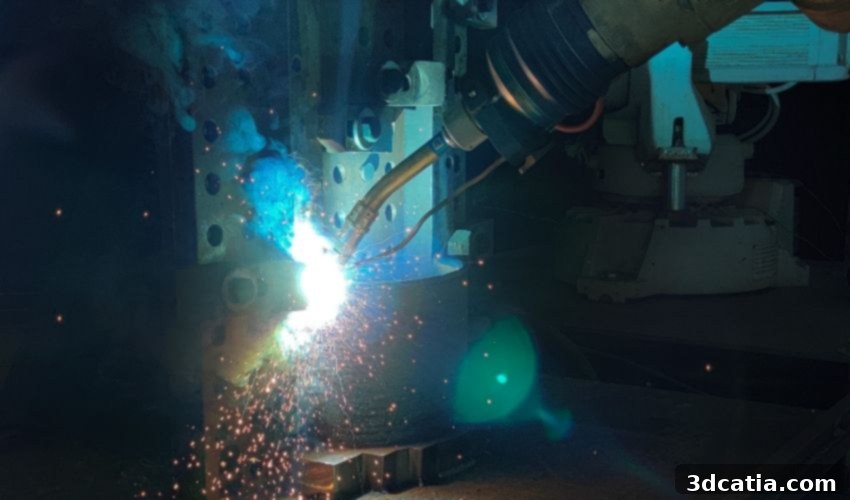
MX3D’s Breakthrough: 3D Printed Pipeline Clamp Certified for Oil & Gas with Hybrid WAAM
In a monumental stride for industrial additive manufacturing, MX3D, a company already globally recognized for its pioneering large-scale metal 3D printing projects, notably the impressive 3D-printed metal bridge in Amsterdam, has unveiled its latest groundbreaking innovation: a 3D printed pipeline clamp specifically engineered for the high-stakes Oil & Gas industry. This critical component represents a significant leap forward, developed and rigorously tested through a collaborative endeavor involving MX3D, Team Industries, and TiaT. Its fabrication leveraged a sophisticated hybrid manufacturing approach, seamlessly integrating MX3D’s advanced robotic Wire Arc Additive Manufacturing (WAAM) process with traditional manufacturing techniques. The ultimate success of this project lies in the pipeline clamp’s ability to not only pass extensive testing but also achieve a high level of certification, unequivocally demonstrating the immense utility and reliability of WAAM technology within the highly demanding and safety-critical oil and gas sector.
The Expanding Horizon of Additive Manufacturing in the Energy Sector
Additive Manufacturing (AM), commonly known as 3D printing, has been steadily gaining prominence across diverse industrial landscapes, with its adoption in the oil & gas and broader energy sectors accelerating at an impressive pace. The inherent capabilities of 3D printing offer unparalleled advantages for developing solutions that must adhere to stringent industry standards for performance, resilience, and operational speed. This year alone has seen notable milestones, including the successful installation of a 3D-printed safety-critical component by Vallourec and Total on an offshore oil rig, underscoring AM’s capacity for use in essential, high-consequence applications. Similarly, the deployment of 3D-printed safety-critical parts at a nuclear plant in Alabama further solidified the technology’s credibility in strictly regulated environments. While its widespread adoption might not yet rival that in sectors like aerospace or medical, the distinctive benefits of AM — particularly its ability to create complex geometries and, crucially, its capacity to dramatically shorten lead times — are proving indispensable for oil and gas operations. MX3D highlights that these reduced lead times are not merely about economic savings; they are paramount in mitigating environmental risks, enhancing human safety, and bolstering overall operational security across intricate infrastructure projects, where every hour counts.
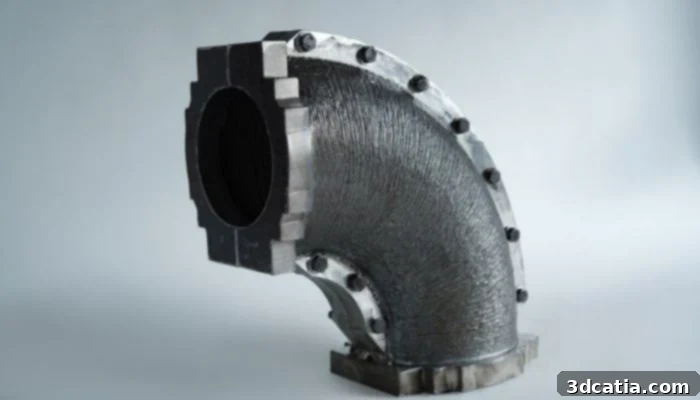
The 3D printed clamp was made using a hybrid WAAM process (photo credits: MX3D)
Addressing Critical Pipeline Challenges with Advanced 3D Printing
Pipeline clamps serve as indispensable components within vast oil and gas infrastructures, specifically engineered for swift deployment on damaged or leaking pipework. Their core purpose is multifaceted: to immediately prevent potential incidents, effectively contain hazardous leaks, and crucially, extend the operational uptime of installations until more comprehensive maintenance or permanent repairs can be meticulously planned and executed. The financial ramifications of pipeline damage or an unexpected leak are colossal. A single pipeline outage can result in staggering losses, potentially ranging from 100,000 to a staggering 1 million EUR per day, depending on the operational scale and the criticality of the affected infrastructure. Traditional repair methodologies often involve lengthy processes that can span two to three weeks, accumulating substantial financial burdens and causing significant operational disruptions. Consequently, the ability to rapidly manufacture a customized pipeline clamp on-demand presents an enormous opportunity for cost reduction and provides a vital strategic advantage for companies navigating the complex and volatile landscape of the energy sector.
Economic and Environmental Superiority over Conventional Methods
Beyond the impressive speed of production, 3D printing offers substantial benefits over conventional manufacturing techniques for producing such critical industrial parts. Traditional repair processes frequently depend on labor-intensive CNC milling or the availability of highly specialized manual labor. CNC machining, while capable of high precision, is notoriously inefficient in terms of material utilization, often generating up to 80% waste from the original material block. This extensive material wastage not only inflates production costs but also carries a considerable negative environmental footprint. Furthermore, the specialized workforce required for complex field repairs is becoming increasingly scarce, leading to prolonged lead times and escalating labor expenditures. Additive manufacturing, particularly the WAAM process, dramatically minimizes material waste by building components layer by layer, precisely utilizing only the required amount of material. This enhanced material efficiency contributes significantly to both economic savings and environmental sustainability, positioning it as an increasingly attractive and responsible alternative for the evolving modern energy industry.
Deconstructing MX3D’s Innovative Hybrid WAAM Process
The successful fabrication of this advanced pipeline clamp represents a landmark achievement for MX3D, marking its inaugural application of a truly innovative Hybrid WAAM process. Wire Arc Additive Manufacturing (WAAM) is a specialized Directed Energy Deposition (DED) based method, where a metal wire feedstock is meticulously melted using a precisely controlled electric arc as the primary heat source. This particular technology is exceptionally well-suited for large-scale metal 3D printing applications, a capability famously showcased by MX3D’s iconic 3D printed bridge in Amsterdam. Its intrinsic ability to rapidly deposit significant volumes of material makes it an ideal candidate for manufacturing substantial industrial components.
What truly distinguishes MX3D’s approach in this instance is the ingenious “hybrid” element. The company has skillfully engineered a process that harmoniously combines the inherent flexibility and complex geometry-building capabilities of additive manufacturing with the efficiency and precision typically associated with traditional subtractive manufacturing. In practical terms, the project strategically deploys 3D printing to create the geometrically most intricate sections of the clamp. This is where AM truly excels, allowing for the production of optimized designs, internal structures, or complex features that would be either impossible or prohibitively expensive to achieve through conventional methods. Conversely, the simpler, more standardized components of the clamp are manufactured using traditional processes, leveraging their proven cost-effectiveness and speed for less complex features. The overarching strategic objective of this hybrid methodology is to surmount common barriers that often hinder AM adoption, such as the perceived necessity for extensive post-processing steps and the challenges of achieving ultra-high precision solely through additive means. By intelligently integrating both advanced and conventional manufacturing approaches, MX3D is poised to deliver parts that are not only structurally robust and functionally superior but also economically viable and significantly faster to produce, thereby accelerating the broader industrial acceptance and integration of cutting-edge manufacturing technologies.
Rigorous Testing and Certification: A New Era for WAAM in Critical Industries
The pipeline clamp, meticulously constructed from robust steel, underwent an exhaustive and stringent series of tests orchestrated by the BWI (Belgium Welding Institute) and subsequently earned official certification from Lloyd’s Register, a globally recognized authority in assurance and risk management. The capacity to successfully qualify and certify these parts in strict adherence to stringent international industry standards was a paramount objective that underpinned the entire project. The remarkable success achieved is a direct result of the profound technical collaboration and shared expertise among MX3D, Team Industries, and TiaT. This collective effort ensured that the highest possible level of assurance was attained, thereby guaranteeing the safe, reliable, and compliant deployment of this critical component in exceptionally demanding operational environments.
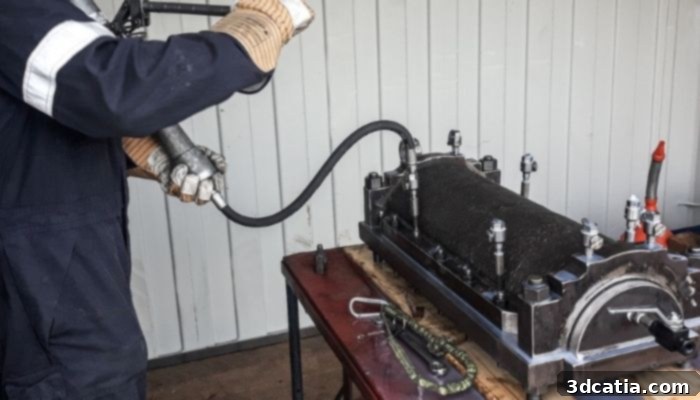
The part was extensively tested, here Team performs Pressure Testing (photo credits: Team Industrial Services)
Stivell Hemon, a distinguished materials expert from MX3D, concisely articulated the profound significance of this accomplishment, stating: “We used assurable Deposit Procedure Specifications (DPS’s), in line with ASTM A370 that can be certified by Lloyd’s Register and other assurance bodies, using our qualified M1 Metal AM System. This means it is now possible to certify parts for demanding industries like Chemicals and Oil & Gas Industry. A game-changer for WAAM.” This powerful statement emphatically underscores the far-reaching impact of this certification. Achieving compliance with globally recognized standards such as ASTM A370 and securing formal approval from an esteemed international assurance body like Lloyd’s Register effectively de-risks the adoption of WAAM for critical, safety-sensitive applications. It paves the way for the broader and more confident industrial utilization of this technology, opening up unprecedented avenues for innovation and operational efficiency in sectors where uncompromising reliability is not merely desired but absolutely non-negotiable. This successful certification not only validates MX3D’s cutting-edge technological prowess but also instills profound confidence in potential industrial adopters of large-scale metal additive manufacturing for vital infrastructure components and high-stakes operational scenarios. For more detailed insights into this project, please visit HERE.
The Transformative Future of Industrial Maintenance and Manufacturing
The successful development and rigorous certification of MX3D’s innovative 3D printed pipeline clamp transcend the introduction of a mere new product; it unequivocally signals a transformative paradigm shift in how critical components for the Oil & Gas industry, and indeed other similarly demanding sectors, will be manufactured, maintained, and managed. By effectively addressing and overcoming key challenges such as prolonged lead times, excessive material waste, and the inherent complexities associated with industrial certification, hybrid WAAM is poised to unlock unprecedented levels of operational efficiency, cost-effectiveness, and environmental responsibility across the industrial landscape. This remarkable advancement conclusively demonstrates that additive manufacturing is rapidly maturing into a truly robust and industrial-grade solution, fully capable of delivering certified, high-performance parts for the most exacting and rigorous applications. As additive technologies continue their rapid evolution and industry standards progressively adapt to these innovations, we can confidently anticipate a much broader and deeper integration of 3D printing into global supply chains. This will enable on-demand production of critical spare parts, the creation of highly customized solutions for unique and evolving challenges, and foster a significantly more resilient, agile, and responsive approach to managing complex industrial infrastructure. MX3D’s pioneering initiative is a clear and compelling indicator that the future of industrial manufacturing is increasingly hybrid, digital, and additive, promising profound and lasting benefits across industries worldwide.
What are your insights on this innovative 3D printed pipeline clamp and its potential to revolutionize the energy sector? We invite you to share your valuable opinions in the comments section below or join the vibrant conversation on our Linkedin, Facebook, and Twitter pages! Don’t miss out on the very latest and most impactful 3D printing news; make sure to sign up for our complimentary weekly Newsletter here, conveniently delivered straight to your inbox! Additionally, you can explore our comprehensive collection of compelling videos on our dedicated YouTube channel.
*Cover Photo Credits: MX3D