
Revolutionizing Fashion and Luxury: How 3D Printing Drives Innovation and Sustainability with D-house Urban Laboratory
The landscape of fashion and luxury is undergoing a significant transformation, driven by innovative technologies that promise enhanced sustainability, efficiency, and unparalleled customization. A pivotal study conducted in Italy by the Additive Manufacturer Green Trade Association (AMGTA), in collaboration with Dyloan Bond Factory and Stratasys, recently shed light on the immense potential of 3D printing within these high-end sectors. This research emphasized that integrating additive manufacturing processes can lead to substantial reductions in both production time and resource consumption for businesses operating in fashion and luxury design. The AMGTA, dedicated to championing the environmental benefits of additive manufacturing, specifically highlighted how certain 3D printing techniques offer a far more sustainable alternative compared to conventional manufacturing methods, marking a crucial step towards a greener industry future.
To gain a deeper understanding of this evolving paradigm and explore how additive manufacturing is currently being leveraged within the luxury sector, along with its future trajectory, we engaged in an insightful conversation with Loreto Di Rienzo. As the R&D Director of D-house Urban Laboratory & Pattern Group, a prestigious collective that includes Dyloan Bond Factory, Mr. Di Rienzo offers a unique perspective. Located in Milan, a global hub for fashion and design, D-house Urban Laboratory has been at the forefront of research and development since 2020. Their mission is to meticulously study and actively promote the adoption of 3D printing applications across the Fashion, Design, and Automotive markets, fostering innovation and sustainable practices.
3DN: Could you introduce yourself and explain your connection to 3D printing?

Loreto Di Rienzo
Hello! I am Loreto Di Rienzo, the R&D Director at D-house Urban Laboratory & Pattern Group, and my role primarily revolves around driving innovation within the fashion industry. As someone inherently sensitive to and deeply interested in new technologies, I’ve had the privilege of observing 3D printing since its very inception, tracking its continuous evolution and its gradual, yet impactful, application in fashion. It was around 2017 when my journey led me to discover Stratasys’ 3DFashion™ technology. This groundbreaking method allows for direct-to-fabric 3D printing, a process often referred to as Direct to Garment. It was at this point that I truly began to grasp the immense potential this technology held for industrial application within the fashion world. This realization sparked a comprehensive phase of experimentation and deep interest, opening up entirely new avenues for design and manufacturing possibilities.
3DN: How did D-house Urban Laboratory come about and what is its mission?
The concept for D-house began to take shape many years ago. Having always been immersed in the world of clothing production and the popularization of technological applications, we consistently sought out alternative paths beyond standard industry practices, bridging the gap between fashion and cutting-edge technology. For a long time, we maintained a traditional showroom in Milan, where clients would visit, but their role was largely passive. This led us to envision a dynamic space where creativity, advanced technology, and invaluable know-how could not only coexist but actively interact—elements we recognized as fundamental for bringing innovative products to life. We saw a crucial need for an ecosystem that fostered collaboration and pushed boundaries.
In 2019, this vision solidified into the idea of establishing an urban laboratory. This unique space would serve as a vital meeting point, made accessible to both technology developers and designers, encouraging them to collaborate, explore new processes, and co-create novel products. Thus, in January 2020, D-house was officially launched. As an Urban Lab, our core mission is to actively shape the sustainable future of the Fashion, Design, and Automotive sectors. We achieve this through dedicated research projects, engaging events, and specialized training programs, continuously pushing the boundaries of what’s possible with new materials and technologies like additive manufacturing.
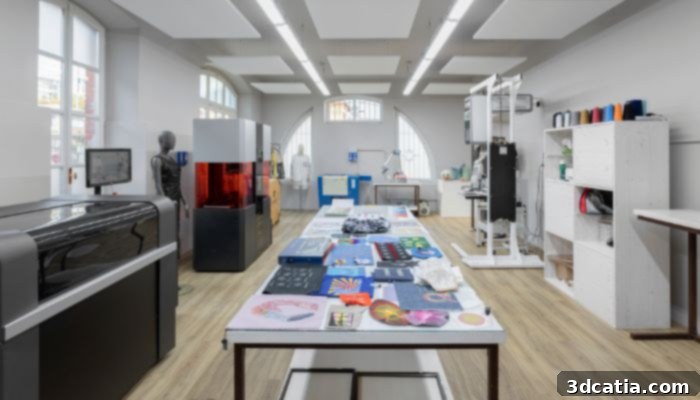
The headquarters of D-house, the Urban Laboratory
3DN: How does D-house leverage additive manufacturing in its operations?
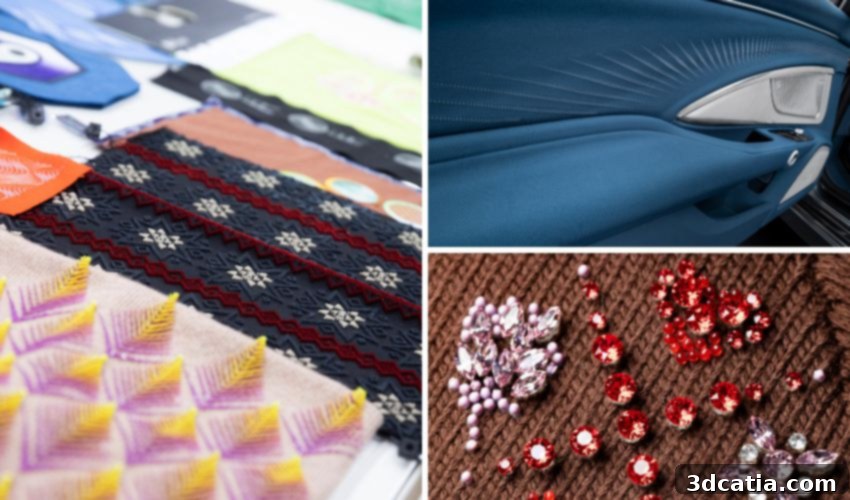
At D-house, our passion lies in experimentation and rigorously testing the practical applications of emerging technologies, with additive manufacturing being a prime example of our focus. We initially embarked on this journey by exploring fabric embellishments, experimenting with a diverse range of materials to create unique textures and designs directly on textiles. This foundational work quickly evolved, leading us to discover broader avenues where additive manufacturing could concretely contribute to product creation. We started producing functional and decorative elements such as bespoke buttons, intricate handles, various accessories, unique buckles, and even progressed to crafting complete artifacts and innovative shoe soles. The versatility of 3D printing allows us to transcend traditional design limitations, offering unparalleled freedom and precision.
Specifically, we heavily utilize Stratasys’ 3DFashion™ technology. This advanced system is central to our process of creating intricate details or even entire garments and accessories directly onto fabrics, achieving results that were previously unimaginable. Beyond this specialized textile printing, our commitment to comprehensive innovation means we also work with other additive manufacturing technologies. This includes powder bed fusion, resin-based 3D printing (like SLA or DLP), and various metal 3D printing technologies. For these more specialized applications, we collaborate closely with external suppliers who possess the specific expertise and equipment, enabling us to produce a wider array of diverse products and sophisticated components that meet the stringent demands of our luxury clients.
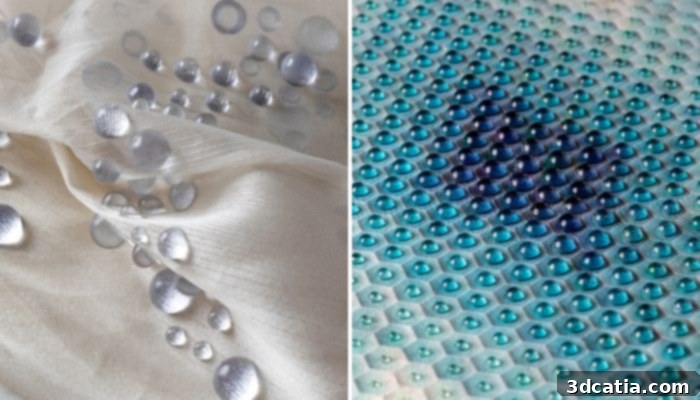
Stratasys’ 3DFashion™ technology allows printing directly onto fabrics
The flexibility of 3D printing means it can cater to a myriad of applications, capable of producing both highly decorative and critically functional elements. When we examine different markets and sectors, we observe distinct patterns of interest. For instance, in the automotive industry, there is a profound and growing interest in customizing interior components of vehicles. This allows for bespoke designs, unique textures, and personalized touches that enhance the luxury experience. Similarly, in the design world, 3D printing is embraced for the intricate customization of lamps, furniture pieces, and various other home accessories, enabling designers to bring complex geometries and unique artistic visions to life with unprecedented ease and precision.
In contrast, within the fashion sector, 3D printing is still relatively nascent and less widely adopted, beyond a few niche applications primarily in accessories. This limited awareness and adoption is precisely why D-house is so committed to its mission of knowledge dissemination. Leveraging our extensive network and over 30 years of accumulated expertise in the field, we actively work to educate, demonstrate, and integrate additive manufacturing solutions into mainstream fashion practices. Our efforts aim to demystify the technology and showcase its transformative potential, from concept to catwalk.
Overall, the potential of 3D printing across numerous fields is immense and largely untapped. This burgeoning growth is fueled by two primary factors: on one hand, the continuous advancement of hardware, leading to higher-performance and faster machines that can produce intricate parts with greater efficiency and accuracy. On the other hand, there’s the relentless research and development into new materials, which are offering superior performance characteristics. These innovative materials are increasingly capable of replacing traditionally manufactured functional elements, providing enhanced durability, lighter weight, and novel aesthetic properties. In my opinion, 3D printing is not just a trend; it is an incredibly powerful and rapidly growing technological force that is set to reshape industries globally.
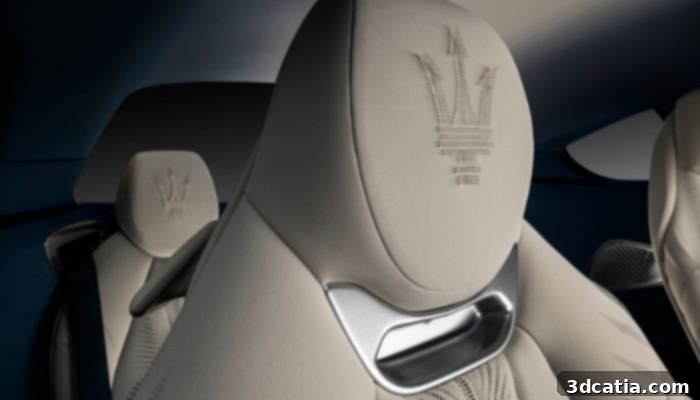
3D printing was used to customize the Maserati’s interior fabrics
3DN: Who are your primary customers, and what motivates them to seek your expertise?
Our clientele primarily consists of leading luxury brands spanning the Design and Furniture, Automotive, and Fashion sectors. These are the brands that, by their very nature, are more inclined towards embracing experimentation and integrating new technologies and cutting-edge applications. While these innovations may initially involve higher costs and require significant fine-tuning, the luxury segment is uniquely positioned to absorb such investments for the sake of unparalleled quality, exclusivity, and groundbreaking design. They seek us out not just for technological solutions, but for our deep expertise in translating complex ideas into tangible, high-value products.
The luxury segment plays a crucial role as an early adopter and trendsetter; it is typically where novel processes and technologies are first introduced and refined. Once these innovations are validated and proven effective within the high-end market, they often become more accessible and gradually trickle down, eventually becoming the domain of lower-end brands seeking to emulate the quality and innovation established at the top. This dynamic positions our luxury clients at the forefront of industrial evolution, driving forward the adoption of sustainable and advanced manufacturing techniques.
3DN: Can you share some D-house projects where 3D printing played a significant role?
Certainly. Among our most notable projects, one that stands out is our collaboration with Maserati. For them, we undertook the ambitious task of creating bespoke interiors for two showcars, which were prominently featured at the most recent Milan Design Week. This project demonstrated the incredible potential of 3D printing to elevate automotive luxury through highly customized, intricate, and high-quality interior components that perfectly blend aesthetics with functionality. We also had the privilege of contributing to a special project for Dior, showcasing additive manufacturing’s capacity to enhance high fashion through unique details and innovative textures.
Furthermore, for the last edition of Pitti Filati 94, a prestigious international trade fair for yarns, we innovated by creating exquisite 3D printed bezels. These precisely engineered components were designed to perfectly house and highlight Swarovski crystals, integrating them seamlessly into textile designs. This project beautifully exemplified how functional and decorative parts can converge through 3D printing, creating intricate details that add significant value and visual appeal to luxury textiles. These projects underscore our ability to push creative and technical boundaries, delivering unique solutions that resonate with the high standards of the luxury market.
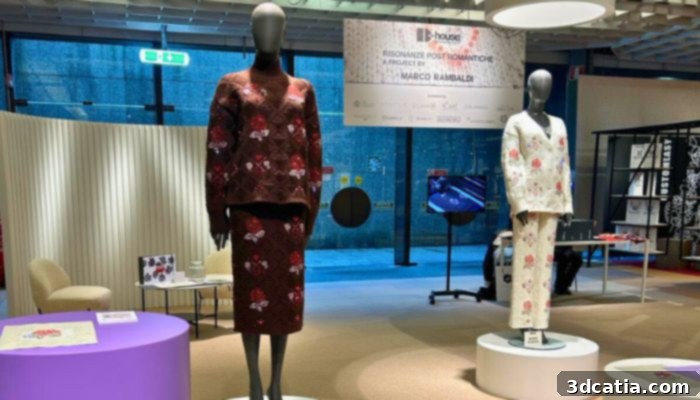
Exhibition at the Pitti Filati 94 event
3DN: Do you have any final thoughts or advice for our readers?
The world of 3D printing, especially in its application to the fashion industry, is still in its nascent stages; it is a realm that is ripe for interpretation, discovery, and innovation. It represents a powerful technology that undoubtedly demands a significant degree of specialized expertise, understanding not only the machines and materials but also the intricate nuances of design and production. However, equally important, and perhaps even more so, is the need to approach this technology with an open mind. An inquisitive and flexible mindset is crucial to truly interpret its vast capabilities, harness its potential, and utilize it as an innovative and experimental tool. By embracing this approach, we can push beyond current application possibilities and unlock unprecedented creative and functional avenues.
3D printing offers an unparalleled opportunity to rethink traditional manufacturing processes, reduce waste, enhance customization, and accelerate product development cycles. It empowers designers and manufacturers to realize complex geometries and integrate functionalities that were once impossible or prohibitively expensive. As this technology continues to evolve, those who are willing to experiment, learn, and collaborate will be at the forefront of shaping the future of fashion, design, and beyond. It’s an exciting time to be involved in additive manufacturing, and the possibilities are truly limitless for those daring enough to explore them.
What are your thoughts on D-house and the integration of 3D printing into luxury sectors? We invite you to share your comments below or engage with us on our LinkedIn, Facebook, and Twitter pages! For the latest updates and breaking news in the world of 3D printing, don’t forget to sign up for our free weekly newsletter here, delivered straight to your inbox. You can also discover all our insightful videos and engaging content on our dedicated YouTube channel.
*All Photo Credits: D-house Urban Laboratory